
Wcześniejsza sprzedaż
- Poziom ryzyka
- Najwyższy
- Ryzyko a zwrot
- Słaby
- Już od
- €10
Link polecający · ryzyko utraty kapitału
Zobacz projekty (8) →Pytania o inwestowanie? Zapytaj przewodnika AI.
Cześć! Jestem przewodnikiem AI Crowdinform.
Zaloguj się za darmo, aby pytać przewodnika AI o platformy, projekty i swoje plany.
Odpowiedzi pochodzą ze sprawdzonych danych Crowdinform. Informacja, a nie osobiste doradztwo inwestycyjne.
Szukam… Coś poszło nie tak. Spróbuj ponownie. Pozostałe pytania dziś: {n}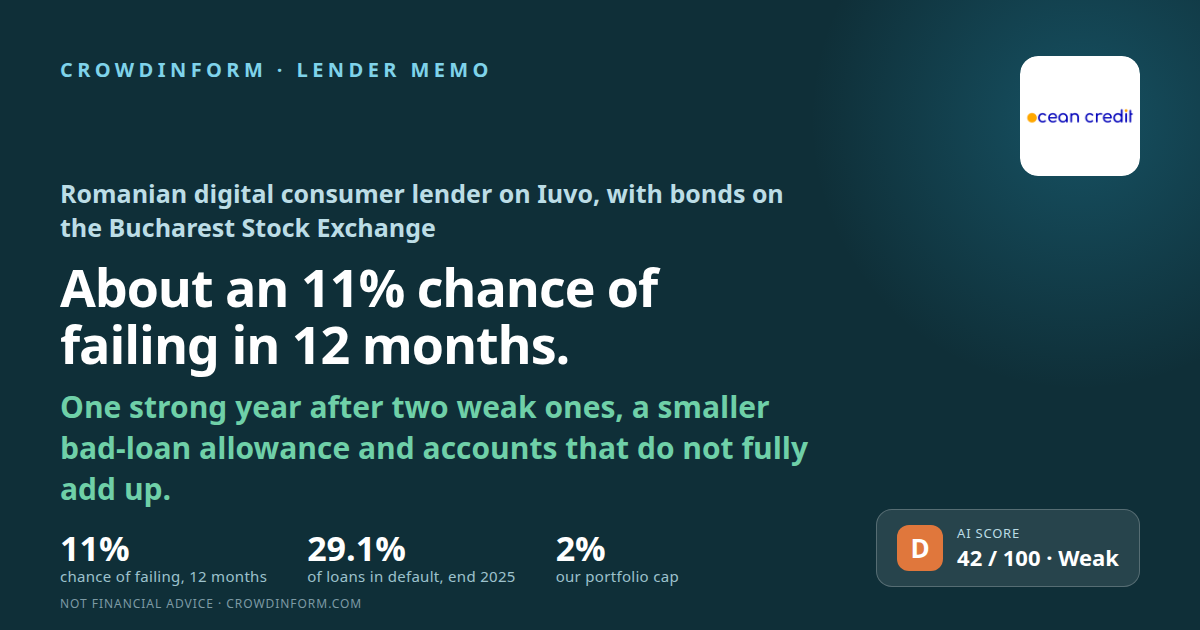
Rumunia
Ryzyko utraty kapitału. Oprocentowanie jest ustalone, ale nie gwarantowane: jeśli pożyczkobiorca nie spłaci zobowiązania, możesz stracić część lub całość swoich pieniędzy.
Nasza AI daje temu projektowi 42 na 100 punktów: Niska. Jak działa ocena AI
Informacje, a nie osobiste doradztwo inwestycyjne. Ocena AI dotyczy dokumentów publikowanych przez platformę, może być błędna i nie przewiduje zysków.
Ocean Credit IFN S.A., Bucharest, trade register J40/4381/2015, tax code 34353350, is a Romanian non-bank lender (an “IFN”) that lends small consumer loans to people in Romania online, through the MyOcean digital platform (its 2024 report says the company leases its microcredit platform from FinTech Lab SRL, which owns and develops it); its report says it has “no physical branches open to the public”. It is the company that owes Iuvo’s investors. Iuvo’s page for “Ocean Credit” shows a buyback and links the 2025 annual report of Ocean Credit IFN S.A. as its financials. The accounts mention Iuvo once, among the company’s borrowings: “EUR 500,000 accessed through Iuvo, for which a variable interest rate has been agreed”. They do not describe the deal or say which balance-sheet line holds it. The money takes this route. Investor → IUVO GROUP OÜ (Estonia, 14063375), which runs the Iuvo platform → Ocean Credit IFN S.A., which keeps the loans on its balance sheet → Romanian borrowers, with loans and receivables of RON 44.8m before allowances at the end of 2025. The buyback is Ocean Credit’s own promise. Iuvo publishes two assignment agreements of 22 April 2026, one in which the investor buys the claim on the borrower and the originator buys it back, and one in which the claim is on the originator itself; which one applies to Ocean Credit is in the key terms behind the investor login, which we have not read. Ocean Credit’s shareholders at the end of 2025 were OCH Fintech Designated Activity Company, Ireland, with 79.21%, and OC Global Limited with 20.79% in preference shares (2025 accounts, note 21). Its 2024 annual report says OC Global Limited is the majority shareholder “through OCH Fintech DAC” and calls the founder, Radu Ciorbă, the company’s “current CEO and main shareholder”; the 2025 accounts name no individual owner. Ocean Credit is not a company of Management Financial Group (MFG), the group that owns Iuvo’s operator and the lenders behind 95.11% of the receivables listed in that quarter: the “group guarantee” that Iuvo describes for MFG’s lenders does not cover it. Ocean Credit was 1.03% of the amount of receivables listed on Iuvo in the third quarter of 2026 (Iuvo’s quarterly portfolio, 13 October 2026); that is new listings, not an amount owed, and Iuvo publishes no amount outstanding per lender. Iuvo’s footer says: “IUVO GROUP OÜ is not a bank, investment firm, crowdfunding service provider or payment institution, and its activity is not subject to supervision as a licensed financial institution.” This memo asks one question: what is the chance that Ocean Credit fails to pay in the next 12 months, and why.
We ask six questions about every lender: does it earn enough, are its loans being repaid, does it have enough of its own money to absorb losses, how risky is its country, can we trust its numbers, and are there warning signs. Each is scored 1 to 5 and weighted. The four cards show how they land. Together they give 42 out of 100, which means about 11%. D runs from 35 to 49, so the grade is D, 7 points above E and 8 below C: not within 3 points of either. No single step on one question changes the grade: one step up on earnings (2 to 3) would give 48, one step down on earnings 36, both still D.
Profit after tax of RON 5.39m in 2025, after RON 43 thousand in 2024 and 649 thousand in 2023. Equity rose to RON 28.5m, 52.0% of assets, when OC Global turned RON 21.9m of its loans into shares; 42% of that equity sits in two share stakes held at cost.
29.1% of the book was more than 90 days late at the end of 2025 (44.1% a year earlier). The allowance for bad loans fell from 46.5% to 27.5% of the book, partly after an update of the loss model, and RON 0.49m was released into profit.
Romania is grade D (2.39) in our country memo of 21 September 2026, which scores 2 out of 5 here: no government since May 2026, a legal cap on the cost of credit, and a draft ordinance that would change the rules again.
Two unmodified audits. But the audited 2025 cash-flow statement does not add up, RON 1.49m was taken out of retained earnings without explanation, the notes on who lent the money disagree, the board and chief executive changed in February 2026, and the platform is not supervised.
Pełna analiza obejmuje pożyczkobiorcę lub spółkę, zabezpieczenie, przepływy pieniężne, ryzyka i werdykt. Zaloguj się, aby ją przeczytać.
Informacje, a nie osobiste doradztwo inwestycyjne. Ocena AI dotyczy dokumentów publikowanych przez platformę, może być błędna i nie przewiduje zysków.
Zaloguj się, aby zapytać AI o dokumenty tego projektu.
Zaloguj się👍 Tak · 0 👎 Nie · 0
Link polecający · ryzyko utraty kapitału
Zobacz projekty (8) →Mintos
Mintos
Komentarze · 0