
Trwa bonus
- Poziom ryzyka
- Wysoki
- Ryzyko a zwrot
- Średni
- Już od
- €10
Link polecający · ryzyko utraty kapitału
Zobacz projekty (13) →Pytania o inwestowanie? Zapytaj przewodnika AI.
Cześć! Jestem przewodnikiem AI Crowdinform.
Zaloguj się za darmo, aby pytać przewodnika AI o platformy, projekty i swoje plany.
Odpowiedzi pochodzą ze sprawdzonych danych Crowdinform. Informacja, a nie osobiste doradztwo inwestycyjne.
Szukam… Coś poszło nie tak. Spróbuj ponownie. Pozostałe pytania dziś: {n}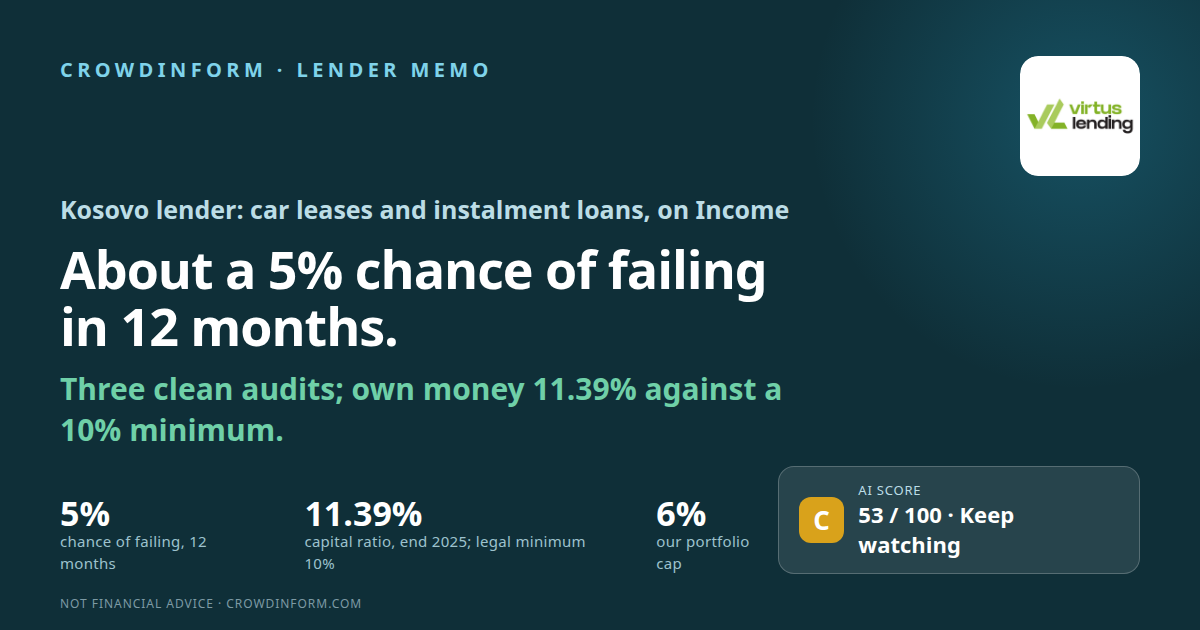
Kosowo
Ryzyko utraty kapitału. Oprocentowanie jest ustalone, ale nie gwarantowane: jeśli pożyczkobiorca nie spłaci zobowiązania, możesz stracić część lub całość swoich pieniędzy.
Nasza AI daje temu projektowi 53 na 100 punktów: Średnia. Jak działa ocena AI
Informacje, a nie osobiste doradztwo inwestycyjne. Ocena AI dotyczy dokumentów publikowanych przez platformę, może być błędna i nie przewiduje zysków.
Loans of Virtus Lending on Income lead to Virtus Lending L.L.C. itself, a company in Prishtina, Kosovo (its accounts give no registration number). Income’s page says: “The company placing loans on Income Marketplace is Virtus Lending”, and that the investment is made “through an assignment agreement between the investor, Virtus Lending, and Income’s SPV”, a special-purpose company of Income. Virtus keeps the loans on its own balance sheet and books the money as a borrowing named “Getincome”: €3,588,183 at the end of 2025, at 12.00%. Its borrowers are individuals and companies in Kosovo; about half of its lending is finance leases of vehicles and half is loans. The accounts say it obtained a licence for leasing from the Central Bank of Kosovo on 29 March 2019 and for lending on 20 June 2022; the Central Bank’s list of financial institutions (a file dated 9 July 2026 by its name; the list itself carries no date) shows it among the registered non-bank financial institutions. Virtus Invesco Partners L.L.C. owns 100% of it; the accounts do not name the people who own that company. No document we read says that Virtus and Income share an owner. Virtus Lending held 12.04% of the €33,720,192 that investors had outstanding on Income on 31 October 2026, by Income’s monthly post for October 2026, which is about €4.06m by our arithmetic. Income’s page for Virtus does not mention a buyback, and nor do Virtus’s accounts. Income’s general “How it works” page, read on 16 November 2026, says: “Every loan on Income comes with a Buyback Obligation”, and that a loan more than 60 days overdue “is contractually required to be bought back with the full principal and interest”; its security page lists “Buyback Obligation (60-day)” as “Yes, on all loans”. Neither page says there who must buy the loan back. Our research notes quote Income’s risk page as saying it is the loan originator; we did not re-read that page. On that reading the promise is Virtus’s, and we read no statement that Income guarantees it. Income’s help page, read on 16 November 2026, states that it “is not regulated by a financial authority”. This memo asks one question: what is the chance that Virtus Lending fails to pay in the next 12 months, and why.
We ask six questions about every lender: does it earn enough, are its loans being repaid, does it have enough of its own money to absorb losses, how risky is its country, can we trust its numbers, and are there warning signs. Each is scored 1 to 5 and weighted. The four cards show how they land. Together they give 53 out of 100, which means about 5%. C runs from 50 to 64, so the grade is C, 3 points above D. One step down on any one of three questions would make it a D: earnings (3 to 2) gives 47, the loan book (3 to 2) gives 49, the cushion (2 to 1) gives 49. The loan book is the closest of these calls (section 2). The country grade also matters: our Kosovo memo keeps its score for the rules at 3 although its own fact-check called that generous. With 2 there, Kosovo would be a D (2.57 out of 5); this lender’s score would then be 50, the lowest C, about 6% odds, and the cap would be 5%, not 6%.
Profit of €372,478 in 2025, the third rising year. Owners’ money was €1,595,842, 11.39% of assets; the legal minimum is 10%.
5.6% of its leases and loans were in default at the end of 2025 (5.2% a year earlier). The money set aside covers 37.8% of them, down from 52.8%. Old leases of €111,884 were written off during the year; the book grew by 50%.
It lends only in Kosovo, in euros. Kosovo is grade C in our new country memo: no currency risk and no interest cap found, but slow courts and a law on non-bank lenders that is about to be amended.
Three clean audits by BDO Kosova. But the security Income describes is not in the accounts, a prepayment of €739,068 is not explained, the maturity table and the borrowings note disagree, and the 2023 and 2024 files carry no notes.
Pełna analiza obejmuje pożyczkobiorcę lub spółkę, zabezpieczenie, przepływy pieniężne, ryzyka i werdykt. Zaloguj się, aby ją przeczytać.
Informacje, a nie osobiste doradztwo inwestycyjne. Ocena AI dotyczy dokumentów publikowanych przez platformę, może być błędna i nie przewiduje zysków.
Zaloguj się, aby zapytać AI o dokumenty tego projektu.
Zaloguj się👍 Tak · 0 👎 Nie · 0
Link polecający · ryzyko utraty kapitału
Zobacz projekty (13) →Mintos
Mintos
Komentarze · 0