
Regulated
Bonus running
Can sell early
- Risk level
- High
- Risk-return
- Medium
- Start from
- €50
Referral link · capital at risk
See 42 projects →Questions about investing? Ask the AI guide.
Hi! I'm the Crowdinform AI guide.
Sign in free to ask the AI guide about platforms, projects and your plans.
Answers come from Crowdinform's checked data. Information, not personal investment advice.
Looking it up… Something went wrong. Please try again. {n} questions left today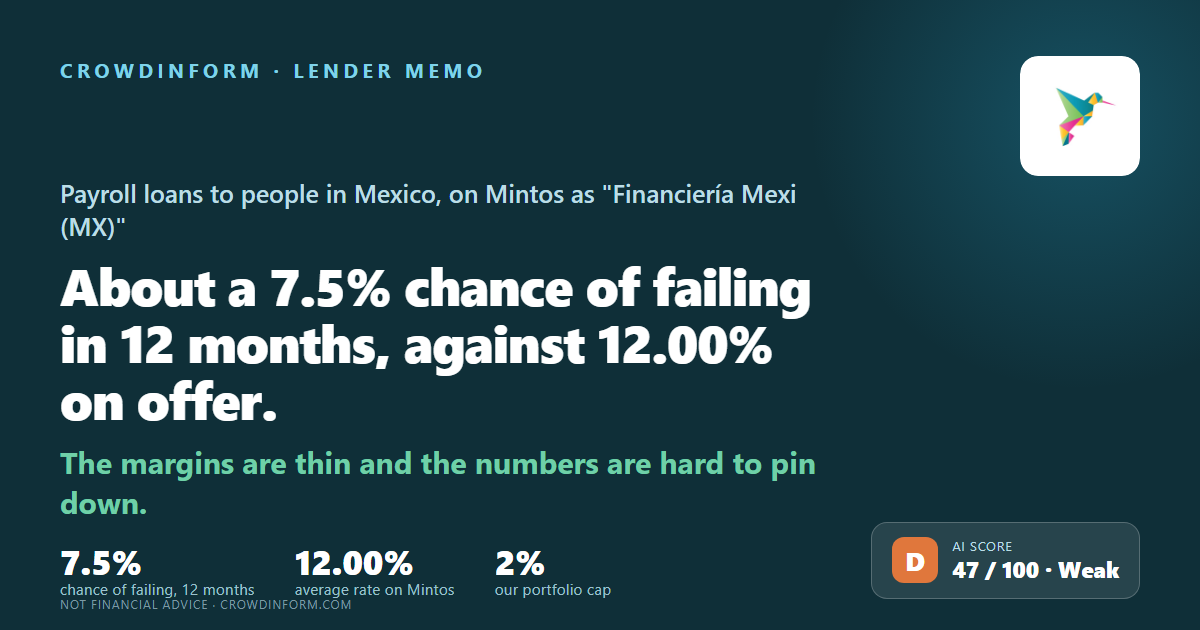
Mexico
Capital at risk. The rate is agreed, not guaranteed: if a borrower defaults you can lose some or all of your money.
Our AI gives this project 47 out of 100: Low. How the AI score works
Information, not personal investment advice. The AI score rates the documents the platform publishes, can be wrong, and does not predict returns.
Vigua Servicios Patrimoniales, S.A. de C.V. is a Mexican company lending to people through branches, mostly against their payroll. Investors on the Mintos platform lend money to it under the name Financiería Mexi. This memo asks one question: what is the chance it fails to pay those lenders back in the next 12 months, and why.
Vigua is a going concern doing an ordinary thing: lending to people in Mexico, mostly through deductions from their pay, at rates between 40% and 150% a year. It is profitable, its owners have put MXN 180m of their own money in over two years, and the audits are clean. Nothing here looks like a company about to stop paying.
What holds the score down is that the margins are thin and the numbers are hard to pin down. Bad debts cost about 9% of the loan book a year and the charge for them rose 86% in the first nine months of 2025. The audited year-ends say about 9.5% of the book is more than ninety days late; the company’s own nine-month reports say 27.5% at September 2024 and 16.6% at September 2025. Those are the same company’s figures about the same loan book, and nothing we read explains the gap.
Six things would stop us scoring at all and send the answer straight to E — a default, a missed payment to a platform, a regulator pulling a licence, an auditor doubting the company can continue, a broken promise to a lender, or accounts we cannot rely on. None of them is triggered here. Two things would pull the answer the other way, a guarantee from a stronger owner or a credit rating, and neither applies. Section 4 sets out both.
Profitable but thinly: 6.01 left of every 100 pesos of income in 2024. Owners’ money is 35% of assets, but only about 20% once you take out the things that are not money.
Bad debts cost about 9% of the book a year. The charge rose 86% in the first nine months of 2025, and the two sets of arrears figures do not agree.
The best part of the memo. No cap on what it may charge. But it owes euros and dollars while its borrowers pay pesos, and we found no hedge.
An audit that arrived nine months late from a new auditor, corrections to earlier years, and owners nobody names.
Every investment carries risk, and risk is not really a letter or a mark out of ten. It is two plain questions: how likely is it that this company fails, and how much of your money would you lose if it did. Put those together and you can see whether the reward is worth it.
For Vigua: Mintos shows an average investor rate of 12.00% a year (read on 9 November 2026). On our reading the chance of this company failing in the next twelve months is about 7.5%. If one in thirteen lenders like this one fails and about 70% of the money is gone when they do, the risk costs about 5.2% a year. On those numbers the reward is about 6.8% once the risk is paid for. That is our arithmetic on our own scale, and you are entitled to disagree with the scale; what you should not do is read the 12.00% on its own.
Vigua promises to take a loan back off you if it goes 60 days late. That promise is only as good as Vigua. In the one case where it would matter most — Vigua in trouble — it is worth least.
Owners’ money here is 35% of assets, which sounds comfortable. More than a third of it is commissions paid out and spread forward, trademarks and a tax asset. On what is left it is about 20%.
We have not picked whichever arrears number flatters or frightens. We have shown you both and told you we cannot reconcile them.
An S.A. de C.V. founded in June 2012 in Monterrey. Not a SOFOM, so it sits outside even the light registration that Mexican non-bank lenders usually carry. Section 5 explains what that means.
A payroll-deduction product (“MEXI DXN”) and a second line (“MEXI Tres”), sold through branches. The rate range is from Mintos’s own announcements of January and April 2026.
About €56m at September 2025, on the company’s own figures. Income of MXN 630.5m in 2024, about €32.0m.
No document we read names the owners. They put MXN 130.0m into the company in 2023 and MXN 50.0m in 2024. A related company, Regiofinanciera, is also one of its lenders.
Listed as “Financiería Mexi (MX)”. You buy Notes; the money reaches Vigua. Prospectus dated 11 December 2025.
Mintos’s own figures, read on 9 November 2026; on 13 September 2026, 89.8% of those loans were current. Platform data as published, not independently verified.
Plus a pledge over receivables and repayments routed through a Banco INVEX trust. Mintos Risk Score 7.0 — buyback strength 5.4, cooperation structure 4.2, as Mintos last updated them on 9 October 2026.
The full review covers the borrower or company, the security, the cash flow, the risks and a verdict. Sign in to read it.
Information, not personal investment advice. The AI score rates the documents the platform publishes, can be wrong, and does not predict returns.
Sign in to ask the AI about this project's documents.
Sign in👍 Yes · 0 👎 No · 0
Referral link · capital at risk
See 42 projects →Mintos