
Crowdfunding in Sweden: the platforms to know
Crowdfunding in Sweden: 5 platforms compared on what you invest in, minimum, stated figures and licence, plus FI's rules and the 30% tax on interest.
- Investing in Loans
- Crowdfunding
Questions about investing? Ask the AI guide.
You are chatting with an AI assistant, not a person. It answers from Crowdinform's data and can make mistakes. Information, not personal investment advice. About this AI
Hi! I'm the Crowdinform AI guide.
Sign in free to ask the AI guide about platforms, projects and your plans.
AI answers from Crowdinform's checked data. It can make mistakes. Information, not personal investment advice.
Looking it up… Something went wrong. Please try again. {n} questions left todayArticle
Learn how to assess investment risk effectively. This practical guide helps you evaluate key financial and emotional factors for smarter investing.

Investment risk assessment is the process of measuring how much financial uncertainty you can realistically handle, then matching that to the right portfolio. Knowing how to assess investment risk means combining two things: a clear-eyed look at your finances and an honest read of your emotions. Most investors focus on one and ignore the other. That gap is where costly mistakes happen. This guide covers the key financial factors, psychological signals, and quantitative metrics you need to evaluate risk properly, whether you are putting money into stocks, bonds, property, or crowdfunding projects across Europe.
Risk capacity is the practical, numbers-based limit of how much loss you can absorb without derailing your life. It has nothing to do with how you feel about markets. It is determined by your income, debts, savings, and time horizon.

The most important starting point is your emergency fund. An effective capacity assessment requires 6–12 months of living expenses held in cash before you commit capital to any investment. Without that buffer, a market downturn can force you to sell at exactly the wrong moment.
Beyond savings, three factors shape your capacity:
The contrast matters enormously. A younger investor can allocate a larger share to higher-volatility assets like equities or growth-focused crowdfunding projects. An older investor needs more capital preservation, favouring bonds, cash, or income-generating assets.
Pro Tip: Calculate your monthly surplus after all fixed costs and debt repayments. That number, not your gross income, is the true measure of how much you can afford to invest at risk.
Risk tolerance is your emotional comfort with watching the value of your portfolio fall. It is entirely separate from your financial capacity, and misaligning the two is the most common reason investors abandon their plans during downturns.
The simplest diagnostic is the "sleep test." If market movements cause you emotional distress at night, your portfolio carries more risk than your psychology can handle. That is a signal, not a weakness. Acting on it before a crisis is far better than panic-selling during one.
A structured way to measure your tolerance is through a risk questionnaire. Most regulated financial advisers use these to gauge behavioural tendencies. They ask questions like: "If your portfolio fell 20% in three months, would you sell, hold, or buy more?" Your answers reveal patterns that pure financial analysis cannot capture.
Here is a practical self-assessment process:
Pro Tip: Your risk tolerance is not fixed. Reassess it after any significant life change, not just when markets move.
Quantitative risk metrics turn gut feelings into numbers. They do not replace your capacity and tolerance assessment, but they add objectivity to your investment decisions. Four metrics do most of the work.
Beta measures how much a stock or fund moves relative to the broader market. A beta of 1.0 means the asset moves in line with the market. A beta of 1.5 means it moves 50% more. A beta below 1.0 indicates lower volatility than the market. Beta is most useful when comparing assets within the same class, such as choosing between two equity funds.
Standard deviation measures the variability of returns around an average. A fund with a high standard deviation produces returns that swing widely from year to year. A fund with a low standard deviation is more predictable. This metric tells you how bumpy the ride will be, regardless of direction.
The Sharpe Ratio compares excess return to volatility by subtracting the risk-free rate from an investment's return and dividing by its standard deviation. A higher Sharpe Ratio means you are being better compensated for the risk you take. Two funds with identical returns but different Sharpe Ratios are not equally good choices. The one with the higher ratio delivers more return per unit of risk.
Value at Risk estimates the maximum loss a portfolio could suffer over a given period at a specific confidence level. For example, a one-day VaR of £5,000 at 95% confidence means there is a 5% chance of losing more than £5,000 in a single day. VaR is widely used by institutional investors and is increasingly available on retail investment platforms.
Practical use: When analysing investment platforms or comparing crowdfunding projects, look for beta and standard deviation data in fund factsheets. Use the Sharpe Ratio to compare similar assets. Use VaR to stress-test your overall portfolio against worst-case scenarios.
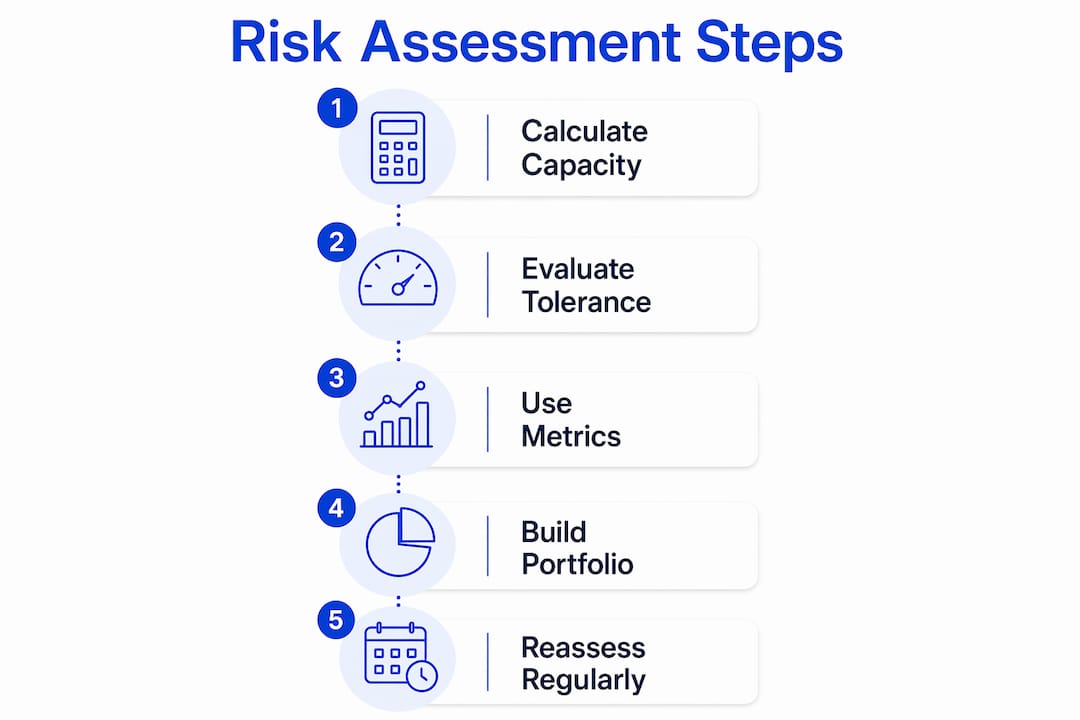
Combining your capacity, tolerance, and metrics into a real portfolio requires a structured process. Here is how to do it in five steps.
One more point worth stating clearly: no investment is without risk. Even cash loses purchasing power to inflation over time. The goal is not to eliminate risk but to align it with your objectives and time horizon. Risk management strategies fall into three categories: avoid, manage, or transfer. Asset allocation is the primary tool for managing risk. Insurance and hedging instruments transfer it. Avoiding an asset class entirely is a legitimate choice when it falls outside your capacity or tolerance.
| Asset class | Typical risk level | Best suited to |
|---|---|---|
| Cash and money market | Very low | Short time horizons, emergency reserves |
| Government bonds | Low to moderate | Capital preservation, income needs |
| Corporate bonds | Moderate | Balanced portfolios, income generation |
| Equities | Moderate to high | Long time horizons, growth objectives |
| Alternatives (property, crowdfunding) | Variable | Diversification, impact investing |
For investors with a long time horizon and a well-matched portfolio, disciplined inaction during market volatility is often the best course. Selling during a downturn locks in losses and removes you from the recovery.
Effective investment risk assessment requires combining your financial capacity, psychological tolerance, and objective risk metrics into a single, coherent portfolio decision.
| Point | Details |
|---|---|
| Separate capacity from tolerance | Capacity is financial; tolerance is emotional. Evaluate both and use the lower score to set portfolio risk. |
| Build your emergency fund first | Hold 6–12 months of expenses in cash before committing capital to any investment. |
| Use metrics to add objectivity | Beta, standard deviation, and the Sharpe Ratio turn subjective impressions into comparable numbers. |
| Diversify across asset classes | Spreading capital across stocks, bonds, and alternatives reduces unsystematic risk without sacrificing return potential. |
| Reassess after life events | Update your risk profile annually or after major changes such as marriage, job loss, or retirement. |
I have watched a lot of investors make the same mistake, and it is not the one they expect. They spend hours researching assets, comparing yields, reading market commentary. Then they build a portfolio that is perfectly calibrated to their financial capacity and completely ignores how they will actually feel when it drops 25% in six weeks.
The distinction between risk tolerance and risk capacity sounds academic until you are staring at a red portfolio in a volatile market. Capacity tells you what you can afford to lose. Tolerance tells you what you will actually do when you see that loss. Those are very different questions, and conflating them is what causes people to sell at the bottom.
My honest view is that the sleep test is underrated. If you are losing sleep over market movements, your portfolio is wrong for you, regardless of what the numbers say. Adjusting it is not weakness. It is the rational response to accurate self-knowledge.
The other thing I have come to believe strongly: reassessment is not optional. Life changes your risk profile whether you update your portfolio or not. A new mortgage, a career change, a growing family. Each of these shifts your capacity in ways that a questionnaire from three years ago cannot capture. The investors who do well over the long term are not the ones who pick the best assets. They are the ones who stay consistent, reassess honestly, and resist the urge to act on emotion during downturns. That discipline, more than any metric, is what protects a portfolio.
— Jevgenijs
Once you know your risk profile, the next question is where to put your capital to work. Crowdinform aggregates reviews and data from over 500 European crowdfunding platforms, giving you a clear, structured view of the investment landscape before you commit a single pound.
The platform's AI copilot analyses individual projects and platforms, helping you match opportunities to your risk level rather than guessing. Whether you are a cautious investor looking for safer crowdfunding options or an experienced investor building a diversified portfolio across property, loans, and green energy, Crowdinform gives you the data to decide with confidence. Explore the platform and see which opportunities align with your risk profile today.
Investment risk assessment is the process of measuring how much financial loss you can absorb and how much volatility you can tolerate emotionally, then using that information to build a suitable portfolio.
Risk tolerance is your emotional comfort with market volatility. Risk capacity is your practical, financial ability to absorb losses. Both must be assessed separately, and your portfolio should reflect the lower of the two.
Beta, standard deviation, and the Sharpe Ratio are the three most widely used metrics. Beta measures relative volatility, standard deviation measures total return variability, and the Sharpe Ratio shows how well returns compensate for risk taken.
Risk assessment should be updated annually or after major life events such as marriage, retirement, or a significant change in income or debt.
No investment is entirely without risk. Even cash held in savings loses purchasing power to inflation over time. The goal is to manage and align risk with your objectives, not to eliminate it entirely.
Capital at risk. Crowdfunding investments are not covered by deposit guarantee schemes, can lose part or all of their value, and may be hard to sell before the end of their term. This guide is information, not personal investment advice.
Was this helpful?

Eugene Sokolovs Expert
Founder of Crowdinform
Keep reading
Crowdfunding in Sweden: 5 platforms compared on what you invest in, minimum, stated figures and licence, plus FI's rules and the 30% tax on interest.
What is crowdfunding? A plain guide to how it works, the main types (reward, equity, loans, real estate), the EU rules and the risks for investors.
Discover what is portfolio diversification and how it reduces risk. Learn to spread your investments effectively for smoother returns.


Comments · 0