
Most European investors understand diversification in theory, yet a surprising number still concentrate their capital in a single property, one market, or a handful of stocks. The result is a portfolio that looks active but behaves like a single bet. Private assets like credit are driven by diversification as the primary motivation for 74% of Pan-European selectors, signalling a clear shift in how informed investors think about building resilient, high-performing portfolios. This article unpacks the evidence, practical frameworks, and actionable steps to help you diversify effectively using crowdfunding platforms across Europe.
Key Takeaways
| Point | Details |
|---|---|
| Reduces risk | Diversification lowers the impact of losses from any single investment, leading to steadier portfolio performance. |
| Boosts returns | Spreading investments across asset classes like real estate and credit improves overall return potential. |
| Crowdfunding enables access | European investors can easily diversify with small amounts by leveraging crowdfunding platforms. |
| Frameworks matter | Using proven allocation frameworks, like mixing asset types and geographies, achieves true diversification. |
| Avoid concentration | Investing in only one asset or sponsor increases risk—balance is key for long-term success. |
What is diversification and why does it matter?
Diversification is the practice of spreading capital across different asset types, geographies, structures, and sectors so that no single failure can significantly damage your overall portfolio. It is not just about owning more things. It is about owning the right combination of things that respond differently to market conditions.

The most common misconception is that holding five properties, or ten stocks in the same sector, constitutes genuine diversification. It does not. If all your assets move together in a downturn, you are still exposed to concentrated risk. True diversification means your investments are uncorrelated, meaning when one falls, others hold steady or rise.
Understanding diversification in investments helps clarify why this matters so deeply: it is one of the few genuinely free advantages available to any investor. You do not need to pay a fund manager to benefit from it. You simply need to be intentional about structure.
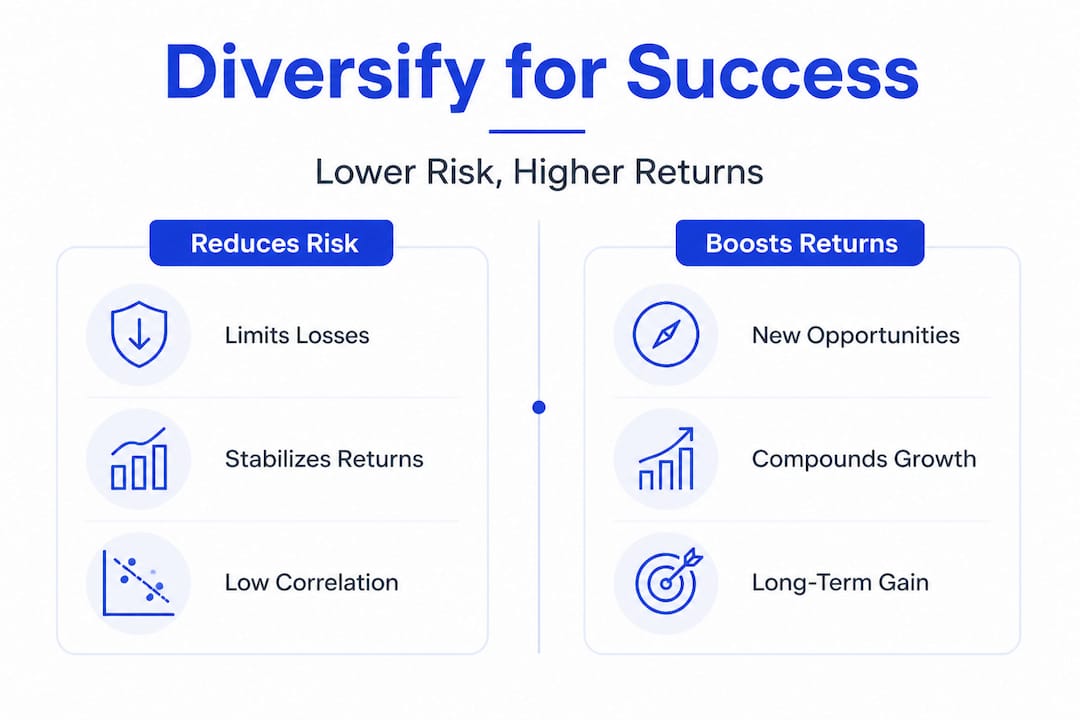
Here are the core benefits that make diversification so compelling:
-
Risk reduction: Losses in one asset are offset by stability or gains in others.
-
Volatility smoothing: A blended portfolio experiences fewer dramatic swings in value.
-
Opportunity capture: Exposure to multiple sectors means you benefit from growth wherever it emerges.
-
Psychological resilience: Knowing your entire portfolio cannot collapse from one event reduces emotional decision-making.
The data backs this up convincingly. 74% of Pan-European selectors name diversification as their primary reason for allocating to private assets, with 60% also citing return potential. These are sophisticated investors making a deliberate choice.
The excellent news for individual investors in 2026 is that fractional ownership diversification through crowdfunding platforms has removed the traditional barriers. You no longer need six figures to access real estate or private credit. Diversification is now achievable with amounts as modest as €50 to €100 per investment.
“Diversification is not just a strategy for the wealthy. With fractional investing via crowdfunding, every European investor can build a genuinely balanced portfolio regardless of starting capital.”
How diversification works: Comparing asset types and strategies
With the definition and importance covered, we now explore how European investors can implement diversification by choosing complementary asset types and strategies.
The three most accessible asset classes through European crowdfunding platforms are real estate, startups, and private credit. Each behaves differently, carries distinct risk profiles, and responds to economic conditions in its own way. Understanding how they complement each other is the foundation of a sound strategy.
| Asset class | Typical yield | Risk level | Liquidity | Correlation to equities |
|---|---|---|---|---|
| Real estate (debt) | 8–10% net | Low to medium | Low | Low |
| Real estate (equity) | 10–15%+ | Medium to high | Low | Medium |
| Private credit | 9.8% avg. | Low to medium | Medium | Very low |
| Startups / venture | 0% to 50%+ | High | Very low | Low |
| Listed equities | 6–8% avg. | Medium | High | High (by definition) |
Real estate crowdfunding allows you to diversify across property types (residential, commercial, logistics), geographies (Western Europe, Central Europe, the Baltics), and structures (debt versus equity). A common and effective approach is a 40% debt, 60% equity split, targeting net yields of 8 to 10% across the European market. This kind of blended real estate exposure alone is more diversified than owning a single buy-to-let flat in one city.
Private credit is particularly exciting right now. Platforms offering structured credit products, such as ECRED, demonstrate what thoughtful underwriting looks like in practice. ECRED’s private credit portfolio has delivered a 9.8% return, with 7.7% since inception, and maintains a 99% senior secured structure with a remarkably low average loan-to-value (LTV) ratio of 39%. That combination of strong returns and low volatility makes private credit a powerful stabiliser in a blended portfolio.
Startups sit at the higher-risk end of the spectrum, but their low correlation to property and credit markets is genuinely valuable. Even a small allocation of 10 to 15% to early-stage companies can enhance overall portfolio returns without dramatically increasing risk, provided you spread across multiple companies and sectors. Our startup investing advantages guide covers this in depth.
The key insight here is that security and better returns are not mutually exclusive. By combining low-correlation assets deliberately, you build a portfolio that is simultaneously more stable and more capable of capturing growth across multiple economic cycles.
Practical frameworks for diversifying with crowdfunding
Understanding which assets complement each other, let’s move to practical frameworks for diversification using crowdfunding investment platforms.
Building a diversified crowdfunding portfolio does not require complex financial modelling. It requires a clear process and consistent discipline. Here is a straightforward framework you can follow:
-
Define your risk profile. Decide what proportion of your portfolio you are comfortable placing in higher-risk assets (startups, equity real estate) versus lower-risk ones (senior secured credit, debt real estate).
-
Set geographic targets. Aim for exposure across at least three European regions. Western Europe (Germany, France, Benelux), Southern Europe (Spain, Italy, Portugal), and Central or Eastern Europe (Poland, the Baltics, Romania) each carry different economic dynamics.
-
Choose your structural mix. For real estate, blend debt and equity positions. A 40/60 debt-to-equity split targeting 8 to 10% net yields is a well-tested starting point.
-
Select platforms with track records. Review sponsor reputation, platform default rates, and asset quality. Crowdinform’s database of 500+ European platforms makes this research considerably faster.
-
Review and rebalance quarterly. Market conditions shift. Check your allocation every three months and adjust if one asset class now dominates your portfolio.
Here is an example of how three different portfolio sizes might look in practice:
| Portfolio size | Real estate (debt) | Real estate (equity) | Private credit | Startups | Cash reserve |
|---|---|---|---|---|---|
| €5,000 | 30% | 25% | 25% | 10% | 10% |
| €20,000 | 35% | 25% | 25% | 10% | 5% |
| €50,000+ | 30% | 25% | 30% | 10% | 5% |
These are starting-point frameworks, not rigid rules. Your personal circumstances, tax position, and investment timeline will shape the final mix. Exploring diversification strategies designed for individual investors can help you refine your approach further.
Pro Tip: Avoid the trap of over-concentration by sponsor. Investing €5,000 across five projects on the same platform with the same sponsor is not diversification. You need variety in platform, sponsor, asset type, and region to achieve genuine protection.
Common mistakes to watch for in crowdfunding diversification include:
-
Investing only in residential real estate across one country
-
Allocating entirely to equity structures and ignoring senior secured debt
-
Ignoring the underlying asset structure (LTV, security type, repayment priority)
-
Chasing the highest advertised yield without reviewing platform track records
-
Treating crowdfunding as a single category rather than a gateway to multiple asset classes
Our step-by-step real estate investing guide walks through many of these pitfalls in detail, particularly for investors new to European property crowdfunding.
Risk reduction and return enhancement: The core benefits
Once you have practical frameworks in place, it is essential to understand exactly how diversification helps your portfolio grow while reducing exposure to risk.
The two core outcomes that diversification delivers are lower volatility and enhanced long-term returns. These are not abstract concepts. They show up in real numbers, in real portfolios, with measurable impact.
On the volatility side, private credit is one of the most compelling examples available today. ECRED’s 99% senior secured structure with an average LTV of 39% means that even in a significant property downturn, the underlying collateral would need to lose more than half its value before investor capital is at risk. That structural protection directly translates into low portfolio volatility, a characteristic that equity-heavy portfolios simply cannot match.
On the returns side, the numbers speak clearly. Private credit targeting 9.8% annual returns, combined with real estate crowdfunding targeting 8 to 10% net yields, produces a blended return profile that comfortably outpaces most savings accounts, government bonds, and even many listed equity funds over a five-year horizon.
Here are the core benefits of a well-structured diversification strategy: 🚀
-
Reduced concentration risk: No single default, market correction, or regulatory change can devastate your portfolio.
-
Volatility smoothing: Blending uncorrelated assets means your portfolio’s month-to-month value is far more stable.
-
Consistent yield generation: Mixing real estate debt, private credit, and equity positions creates multiple income streams with different timing and structures.
-
Access to upside in multiple markets: Growth in Baltic real estate, Southern European logistics, and Nordic startups can all contribute to your returns simultaneously.
-
Psychological stability: Knowing your portfolio is resilient reduces panic-driven decisions during market turbulence.
The top benefits of diversification are especially relevant for younger investors building wealth over a longer horizon, where compounding across multiple asset classes creates substantial advantages.
📊 Statistic spotlight: 74% of Pan-European private asset selectors prioritise diversification above all other factors, including yield. This is a clear signal from the most experienced players in the market.
Pro Tip: True diversification must cross asset classes and structures, not just sponsors or locations. Owning ten senior secured real estate loans across five countries is well-structured, but it is still concentrated in a single asset class. Add private credit or startup exposure to genuinely reduce correlation and enhance resilience. Explore fractional investment options to make this easy, even with modest capital.
A fresh perspective: Beyond basic diversification for European investors
With the foundational knowledge and frameworks laid out, let’s reflect on some overlooked truths and practical lessons in diversification, especially in the European crowdfunding landscape.
Here is something most diversification guides will not tell you: spreading your investments too thinly is its own risk. We see this regularly in the European crowdfunding space. An investor places €100 across 40 different projects, congratulates themselves on their diversification, and then watches as administrative complexity, delayed repayments from multiple platforms, and negligible position sizes make the portfolio almost impossible to manage meaningfully. Over-dilution is real, and it hinders returns.
The smartest investors we observe treat diversification as a deliberate architecture, not a numbers game. They identify three to five complementary strategies, allocate meaningfully to each (at least 5 to 10% of their portfolio per position), and resist the urge to chase every new platform or project simply because it looks different.
There is also a persistent blind spot around asset structure. Many European crowdfunding investors focus entirely on geography (“I want exposure to Spanish property and German startups”) without considering the structural layer. A junior equity position in Spanish real estate behaves completely differently from a senior secured debt position in the same market. Two investors can both say they have “Spanish property exposure” and face radically different risk profiles. Understanding this distinction is what separates informed investors from casual ones.
Alternative assets are not a magic solution either. The excitement around startup investment opportunities is genuine and well-founded, but venture-stage companies carry binary outcomes. Most will underperform; a few will generate exceptional returns. Treating startup allocation as a calculated, time-bounded bet with capital you are genuinely comfortable losing is the right mindset.
What genuinely works, in our observation, is combining education, patience, and structural awareness. The investors who benefit most from European crowdfunding diversification are those who take the time to understand what they own, why each piece belongs in their portfolio, and how it behaves relative to the rest. Crowdfunding makes access easy. Making access valuable requires that extra layer of informed judgement.
Diversify your portfolio with ease: Crowdinform solutions
Ready to put sound diversification principles into practice? Crowdinform brings together 500+ European crowdfunding platforms in one place, making it straightforward to research, compare, and invest across real estate, private credit, and startup opportunities from a single dashboard. 🌱
Whether you are building your first diversified portfolio or refining an existing one, Crowdinform gives you the tools to do it with confidence. Our AI copilot reviews individual projects, surfaces risk signals, and helps you explore how different assets complement each other in your specific context. Pair that with our in-depth real estate investing guide and you have everything you need to start allocating intelligently. Stop guessing and start building a portfolio that is genuinely diversified, yield-generating, and built to last.
Frequently asked questions
Can I diversify with small investment amounts through crowdfunding?
Yes, most European crowdfunding platforms allow fractional investments starting from €50 to €100, enabling broad diversification across asset classes even with limited starting capital.
Does diversification guarantee higher returns?
Diversification increases portfolio stability and reduces risk, but actual returns depend on asset selection, platform quality, and prevailing market conditions. 60% of Pan-European selectors cite return potential as a key motivation alongside diversification benefits.
How should I decide the right mix of assets for my portfolio?
Define your risk tolerance and investment timeline first, then blend asset classes such as real estate debt, private credit, and startup equity to match your goals and ensure structural variety across your positions.
Are alternative assets riskier than traditional ones?
Not necessarily, particularly when well-structured. ECRED’s private credit portfolio achieves 9.8% returns with 99% senior secured loans and a 39% average LTV, demonstrating that alternative assets can deliver strong yields with low volatility when the underlying structure is sound.
What are common mistakes with diversification?
The most frequent error is diversifying only by sponsor name or country, whilst keeping all capital in the same asset class and structure. Genuine diversification requires variety across asset type, risk level, geography, and structural position simultaneously.
Recommended
- Fractional ownership: How investors diversify with ease - Article | Crowdinform Investment Guides fractional investment
- Top advantages of startup investing for European investors - Article | Crowdinform Investment Guides Startups
- Crowdinform - Make money by investing in loans(P2P), real estate and startups with crowdfunding!
- Step-by-step real estate investing in Europe: a clear guide - Article | Crowdinform Investment Guides Real estate crowdfunding
- Diversificación en inversiones: ¿qué es? - Life Academy
- Building a Diversified Portfolio in Forex Trading | Trade Copier for MT4 & MT5


