
Crowdfunding in Sweden: the platforms to know
Crowdfunding in Sweden: 5 platforms compared on what you invest in, minimum, stated figures and licence, plus FI's rules and the 30% tax on interest.
- Investing in Loans
- Crowdfunding
Questions about investing? Ask the AI guide.
You are chatting with an AI assistant, not a person. It answers from Crowdinform's data and can make mistakes. Information, not personal investment advice. About this AI
Hi! I'm the Crowdinform AI guide.
Sign in free to ask the AI guide about platforms, projects and your plans.
AI answers from Crowdinform's checked data. It can make mistakes. Information, not personal investment advice.
Looking it up… Something went wrong. Please try again. {n} questions left todayArticle
Discover what is portfolio diversification and how it reduces risk. Learn to spread your investments effectively for smoother returns.

Portfolio diversification spreads your investments across different asset classes, sectors, and geographic regions to reduce the impact of any single holding's poor performance. The core objective is risk mitigation, not return maximisation. When one asset falls, others with different risk profiles can hold steady or rise, smoothing your overall returns over time.
Here is what a well-diversified portfolio typically covers:
The specific risk that diversification reduces is called unsystematic risk, which is the risk tied to an individual company or sector rather than the market as a whole. Systematic risk, such as a global recession, affects all assets and cannot be diversified away. Understanding that distinction is the foundation of any sound investment strategy.
The engine behind diversification is correlation, the degree to which two assets move together. When you combine assets with low correlation, a decline in one is often offset by stability or gains in another, which lowers overall portfolio volatility. Stocks and bonds, for instance, frequently move in opposite directions during economic shifts, making them a classic pairing.

Three pillars underpin effective diversification: risk, return, and correlation. Correlation is the one most investors overlook. Two assets can each carry moderate risk individually, yet together they can produce a portfolio that is calmer than either on its own, provided their price movements are not tightly linked.
Diversification also operates within asset classes, not just across them. Within equities, for example, mixing large-cap, mid-cap, and small-cap stocks across different sectors adds another layer of protection. A portfolio of twenty UK technology stocks is not diversified in any meaningful sense, even though it holds twenty positions.
Your time horizon and risk tolerance shape how you apply these principles. A 30-year-old building long-term wealth can absorb more short-term volatility and lean heavier on equities. Someone approaching retirement prioritises capital preservation and typically shifts towards bonds and income-generating assets.
Practical approaches to diversification include:
Pro Tip: Check the correlation between your holdings, not just the number of funds you own. Two funds labelled differently can hold nearly identical underlying stocks, giving you the illusion of diversification without the reality.
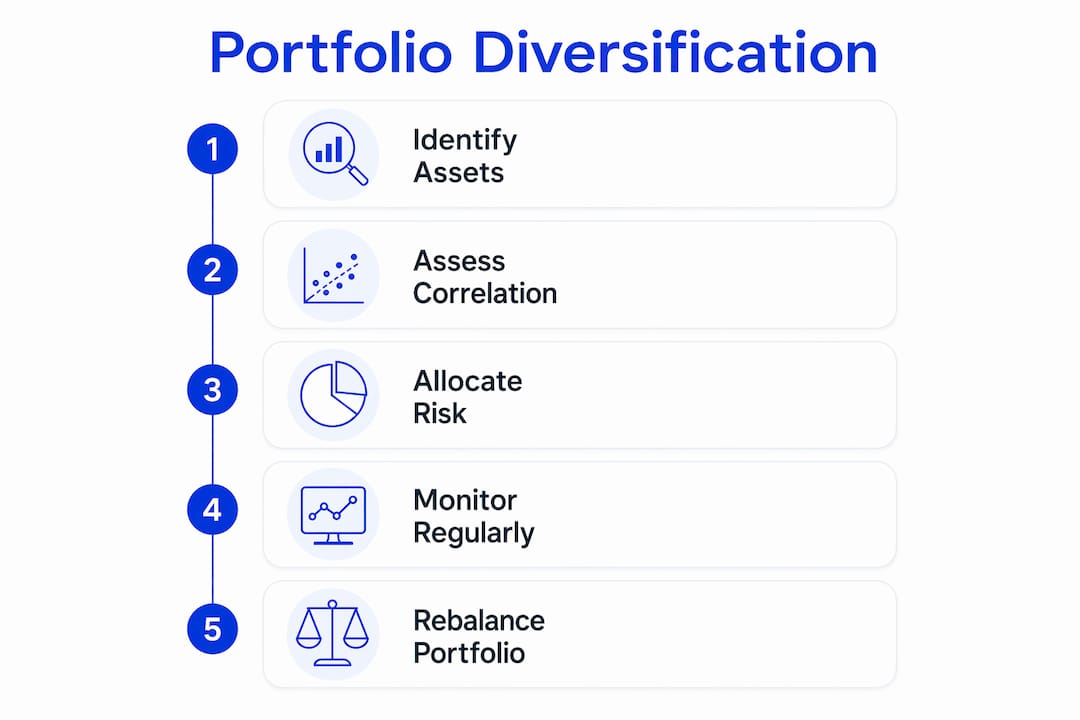
Reduced volatility is the most direct benefit. By holding assets that do not all move in the same direction at the same time, your portfolio experiences smaller swings, which makes it far easier to stay invested through turbulent periods rather than panic-selling at the worst moment.

Beyond smoother returns, diversification mitigates unsystematic risk tied to individual companies or sectors. A single profit warning from one company, or a regulatory shock to one industry, has a limited impact on a portfolio spread across dozens of holdings and multiple asset classes.
Key benefits at a glance:
Statistic callout: Most investment professionals agree that, while diversification does not guarantee against loss, it is the most important component of reaching long-range financial goals while minimising risk, according to Investopedia's analysis.
One nuance worth keeping in mind: diversification does not guarantee profits or eliminate risk entirely. It is a disciplined framework for managing the risks you can control, while accepting that market-wide risks will always exist.
Start with your personal situation before touching any asset class. Your time horizon, risk tolerance, and financial goals determine the right mix. A 40-year-old saving for retirement in 25 years has a very different starting point from a 60-year-old drawing down income.
Once you have clarity on those factors, building a diversified portfolio typically follows these steps:
You can also explore real asset investing as a way to add further diversification beyond traditional stocks and bonds.
Pro Tip: Before adding a new fund, look at its top ten holdings and compare them with what you already own. Overlap is the silent killer of diversification.
The most widespread error is confusing the number of holdings with genuine diversification. Owning ten funds sounds diversified, but if they all hold the same large-cap US technology stocks, you have little true diversification. FINRA describes this as the "illusion of diversification," and it catches out experienced investors as much as beginners.
Common mistakes to watch for:
Pro Tip: Go beyond fund names and sector labels. Pull up the actual holdings list for each fund you own and check for concentration in the same ten or twenty stocks. Many "diversified" funds are more concentrated than their marketing suggests.
At Crowdinform, we aggregate data and reviews across hundreds of European investment and crowdfunding platforms, which gives us a clear view of how real investors approach diversification in practice. One pattern stands out: investors who treat diversification as a one-time setup rather than an ongoing commitment tend to accumulate hidden concentration over time, often without realising it.
Correlation dynamics during market stress deserve particular attention. When volatility spikes, assets that appeared uncorrelated in calm conditions can move together, as seen during broad market sell-offs. This is why Crowdinform's educational resources consistently highlight the value of including assets with genuinely low historical correlation to equities, such as commodities, infrastructure, or high-quality government bonds, rather than simply adding more equity funds with different names.
Educational callout: Diversification is an ongoing commitment requiring regular review and rebalancing to maintain intended risk profiles and reduce hidden concentration, not a one-time portfolio setup.
Key principles Crowdinform's research reinforces:
Crowdinform's AI-powered project explorer helps investors evaluate crowdfunding opportunities across Europe, providing the kind of detailed project-level data that makes informed diversification decisions possible. You can also read Crowdinform's in-depth guide on why diversification matters for a deeper look at pooled vehicles and risk mitigation strategies.
The UK market offers a rich set of building blocks for a diversified portfolio, and understanding how they fit together is where strategy becomes practical.
UK equities via the FTSE 100 and FTSE 250 provide domestic exposure, but the FTSE 100 is heavily weighted towards energy, mining, and financial companies. Relying solely on it creates sector concentration, so pairing it with a broader global equity index fund balances that skew.
UK government gilts are the traditional counterweight to equities in British portfolios. When equity markets fall sharply, gilts often hold their value or rise, providing a stabilising effect. Corporate bonds add yield but carry more credit risk, so mixing both is standard practice.
UK real estate investment trusts (REITs) give you property exposure without the capital required to buy physical property. They trade on the London Stock Exchange and distribute rental income as dividends, making them accessible for most investors.
Commodities such as gold and oil tend to behave differently from both equities and bonds, particularly during inflationary periods. Gold, in particular, has a long history as a store of value during market turbulence. You can access commodities through ETFs listed on the London Stock Exchange without holding physical assets.
International diversification is straightforward through low-cost index ETFs covering North America, Europe, Asia-Pacific, and emerging markets. Many UK investors underweight international exposure, concentrating too much in domestic stocks. A globally diversified equity allocation typically includes the UK as one component rather than the whole portfolio.
For investors interested in managing investment risk across these different asset classes, understanding how each behaves under different economic conditions is the starting point.
Three metrics give you the clearest picture of diversification quality.
Correlation coefficient measures how closely two assets move together, on a scale from -1 (perfectly opposite) to +1 (perfectly in sync). A well-diversified portfolio holds assets with correlations well below +1. Analysing correlation pairs is the most direct way to assess whether your holdings genuinely offset each other.
Beta measures how sensitive an asset is to broader market movements. A beta of 1.0 means the asset moves in line with the market; below 1.0 means it is less volatile; above 1.0 means it amplifies market swings. Mixing assets with different beta values reduces your portfolio's overall sensitivity to market-wide moves.
Sharpe ratio measures return per unit of risk. A higher Sharpe ratio means you are being compensated well for the risk you are taking. Diversification typically improves a portfolio's Sharpe ratio over time by reducing volatility without proportionally reducing returns.
Practically, you can calculate these metrics using portfolio analysis tools available through most UK investment platforms. The key habit is reviewing them periodically rather than only at setup, since correlations and betas shift as market conditions change.
Diversifying across asset classes in the UK creates different tax obligations depending on what you hold and how you hold it.
Capital Gains Tax (CGT) applies when you sell assets at a profit outside of a tax-advantaged wrapper. For the 2025/26 tax year, the annual CGT exempt amount is £3,000. Gains above this threshold are taxed at 18% for basic-rate taxpayers and 24% for higher and additional-rate taxpayers on most assets, including shares.
Dividend income from equities is taxed above the £500 dividend allowance (2025/26). Basic-rate taxpayers pay 8.75%, higher-rate taxpayers pay 33.75%, and additional-rate taxpayers pay 39.35%.
ISAs and SIPPs are the most tax-efficient wrappers for a diversified UK portfolio. Within a Stocks and Shares ISA, all gains and income are free from CGT and Income Tax. The annual ISA allowance is £20,000. A Self-Invested Personal Pension (SIPP) adds upfront tax relief on contributions, making it particularly powerful for long-term diversified investing.
Property income from REITs is taxed as ordinary income unless held within an ISA or SIPP. Holding REITs inside a tax-advantaged wrapper removes this liability entirely.
Rebalancing, which is essential for maintaining diversification, can trigger CGT events outside of wrappers. One practical approach is to rebalance primarily by directing new contributions towards underweight assets rather than selling overweight ones, minimising taxable events.
Portfolio diversification reduces unsystematic risk by spreading investments across asset classes, sectors, and geographies, with correlation being the critical factor that determines whether diversification is genuine or illusory.
| Point | Details |
|---|---|
| Correlation drives diversification | Assets with low or negative correlation smooth returns; high correlation between holdings negates diversification benefits. |
| Rebalance annually | Portfolios drift as assets perform differently; rebalancing when allocations shift by around 5% restores your target risk profile. |
| Illusion of diversification | Owning multiple funds that hold the same underlying assets offers little real protection, as FINRA highlights. |
| Use tax-efficient wrappers | Holding a diversified portfolio inside an ISA or SIPP shelters gains and income from CGT and dividend tax. |
| Diversification does not guarantee profit | It reduces controllable risk and improves risk-adjusted returns, but systematic market-wide risk always remains. |
Capital at risk. Crowdfunding investments are not covered by deposit guarantee schemes, can lose part or all of their value, and may be hard to sell before the end of their term. This guide is information, not personal investment advice.
Was this helpful?

Eugene Sokolovs Expert
Founder of Crowdinform
Keep reading
Crowdfunding in Sweden: 5 platforms compared on what you invest in, minimum, stated figures and licence, plus FI's rules and the 30% tax on interest.
What is crowdfunding? A plain guide to how it works, the main types (reward, equity, loans, real estate), the EU rules and the risks for investors.
Article
Discover why benchmark investment returns are crucial for UK investors. Gain performance insights, assess risk, and hold managers accountable.

Comments · 0