
Crowdfunding in Sweden: the platforms to know
Crowdfunding in Sweden: 5 platforms compared on what you invest in, minimum, stated figures and licence, plus FI's rules and the 30% tax on interest.
- Investing in Loans
- Crowdfunding
Questions about investing? Ask the AI guide.
You are chatting with an AI assistant, not a person. It answers from Crowdinform's data and can make mistakes. Information, not personal investment advice. About this AI
Hi! I'm the Crowdinform AI guide.
Sign in free to ask the AI guide about platforms, projects and your plans.
AI answers from Crowdinform's checked data. It can make mistakes. Information, not personal investment advice.
Looking it up… Something went wrong. Please try again. {n} questions left todayArticle
Discover what is investor protection in UK crowdfunding. Learn about FCA regulations, risk warnings, and why your capital is at risk.

Investor protection in UK crowdfunding is a regulatory framework, not a financial guarantee. The Financial Conduct Authority (FCA) requires authorised platforms to operate transparently, deliver clear risk warnings, and conduct suitability assessments before accepting investments. Critically, losses from crowdfunding projects or borrower defaults are not covered by the Financial Services Compensation Scheme (FSCS). The 2026 Public Offer Platform (POP) regime adds further disclosure and due diligence standards. Your capital is genuinely at risk.
Key elements of investor protection in UK crowdfunding:
The FCA sits at the centre of UK crowdfunding regulation, setting conduct standards every authorised platform must follow.
Platform authorisation. Every firm facilitating crowdfunding must hold the correct FCA permissions. Operating without authorisation means investors receive no regulatory protection whatsoever.
Financial promotion rules. Platforms must ensure all marketing is fair, clear, and not misleading, with standardised risk warnings and costs disclosed as a percentage of capital raised.
Suitability assessments. Before investors access high-risk, non-readily realisable securities, platforms must verify that investors understand the risks involved.
Loan-based and investment-based rules. Peer-to-peer lending platforms must apply client money protections under the FCA's Client Assets sourcebook (CASS), while equity platforms face additional investor categorisation requirements.
POP regime. The Public Offer Platform regime requires platforms acting as gatekeepers to conduct due diligence on issuers, improve disclosure quality, and prevent fraudulent offers from reaching investors.
Understanding the limits of protection is just as important as knowing what exists.
Pro Tip: Always check a platform's FCA authorisation scope, not just whether it appears on the register. A firm may be authorised for payment services but not for crowdfunding investments specifically.
Use the FCA Firm Checker tool to confirm a platform holds the correct permissions for the investment type you are considering. Verify that its regulatory permissions explicitly cover the activity offered, whether equity crowdfunding, peer-to-peer lending, or securities offers via a POP. Review the platform's own due diligence disclosures and project information carefully. FCA authorisation is a baseline, not a quality stamp for individual projects. Crowdinform's regulated platform guide for 2026 helps you cross-reference platforms against these criteria efficiently.
| Risk | FCA Measure | What It Does Not Cover |
|---|---|---|
| Capital loss | Suitability assessments, risk warnings | Cannot prevent investment failure |
| Fraud | POP gatekeeping, due diligence rules | Cannot guarantee issuer honesty |
| Illiquidity | Disclosure requirements | Does not create a secondary market |
| Misinformation | Financial promotion rules | Does not validate project projections |
| Platform failure | Authorisation and conduct standards | No FSCS compensation for investor losses |

The POP regime's gatekeeping function specifically targets fraud by ensuring only legitimate capital-raising offers reach investors. Risk warnings and suitability checks help you understand and accept these risks consciously, rather than eliminating them.
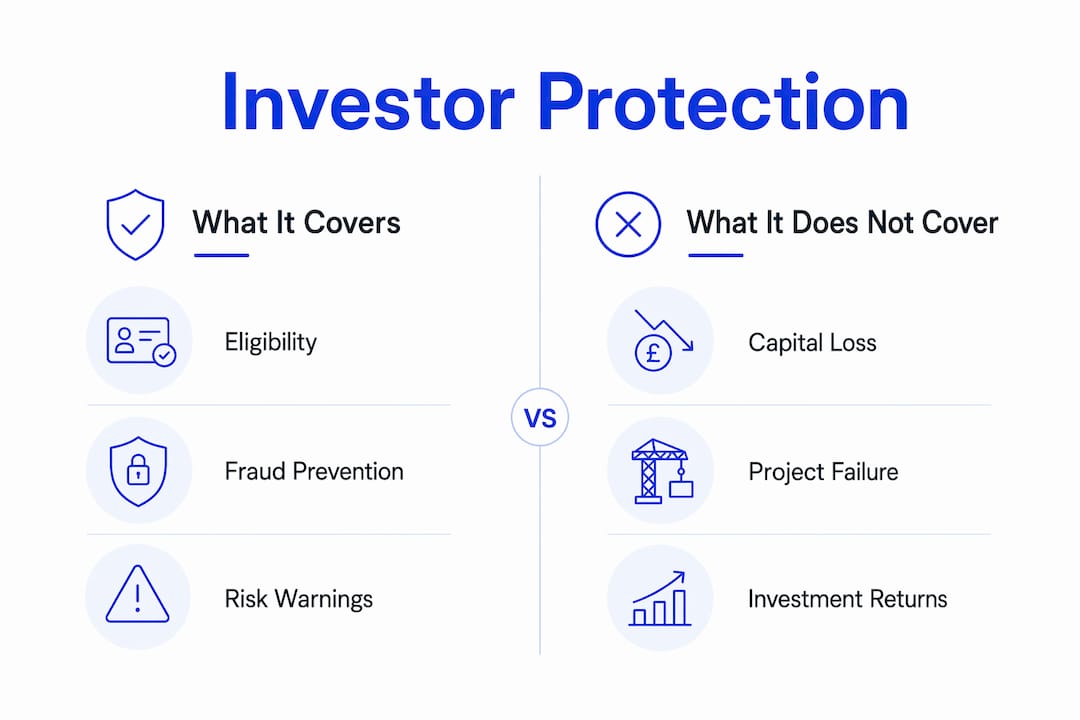
Recourse options in crowdfunding are narrower than many investors expect.
Crowdfunding and traditional investments operate under very different protection frameworks, and the gap matters for your portfolio decisions.
UK crowdfunding investor protection is a transparency and conduct framework enforced by the FCA, not a compensation guarantee, and investors bear full capital risk on every project.
| Point | Details |
|---|---|
| No FSCS coverage | Losses from crowdfunding defaults are not compensated; capital loss is a real outcome. |
| FCA authorisation scope | Verify the platform holds permissions specifically for your investment type using the FCA Firm Checker. |
| POP regime (2026) | Requires platforms to conduct due diligence and improve disclosure before facilitating public offers. |
| Suitability assessments | Confirm you understand the risks involved but do not protect you from experiencing them. |
| Recourse is limited | Complaints via the Financial Ombudsman cover conduct failures, not investment performance losses. |
Capital at risk. Crowdfunding investments are not covered by deposit guarantee schemes, can lose part or all of their value, and may be hard to sell before the end of their term. This guide is information, not personal investment advice.
Was this helpful?

Eugene Sokolovs Expert
Founder of Crowdinform
Keep reading
Crowdfunding in Sweden: 5 platforms compared on what you invest in, minimum, stated figures and licence, plus FI's rules and the 30% tax on interest.
What is crowdfunding? A plain guide to how it works, the main types (reward, equity, loans, real estate), the EU rules and the risks for investors.
Discover what is portfolio diversification and how it reduces risk. Learn to spread your investments effectively for smoother returns.


Comments · 0