
Can sell early
- Risk level
- Highest
- Risk-return
- Bad
- Start from
- €10
Referral link · capital at risk
See 8 projects →Questions about investing? Ask the AI guide.
Hi! I'm the Crowdinform AI guide.
Sign in free to ask the AI guide about platforms, projects and your plans.
Answers come from Crowdinform's checked data. Information, not personal investment advice.
Looking it up… Something went wrong. Please try again. {n} questions left today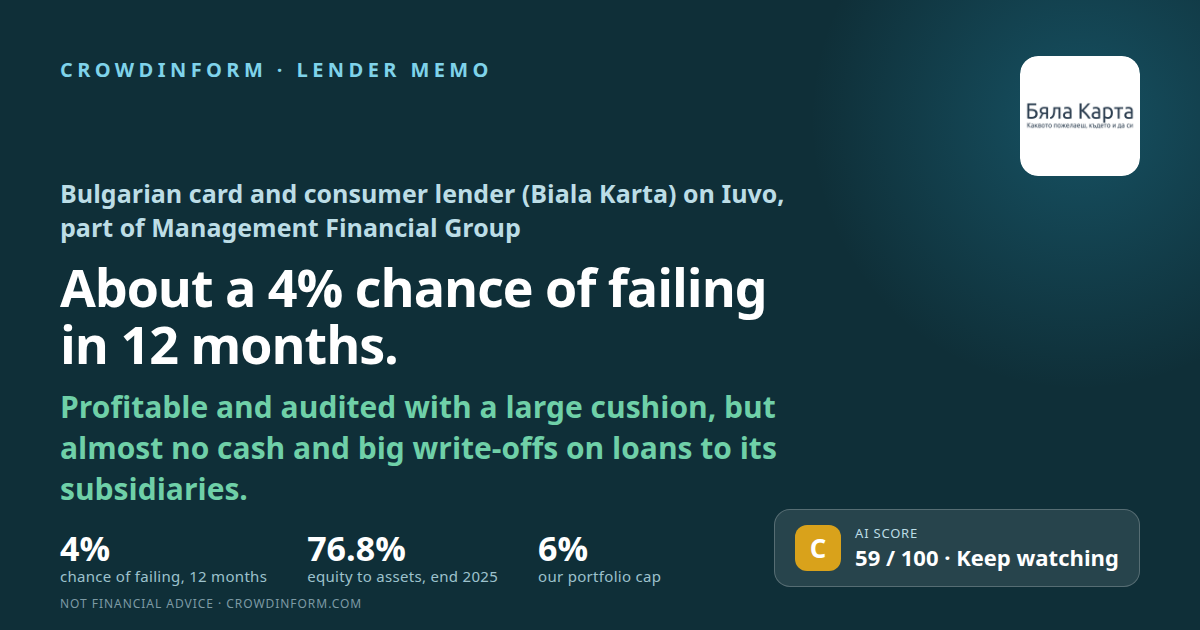
Bulgaria
Capital at risk. The rate is agreed, not guaranteed: if a borrower defaults you can lose some or all of your money.
Our AI gives this project 59 out of 100: Medium. How the AI score works
Information, not personal investment advice. The AI score rates the documents the platform publishes, can be wrong, and does not predict returns.
Loans of Biala Karta on Iuvo lead to Access Finance AD itself, a Bulgarian non-bank lender (UIC 207140327 in the auditor’s report and note 1 of its accounts; the activity report gives 202806978, the number of the limited company it was converted from in 2022). It lends without security to people on low and middle incomes, mostly through its White Card (“Byala Karta”) credit card: 160,119 active cards and 5,498 consumer loans at the end of 2025, all in Bulgaria. Its accounts say how Iuvo’s money reaches it. Investors buy, through a P2P platform “regulated under the laws of the Republic of Estonia” that “acts as an agent on behalf of the Company”, the right to up to 70% of the principal of single loans. The transfers are “agreements with the right of recourse that require the Company to guarantee that the remaining part of the principal will be fully repaid to the investor” if the borrower is more than 60 days late, a buy-back guarantee. The accounts add that “neither the investors nor the P2P platform bears any risks in relation to the creditworthiness of the Company’s customer”. So the investor depends on Access Finance AD paying, and the company books the money as its own debt: BGN 6,149 thousand of “borrowings from P2P investors” at the end of 2025 (about €3.1m at the fixed rate of 1.95583 leva to the euro). The accounts do not name the platform; Iuvo Group OÜ is in their list of related parties. Iuvo’s lender page shows “Buyback” and gives no terms; which of Iuvo’s two contract forms these loans use (the originator as guarantor of a claim on the borrower, or the originator as the debtor) is in each loan’s key terms behind the login, which we did not read. The buyback is the lender’s own promise. Management Financial Group AD (MFG), Bulgaria, owns 75.74% of Access Finance (961,875 shares, by the 2025 activity report and note 23; it held 75.54% at the end of 2024), and MFG also owns 96.59% of IUVO GROUP OÜ, which runs Iuvo; MFG is owned 50/50 by Nedelcho Spasov and Stanimir Vassilev. Access Finance is also the parent of companies in Romania, Spain, the USA and Mexico. Its Spanish subsidiary, Access Finance S.L.U., lends on Iuvo as “AXI Card” and is not covered by this memo. Access Finance took 7.87% of the amount of loans listed on Iuvo in the third quarter of 2026 (Iuvo’s quarterly portfolio, 13 October 2026); that is new listings, not money outstanding, and Iuvo publishes no amount outstanding per lender. Iuvo’s footer and its user agreement (2.1.1) say that IUVO GROUP OÜ “is not a bank, investment firm, crowdfunding service provider or payment institution, and its activity is not subject to supervision as a licensed financial institution”. This memo asks one question: what is the chance that Access Finance AD fails to pay in the next 12 months, and why.
We ask six questions about every lender: does it earn enough, are its loans being repaid, does it have enough of its own money to absorb losses, how risky is its country, can we trust its numbers, and are there warning signs. Each is scored 1 to 5 and weighted. The four cards show how they land. Together they give 59 out of 100, which means about 4%. C runs from 50 to 64, so the grade is C, 6 points below B and 9 above D: not within 3 points of either line. No single step up reaches B: one step up on the loans (2 to 3) or on the cushion (3 to 4) would give 63, on trust in the numbers (2 to 3) 61, all still C. One step down on earnings (4 to 3) would give 53, still C. The answers to the open questions, which we have not yet asked, could move it either way.
Profit of BGN 9.9m, 15.8m and 33.4m in 2023, 2024 and 2025; BGN 8.9m of the 2025 profit was a dividend from its Romanian subsidiary. Owners’ money BGN 85.1m, 76.8% of everything it owns; but cash of only BGN 1.2m against BGN 13.5m due within a year.
22.8% of its customer loans were non-performing at the end of 2025. Its BGN 59.0m of loans to its own subsidiaries abroad are written down by 98.8%, and it lent them BGN 20.3m more in 2025.
Its own loans are all in Bulgaria, grade C in our country memo: no currency risk since the euro, but a new Consumer Credit Act. Its Romanian subsidiary pays it dividends; Romania is grade D.
Two clean audits; but the 2023 auditor’s report is missing from the published file, the activity report says no dividend was paid while the notes show BGN 16.2m, and its largest related counterparty is missing from the list of related parties.
The full review covers the borrower or company, the security, the cash flow, the risks and a verdict. Sign in to read it.
Information, not personal investment advice. The AI score rates the documents the platform publishes, can be wrong, and does not predict returns.
Sign in to ask the AI about this project's documents.
Sign in👍 Yes · 0 👎 No · 0
Referral link · capital at risk
See 8 projects →
Comments · 0