
Regulated
Bonus running
Can sell early
- Risk level
- High
- Risk-return
- Medium
- Start from
- €50
Referral link · capital at risk
See 42 projects →Questions about investing? Ask the AI guide.
Hi! I'm the Crowdinform AI guide.
Sign in free to ask the AI guide about platforms, projects and your plans.
Answers come from Crowdinform's checked data. Information, not personal investment advice.
Looking it up… Something went wrong. Please try again. {n} questions left today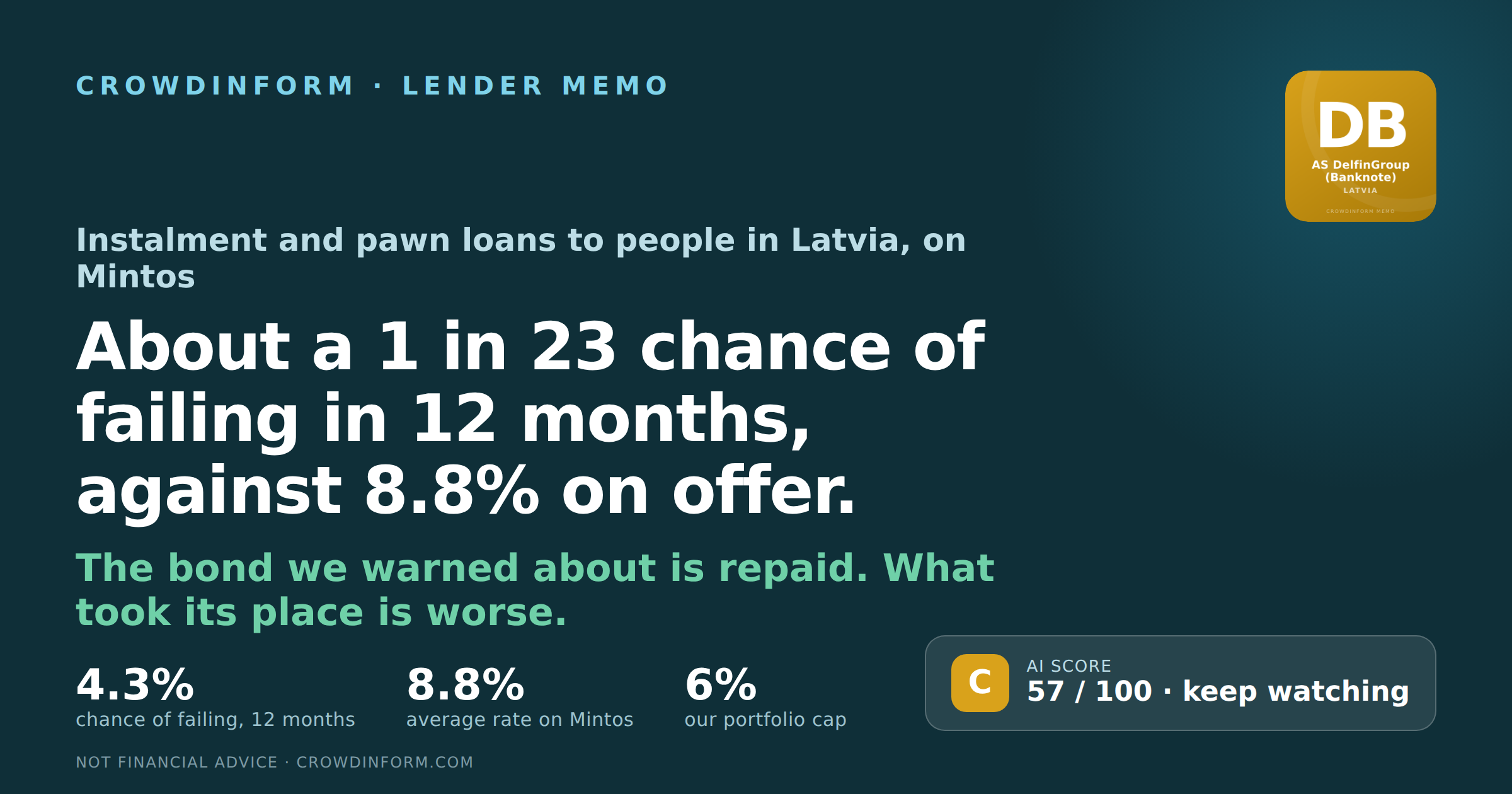
Latvia
Capital at risk. The rate is agreed, not guaranteed: if a borrower defaults you can lose some or all of your money.
Our AI gives this project 57 out of 100: Medium. How the AI score works
Information, not personal investment advice. The AI score rates the documents the platform publishes, can be wrong, and does not predict returns.
AS DelfinGroup is a Latvian company that lends money to people and runs pawnshops, under the name Banknote. Its shares are listed in Riga. Separately, investors on Mintos lend money to it. This memo asks one question: what is the chance that DelfinGroup fails to pay those investors back in the next 12 months, and why.
We have used its audited group accounts for 2023, 2024 and 2025, all signed off by BDO with no reservations, and its own unaudited figures for the first half of 2026 — which are the newest numbers it has published. Its subsidiary ViziaFinance is covered by a separate memo of ours.
Profit is up 52% in the first half of 2026. That is mostly because income grew by €2.7m. About €1.0m came off the cost of selling and administration, which helped; about €1.2m more was charged for bad loans, which pulled the other way. Money lost on borrowers who never pay has taken a bigger share of income in every single period for three years. Loans more than 90 days late rose 54.6% in six months, from €6.7m to €10.4m, while the money set aside across the whole book rose only 13.6%.
We ask six questions about every lender: does it earn enough, are its loans being repaid, does it have enough of its own money to absorb losses, how risky is its country, can we trust its numbers, and are there warning signs. Each is scored 1 to 5 and weighted. The four cards below cover five of those six — the first card holds two of them — and only trust in the numbers has no card of its own; it runs through section 5. The weights differ a lot: earnings 30%, the loan book 20%, the cushion 20%, the country 15%, trust 10%, warning signs 5%, so the card carrying our worst mark is also the one that counts for least. The cards are not meant to be added up; the weighted result is the about 4.3% at the top of this page.
Income grew from €50m to €78m in three years and it has made money every year. But the owners’ money is only €19 in every €100 of what the group owns, about half of what it earns is paid out as dividends, and the tightest promise it has made to its lenders has about 8% of room left in it.
Loans more than 90 days late went from 4.35% of what borrowers owed at the end of 2025 to 6.30% by June 2026 — €6.7m to €10.4m, up 54.6% in six months — while the money set aside across the whole book rose only 13.6%. Cover of the worst loans fell from 277% to 203%.
The euro, so no currency risk for an investor whose own money is in euros. Courts that work. The government fell in May 2026 and a new coalition was confirmed a fortnight later, an election was due on 3 October, and from January 2027 a new supervisor takes over.
Its majority owner takes cash out of DelfinGroup and puts none back into it — it needs the money for a bank it is building. A bank lender can demand repayment from 16 October. And the regulator has fined it €285,000 with a warning about its licence.
Every investment carries risk, and risk is not really a letter or a mark out of ten. It is two plain questions: how likely is it that this company fails, and how much of your money would you lose if it did. Put those together and you can see whether the reward is worth it.
For DelfinGroup: about a 4.3% chance of failing in the next 12 months. If we assume about 30% of the money comes back in that case, the risk costs roughly 3.0% a year — so the 8.8% rate is worth about 5.76% once the risk is paid for.
An advertised 8.8% is what you are promised if everything goes well. What you keep is that rate minus what failures cost you. So the rate on its own tells you very little.
Risk cost = the chance of failing × the share you do not get back. We assume 30% comes back and 70% is lost. That 30% is an assumption we apply to every lender so they can be compared with each other — it is not a measured figure, and the answer moves a lot if you choose differently.
Take two imaginary lenders. One pays 14% but has a 17% chance of failing within the year: the risk costs about 11.9% a year, leaving roughly 2%. The other pays 9% with a 2.5% chance: the risk costs about 1.8%, leaving about 7%. The bigger number on the screen can easily be the worse one.
| With our figures | |
|---|---|
| Chance of failing in a year | 4.3% |
| Loss if it fails (70%) | × 0.7 |
| Risk cost a year | 3.0% |
| Rate on the Mintos funding | 8.8% |
| Left after the risk cost | about 5.76% |
One caution on that rate. 8.8% is what DelfinGroup itself pays on its Mintos funding, taken from its own accounts at 30 June 2026. What an investor receives is not that figure, and the two are not measured the same way. Mintos publishes an investor net return of 9.0% on personal loans in our capture of 13 September 2026 — above the 8.8% the company books, because that 9.0% is a realised return on one product for the whole DelfinGroup brand, ViziaFinance included, while the 8.8% is what this company paid across all its Mintos funding at 30 June 2026. The two cannot be subtracted from one another. One more caution, in the company’s favour this time: we have not raised the 30% recovery assumption to allow for the security registered in favour of the Mintos companies, because we cannot put a figure on what it would actually return. If it is worth something, the figure above is on the cautious side.
Not a bank, and it takes no deposits. Licensed by Latvia’s consumer rights centre since 2016, with shares listed on Nasdaq Riga. It ran 89 branches in Latvia at 30 June 2026, up from 88 at the end of 2025. From 1 January 2027 the Bank of Latvia supervises it instead.
Instalment loans with nothing pledged against them, averaging about four years, plus pawn loans against goods, plus second-hand retail. It also lends in Lithuania and set up a Romanian subsidiary in July 2025 that has no revenue yet.
After money set aside, at 30 June 2026. Income was €78.2m in 2025 and €39.8m in the first half of 2026. Profit after tax was €9.6m in 2025 and €5.7m in the half.
A Latvian pension manager that also owns INDEXO Banka, which took control between December 2025 and January 2026. DelfinGroup stays listed, with minority shareholders. Section 4 explains why that ownership is a risk rather than a comfort.
Listed there as “DelfinGroup (Banknote)”. Its subsidiary VIZIA is listed separately and has its own memo; under our method the two share one limit. Mintos also shows money owed to investors and not yet passed on. On the personal-loan line of the DelfinGroup brand that was €243,228 against €19.99m outstanding — about 1.2%, against 1.5% for all personal loans on the platform and 0.7% for the middle brand on that line — and it had been waiting 2 days on average, against 3 days for the middle brand. That reads as an ordinary settlement lag rather than a sign of trouble.
The average rate DelfinGroup paid on its Mintos funding at 30 June 2026 — weighted by the size of each loan — taken from its own accounts, when it owed the platform €29.5m. Mintos’s own figure for the amount outstanding to investors was €19.0m for Banknote at 9 November 2026, plus €8.5m for VIZIA. Mintos does publish what an investor actually receives, but for the DelfinGroup brand as a whole rather than for this company alone. In our capture of 13 September 2026 it was 9.0% on personal loans, 8.0% on the revolving pool and 6.9% on pawnbroking. That brand also covers ViziaFinance.
Mintos’s own mark, not ours, read on the Mintos register on 9 November 2026. The four parts behind it are 9.0 for how the loans perform, 9.5 for servicing, 9.7 for buyback strength and 6.5 for the structure of the arrangement — the structure is much the weakest of the four. Mintos raised one part of the score in January 2026 on a higher capitalisation ratio — the company’s own measure of its safety cushion — then cut the same part in April 2026 on a lower one. The register stamps this score as last updated on 9 October 2026.
The full review covers the borrower or company, the security, the cash flow, the risks and a verdict. Sign in to read it.
Information, not personal investment advice. The AI score rates the documents the platform publishes, can be wrong, and does not predict returns.
Sign in to ask the AI about this project's documents.
Sign in👍 Yes · 0 👎 No · 0
Referral link · capital at risk
See 42 projects →Mintos