
Regulated
Bonus running
Can sell early
- Risk level
- High
- Risk-return
- Medium
- Start from
- €50
Referral link · capital at risk
See 42 projects →Questions about investing? Ask the AI guide.
Hi! I'm the Crowdinform AI guide.
Sign in free to ask the AI guide about platforms, projects and your plans.
Answers come from Crowdinform's checked data. Information, not personal investment advice.
Looking it up… Something went wrong. Please try again. {n} questions left today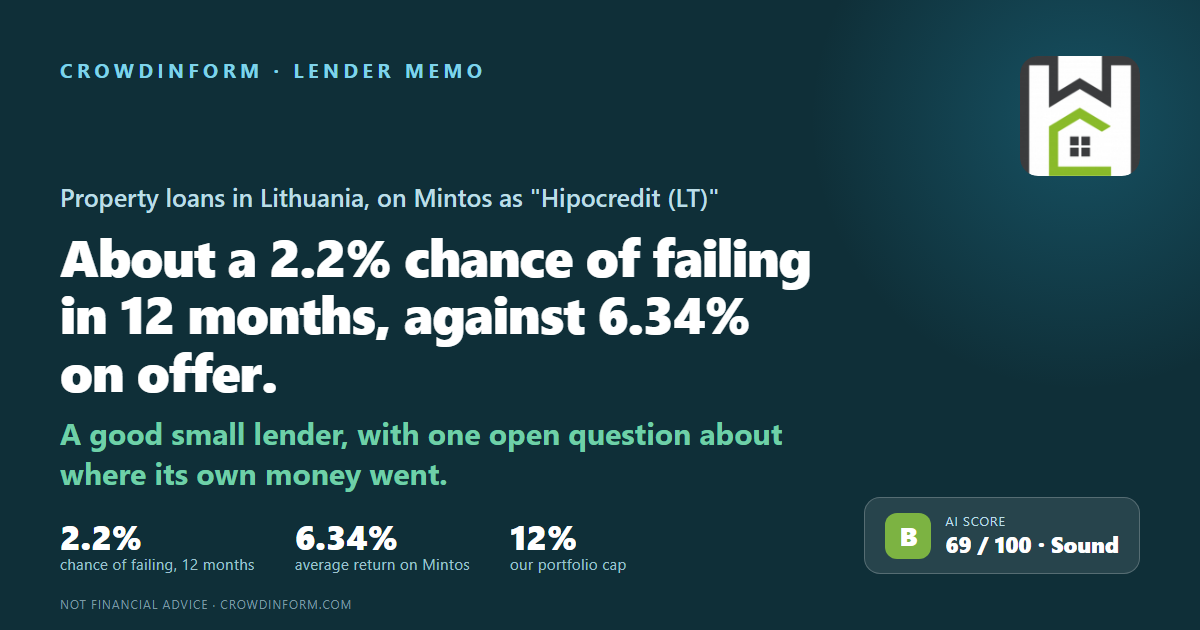
Lithuania
Capital at risk. The rate is agreed, not guaranteed: if a borrower defaults you can lose some or all of your money.
Our AI gives this project 69 out of 100: Medium. How the AI score works
Information, not personal investment advice. The AI score rates the documents the platform publishes, can be wrong, and does not predict returns.
UAB Hipotekiniai kreditai is a small Lithuanian lender in Kaunas — 3 staff — that lends against property, mostly to companies, at 12% to 18% a year. Mintos investors lend to it under the name "Hipocredit (LT)", which is worth knowing because a different company called Hipocredit has its own memo. This memo asks one question: what is the chance it fails to pay its lenders back in the next 12 months, and why.
The marks come to 69, a B — about 1 in 45, or 2.2%. In every year we can see, the company lent more to companies in its own family than half of what it owns itself, which is the line our method watches. We checked whether that still applies today, and we cannot say it does: the larger loan has left the accounts, and the one still shown went with a company that was sold. So the grade comes from the score, and the question stays in this memo as a warning. We could not confirm whether the €3.70m this company lent to AS Hipocredit, a company it sold in July 2026, has been repaid; if it is still owed, an unsecured loan worth 86% of the company's own money sits with a company it no longer controls.
The figures. Against owners' money of €1.86m at the end of 2023 it had lent €8.12m — 437% of it. A year later €10.27m against €3.16m, or 325%. By the end of 2025 the figure was €3.70m against €4.28m — 86%, still above the half-the-cushion line at that date.
And the direction of travel is the interesting part. The larger of the two loans — €6.57m to a related Latvian company, made "through the Company's shareholder" and secured on 592 vehicles — simply stops appearing in the 2025 accounts. It was due on 16 September 2026, a date that has now passed. Lending to Lithuanian companies rose by almost exactly the same amount in the same year. That may be a repayment. It may be a reclassification. The accounts do not say, and we found no statement either way.
What is left is a loan to a company it no longer owns. The €3.70m was lent to AS Hipocredit, its Latvian subsidiary — but on 16 July 2026 that company was sold out of the group. Whether the loan went with it, was repaid, or simply stayed is not disclosed. An unsecured loan to a subsidiary is one thing; the same loan to a company you no longer control is another.
Everything else about it is sound, and the memo should say so plainly. It kept €32.81 of every €100 of income in 2025 and about a third in each of the three years. Every loan it makes carries a mortgage, at an average of 43% of the property's value. Interest was covered 1.77 times. Owners' money has grown every year because no dividend has ever been paid. The open question is not about whether it can lend; it is about where its own capital has gone.
Six things would stop us scoring at all and send the answer straight to E — a default, a missed payment to a platform, a regulator pulling a licence, an auditor doubting the company can continue, a broken promise to a lender, or accounts we cannot rely on. None applies on what we could confirm. The lending to its own family crossed our line at the end of 2025, but that loan's borrower has since been sold and we could not find out whether it was repaid, so it is a warning below rather than a reason to stop scoring. Two things would pull the answer the other way, a guarantee from a stronger owner or a credit rating. Neither applies. This is the top company of its own group — there is nobody above it to give a guarantee — so there is no second number on this page.
Profit €1,117,300 in 2025, €32.81 of every €100 left over, interest covered 1.77 times.
Every loan secured on property at 43% of its value on average — but 91% is lent to companies and no arrears figures are published at all.
Grade A (4.25 out of 5). The euro, courts in the world's top ten, a sovereign rated A. The best country we cover.
The related-party lending above, €13.92m from lenders the accounts never name, and sponsorship rising eightfold in two years.
Every investment carries risk, and risk is not really a letter or a mark out of ten. It is two plain questions: how likely is it that this company fails, and how much of your money would you lose if it did. Put those together and you can see whether the reward is worth it.
Here are both halves of the sum, side by side. Mintos showed an average net annual return of 6.34% on these loans when we read it on 9 November 2026. Our half is this: if a company on about 2.2% odds fails and about 70% of the money is gone when it does, the risk costs about 1.5% a year. Whatever rate you are offered, that is what has to be covered before anything is left. Check the rate yourself before you rely on it: it is Mintos's average, not a promise.
This company lends carefully against property and makes money doing it. The question is what it did with its own capital: €3.70m lent to a company it has since sold, and whether that money has come back.
The car-backed loan stopped being mentioned. That is all we know. Treat a figure that disappears as unexplained until something explains it.
Mintos lists this one as "Hipocredit (LT)". AS Hipocredit in Latvia is a different company, sold out of this group in July 2026, with its own memo. Do not read one as the other.
On the Bank of Lithuania's public list of real-estate credit lenders since 2017. Kaunas, 3 staff, lending across Lithuania. Its registered share capital is €5,000 — everything else in the cushion is profit it never paid out.
At 12% to 18% a year, every one secured by a mortgage. Limits run from 75% of value for a flat in central Vilnius down to 40% outside the 35 largest towns.
At the end of 2025, flat on the year, with €13.7m newly lent during it. Income was €3,405,620 and profit €1,117,300.
Led by Gediminas Velička with 49.9%, on the company's own 2025 presentation. It is the top company of its own group, so there is nobody above it to guarantee anything.
The name is the Latvian company's; the borrower is this one. Mintos raised the buyback part of its score twice during 2025.
Outstanding when we read it on 9 November 2026, on the platform's own figure. The audited accounts show €3.23m owed to Mintos investors at the end of 2025 — a small part of its €27.16m of funding.
Each Mintos loan is repaid when the matching borrower repays, backed by a buyback promise. Mintos showed an average net annual return of 6.34% on 9 November 2026; the box above sets it against our estimate of what the risk costs.
Read on 9 November 2026: portfolio performance 10.0, servicer efficiency 8.3, buyback strength 7.2, cooperation structure 5.5. The loan-servicer subscore was raised in that quarterly round, after an improvement in a country rating Mintos uses.
The full review covers the borrower or company, the security, the cash flow, the risks and a verdict. Sign in to read it.
Information, not personal investment advice. The AI score rates the documents the platform publishes, can be wrong, and does not predict returns.
Sign in to ask the AI about this project's documents.
Sign in👍 Yes · 0 👎 No · 0
Referral link · capital at risk
See 42 projects →Mintos