
Can sell early
- Risk level
- Highest
- Risk-return
- Bad
- Start from
- €10
Questions about investing? Ask the AI guide.
Hi! I'm the Crowdinform AI guide.
Sign in free to ask the AI guide about platforms, projects and your plans.
Answers come from Crowdinform's checked data. Information, not personal investment advice.
Looking it up… Something went wrong. Please try again. {n} questions left today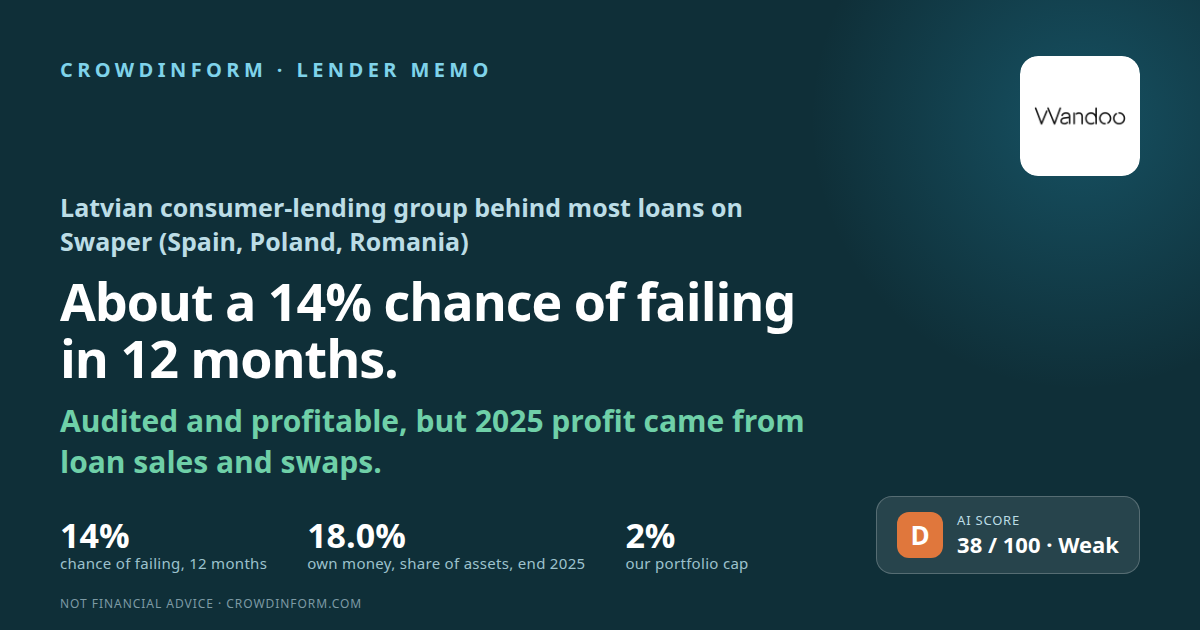
Latvia
Capital at risk. The rate is agreed, not guaranteed: if a borrower defaults you can lose some or all of your money.
Our AI gives this project 38 out of 100: Low. How the AI score works
Information, not personal investment advice. The AI score rates the documents the platform publishes, can be wrong, and does not predict returns.
The Wandoo Finance group is the main lender group on Swaper: by Swaper Platform OÜ’s 2024 accounts, 99.9% of its income came from Latvia, Spain and Poland, countries where Wandoo group companies are based; the accounts name no lender, so that this income is Wandoo’s is our reading, not confirmed. The group is SIA “Wandoo Finance” (Latvia, registration number 40103970112) and its subsidiaries, consolidated. An investor on Swaper does not lend to Wandoo directly. The money takes this route. Investor → Swaper Platform OÜ (Estonia, registry code 14726410): it sells the investor the claim as the assignor, books the investors’ money as its own loan liability (€30.7m at 31 December 2024) and, by its own audited accounts, owes the buyback. → The Wandoo companies whose loan claims it sells on, or, for part of the money, Swaper’s own lender SW Finance OÜ (Estonia, 16774146, wholly owned by Swaper Platform OÜ), which had lent €18.9m, unsecured, to “three companies” at the end of 2025, earning its income in Latvia and Poland; its accounts do not name them. → Consumer borrowers in Spain, Poland and Romania, and, on Swaper since October 2025, a new line in Peru whose size is not published. In plain words: the investor is paid only if both Swaper Platform OÜ and the Wandoo companies can pay. This memo is about the second link, the Wandoo group; section 4 describes the first. Swaper publishes no amount per lender that we could read: its statistics page refused our reader, and a blog page updated in August 2026 put Swaper’s total outstanding at €21.5m, with no date for the figure, which we give low weight. The buyback is Swaper Platform OÜ’s promise by its accounts; its site’s wording is softer (“we or the loan originator (depending on the loan) shall refund you”), and we have not read the Assignment Agreement, which decides it. Swaper is not regulated by a financial authority: its footer says “Swaper Platform OÜ is not regulated under any financial services license.” Wandoo and Swaper have different registered owners; a link between them is described in section 4 and is not confirmed as control. This memo asks one question: what is the chance that the Wandoo group fails to pay in the next 12 months, and why.
We ask six questions about every lender: does it earn enough, are its loans being repaid, does it have enough of its own money to absorb losses, how risky are its countries, can we trust its numbers, and are there warning signs. Each is scored 1 to 5 and weighted. The four cards show how they land. Together they give 38 out of 100, which means about 14%. D runs from 35 to 49, so the grade is D, 3 points above E: close to the line. One step down on earnings alone, from 2 to 1, would give 32, an E, with about 19%; so would one step down on the cushion (34). One step up on the loans, from 1 to 2, would give 42, still D. A better score needs a profit that does not rest on selling loans, figures on late loans, and the 2026 repayments shown to be covered.
Profit before tax of €3.58m in 2025, but €8.19m came from selling loans: without it, a loss of €4.6m. Owners’ money €11.0m, 18.0% of assets, rising each year.
Borrowers who did not pay took 50 of every 100 euros of income in 2025, against 34 to 37 in 2023 and 2024. The accounts publish no table of late loans.
Spain C and Poland C, Romania D in our country memos; weighted by the best split we have, C. Spain’s draft law would cap high-cost loans.
Clean audits, but a borrowings note that does not agree with its own table, no note on related parties, and credit default swap income with no exposure shown. Debt due in 2026 is twenty times last year’s.
The full review covers the borrower or company, the security, the cash flow, the risks and a verdict. Sign in to read it.
Information, not personal investment advice. The AI score rates the documents the platform publishes, can be wrong, and does not predict returns.
Sign in to ask the AI about this project's documents.
Sign in👍 Yes · 0 👎 No · 0
Comments · 0