
Transparency in crowdfunding is defined as the structured, timely, and standardised disclosure of material information that enables investors to make informed decisions and hold issuers accountable. The role of transparency in crowdfunding extends well beyond regulatory compliance. It reduces the information asymmetry that naturally exists between entrepreneurs seeking capital and investors evaluating risk. Frameworks such as U.S. Regulation Crowdfunding (Reg CF) and the EU European Crowdfunding Service Providers Regulation (ECSPR) have codified transparency into law, requiring specific filings and standardised documents before any investment can take place. For investors, understanding how these mechanisms work, and how to read beyond them, is the difference between informed capital allocation and avoidable loss.
How regulatory frameworks enforce transparency in crowdfunding
Formal regulation is the baseline of transparency in any crowdfunding market, and both the U.S. and EU have built detailed disclosure regimes that protect investors at every stage of a raise.
In the United States, Reg CF mandates standardised public Form C disclosures before and during fundraising, with a $5M raise cap, a Form C-U filing at close, and annual Form C-AR filings while offerings remain open. This means you can access audited or reviewed financials, business descriptions, risk factors, and ownership structures for every compliant issuer, all in a publicly searchable format on the SEC's EDGAR system. The practical implication is significant: no Reg CF issuer can legally raise funds from the public without first publishing this information.

The SEC has also tightened the timing of these disclosures. Rolling offerings exceeding 120 days past fiscal year-end must file amended Form C filings with updated financials, preventing issuers from relying on stale data during long fundraising windows. This matters for investors in ongoing raises: the financials you reviewed at launch may not reflect the issuer's current position. Annual income for investment limits is measured on a calendar year basis, and rolling 12-month caps apply to staged closings, giving investors clearer eligibility boundaries.
In the EU, the ECSPR framework takes a comparable approach through the Key Investment Information Sheet (KIIS). The KIIS standardises critical project details including risks, fees, and owner information, and is subject to ESMA quality oversight. Its purpose is to enable consistent comparison across offerings rather than leaving investors to parse uncontrolled marketing narratives. You can read more about how these frameworks operate in practice in this overview of regulated crowdfunding platforms.
Here is a direct comparison of the two frameworks:
| Feature | U.S. Reg CF | EU ECSPR (KIIS) |
|---|---|---|
| Disclosure document | Form C (pre-offering) | Key Investment Information Sheet |
| Ongoing updates | Form C-AR annually | ESMA-overseen updates |
| Raise cap | $5M | €5M |
| Standardisation body | SEC (EDGAR) | ESMA |
| Investor protection focus | Financial + ownership disclosure | Risk, fees, and comparability |
Key mandatory disclosures under Reg CF include:
- Business description and use of proceeds: issuers must explain exactly how raised funds will be deployed
- Financial statements: reviewed or audited depending on raise size
- Risk factors: material risks specific to the business and offering
- Ownership and capital structure: who owns what, and how new investment dilutes existing holders
- Related party transactions: any financial relationships between the issuer and its insiders
What transparency signals build trust beyond regulations?
Regulatory disclosures set the floor, but investor trust is also shaped by behavioural and social cues that go beyond formal filings. Research published in the Journal of Global Entrepreneurship Research finds that facial disclosure correlates positively with crowdfunding success (β1=0.087, p=0.0547) across Kickstarter and Indiegogo campaigns. Entrepreneurs who display their image signal authenticity and accountability, two qualities that matter enormously when investors cannot meet founders in person.
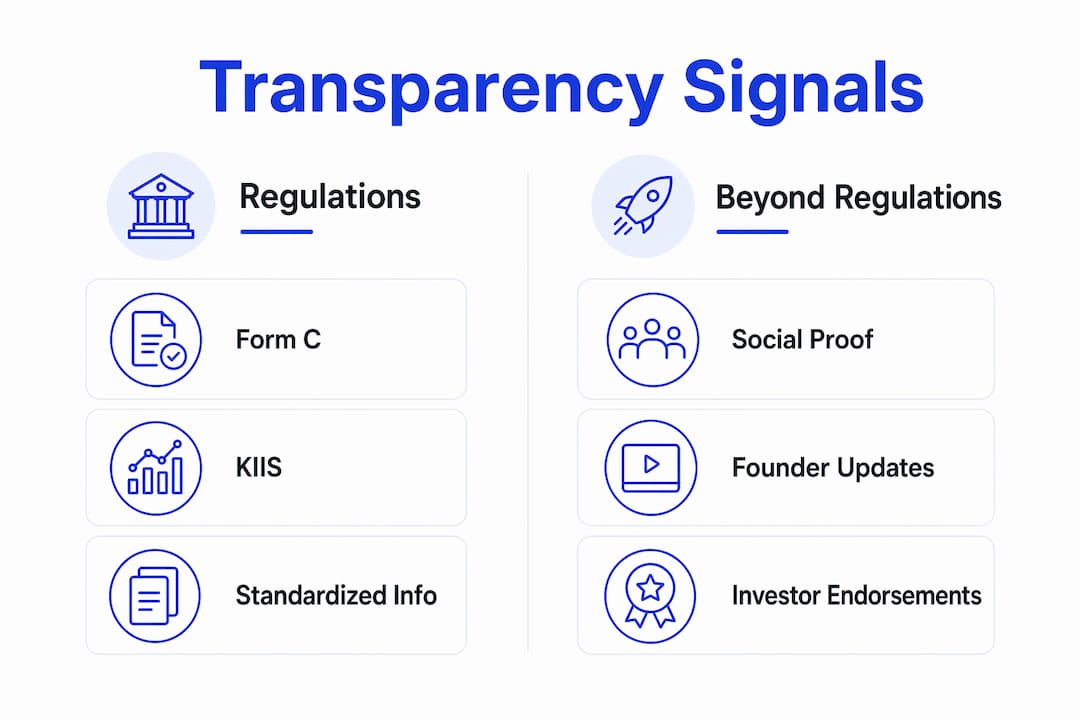
This finding reflects a broader principle: in high-uncertainty environments, people use available signals to infer credibility. A founder who shows their face, shares a detailed biography, and communicates regularly throughout a campaign is signalling that they are willing to be held accountable. These cues complement formal disclosures rather than replacing them.
Social proof, including backer counts, comment activity, and endorsements from known investors, also influences decisions. However, a 2026 study in Frontiers in Psychology found that algorithmic transparency reduces social influence on investment decisions by 34.7%, encouraging investors to act on personal analysis rather than crowd behaviour. This is a counter-intuitive but important result: when platforms make their recommendation logic visible, investors become more independent in their judgements.
There are genuine risks on the other side of this equation. Entrepreneurs who share personal images or detailed personal narratives expose themselves to privacy concerns, and investors should be cautious about over-weighting visual or emotional cues at the expense of financial analysis.
Pro Tip: When evaluating a campaign, treat the founder's bio, photo, and update history as supplementary signals. Cross-reference them against the Form C or KIIS to confirm that the narrative matches the numbers.
- Facial disclosure and regular campaign updates signal founder accountability
- Social proof (backer counts, endorsements) provides context but should not drive decisions
- Algorithmic transparency on platforms helps investors rely on their own analysis
- Privacy considerations mean some founders may legitimately withhold personal details
Does transparency always help? The innovation paradox by project type
Transparency effects on crowdfunding success are not uniform across project categories, and this is one of the most practically useful findings for investors to understand. Research published in the Annals of Operations Research, drawing on 1,332 crowdfunding projects, finds that calibrated transparency improves outcomes, but excessive disclosure in technology projects can actually signal over-promising or high execution risk.
This is the Innovation Paradox: in tech offerings, a campaign that reveals too much about speculative future capabilities may increase investor scepticism rather than confidence. Investors interpret granular technical detail as a sign that the team is still working things out, rather than evidence of competence. The opposite holds for creative and artistic projects, where rich disclosure of the creative process signals genuine engagement and encourages social sharing and community backing.
"Excess transparency can backfire in some contexts by signalling over-promising or risk, suggesting that optimal transparency is context-dependent and strategic." — Annals of Operations Research, 2026
The table below summarises how transparency effects differ by sector:
| Project type | Transparency effect | Investor implication |
|---|---|---|
| Art and craft | Positive: social engagement, creativity signals | More disclosure generally builds confidence |
| Technology | Mixed: Innovation Paradox risk above a threshold | Scrutinise claims; excess detail may signal uncertainty |
| Real estate | Positive: asset-backed, verifiable data | Demand full financial and legal documentation |
| Startups (equity) | Positive with caveats: team and traction matter | Weight team transparency alongside financials |
For investors, this means that the right question is not simply "how much has this campaign disclosed?" but "is the level and type of disclosure appropriate for this project category?" A tech startup that publishes a 40-page technical white paper without audited financials is not more transparent than one that files a clean Form C with a concise product description.
How to evaluate transparency in crowdfunding campaigns
Practical due diligence on transparency requires a structured approach. The following steps reflect both regulatory requirements and behavioural research findings.
-
Start with the formal disclosure document. For U.S. campaigns, locate the Form C on EDGAR before reading any marketing material. For EU campaigns, request or download the KIIS directly. These documents are your primary source of standardised, legally accountable information.
-
Check the filing date and update history. If a Reg CF offering has been running for more than 120 days past the issuer's fiscal year-end, confirm that an amended Form C with updated financials has been filed. Stale financials in a rolling offering are a material transparency gap.
-
Use the KIIS to compare, not just to read. The KIIS document's standardisation in the EU enables meaningful comparison across offerings, reducing dependence on uncontrolled marketing narratives. Place two or three KIIS documents side by side and compare risk ratings, fee structures, and projected returns on a like-for-like basis.
-
Assess founder and team transparency separately. Review bios, LinkedIn profiles, and prior venture history. Cross-reference any claims in the campaign narrative against verifiable public records. Treat founder image and communication quality as supplementary signals, not primary evidence.
-
Apply extra scrutiny to Web3 and token offerings. Prior to the Token Transparency Framework, retail investors had to reconstruct token economics from scattered sources. The framework now standardises supply, vesting schedules, and allocation fields. If a token offering does not provide these fields, treat the omission as a red flag.
-
Revisit disclosures after fiscal year-end. Investors in ongoing raises should schedule a review of updated filings after each fiscal year-end, not just at the point of initial investment. Financial positions change, and regulatory frameworks require issuers to reflect those changes.
Pro Tip: Build a simple checklist: formal disclosure document (Form C or KIIS), filing date, updated financials, team verification, and (for Web3) token economics fields. Any campaign that cannot satisfy all five points warrants a deeper conversation with the issuer before you commit capital.
For a broader framework on applying these principles across different platform types, Crowdinform's guide to crowdfunding best practices covers due diligence across European markets in 2026.
Key takeaways
Transparency in crowdfunding is most effective when it combines mandatory regulatory disclosures, calibrated founder communication, and investor-led due diligence across the full lifecycle of an offering.
| Point | Details |
|---|---|
| Regulatory baseline matters | Form C (U.S.) and KIIS (EU) are your primary sources; always start there. |
| Timing of disclosures is critical | Check for updated filings in rolling offerings beyond 120 days past fiscal year-end. |
| Transparency signals vary by project type | Art projects benefit from rich disclosure; tech projects risk the Innovation Paradox. |
| Social cues complement, not replace, data | Founder image and backer counts are useful signals but must be cross-referenced with financials. |
| Web3 requires extra vigilance | Demand standardised token economics fields; absence of these is a material gap. |
Transparency is necessary but not sufficient: a personal view
I have spent years reviewing crowdfunding campaigns across European platforms, and the single most common mistake I see from investors is treating disclosure volume as a proxy for disclosure quality. A campaign that publishes a 60-page prospectus is not automatically safer than one with a concise, well-structured KIIS. What matters is whether the disclosed information is material, current, and independently verifiable.
The regulatory progress has been genuinely encouraging. The SEC's 2026 updates to Reg CF, and ESMA's ongoing oversight of the KIIS framework, have raised the baseline for investor protection in ways that were not in place five years ago. But regulation sets a floor, not a ceiling. I have seen Reg CF-compliant campaigns with technically accurate but strategically framed disclosures that obscured more than they revealed.
The behavioural research on facial disclosure and social proof is fascinating, but I would caution against over-indexing on it. A founder with a polished video and a warm personal story is not more trustworthy than one who files clean financials and updates investors promptly after each quarter. The former is easier to produce; the latter is harder to fake.
My honest recommendation: treat transparency as a process, not a document. The best campaigns are those where the issuer communicates proactively, updates disclosures without being prompted, and responds to investor questions with specificity. That behaviour, sustained over the life of an offering, is the most reliable signal of a team worth backing.
— Jevgenijs
Explore transparent crowdfunding projects with Crowdinform
If you are ready to apply these transparency principles to real investment decisions, Crowdinform is built for exactly this purpose.

Crowdinform aggregates reviews and data from over 500 European crowdfunding platforms, with an AI copilot that analyses project disclosures and surfaces the information that matters most to investors. Whether you are evaluating loans, real estate, or startup equity, the platform helps you cut through marketing narratives and focus on standardised, comparable data. Explore current investment opportunities across loans, real estate, and startups, and use the built-in AI tools to assess transparency quality before you commit.
FAQ
What is the role of transparency in crowdfunding?
Transparency in crowdfunding provides investors with standardised, timely, and material information that reduces information asymmetry and supports informed decision-making. Regulatory frameworks such as Reg CF and the EU ECSPR mandate specific disclosures to protect investors and build market trust.
How does the KIIS document protect EU crowdfunding investors?
The Key Investment Information Sheet standardises risk, fee, and ownership disclosures across EU crowdfunding offerings, enabling investors to compare campaigns on a like-for-like basis rather than relying on platform marketing narratives.
Does more transparency always improve crowdfunding success?
Not always. Research on 1,332 projects finds that excessive disclosure in technology campaigns can trigger the Innovation Paradox, where over-detailed claims increase perceived execution risk and reduce investor confidence.
How often should investors review crowdfunding disclosures?
Investors in ongoing Reg CF offerings should review updated Form C filings after each fiscal year-end, particularly when a rolling offering exceeds 120 days past that date, as updated financials are legally required at that point.
What should investors look for in Web3 crowdfunding transparency?
Investors should demand standardised token economics fields including supply schedules, vesting periods, and allocation breakdowns. The Token Transparency Framework introduced these standard fields to address the dilution and sell-pressure risks that were previously opaque in token offerings.


