
Green fintech is defined as the application of digital financial technology to measure, reduce, or offset environmental impacts across financial services, enabling technologies, and financial infrastructure. It is not simply a "green" label applied to existing banking apps. True green fintech produces verifiable environmental impact data that can withstand the same scrutiny as a balance sheet. For investors and financial institutions serious about sustainability, understanding this distinction is the starting point for every credible capital allocation decision.
What is green fintech and how does it differ from traditional fintech?
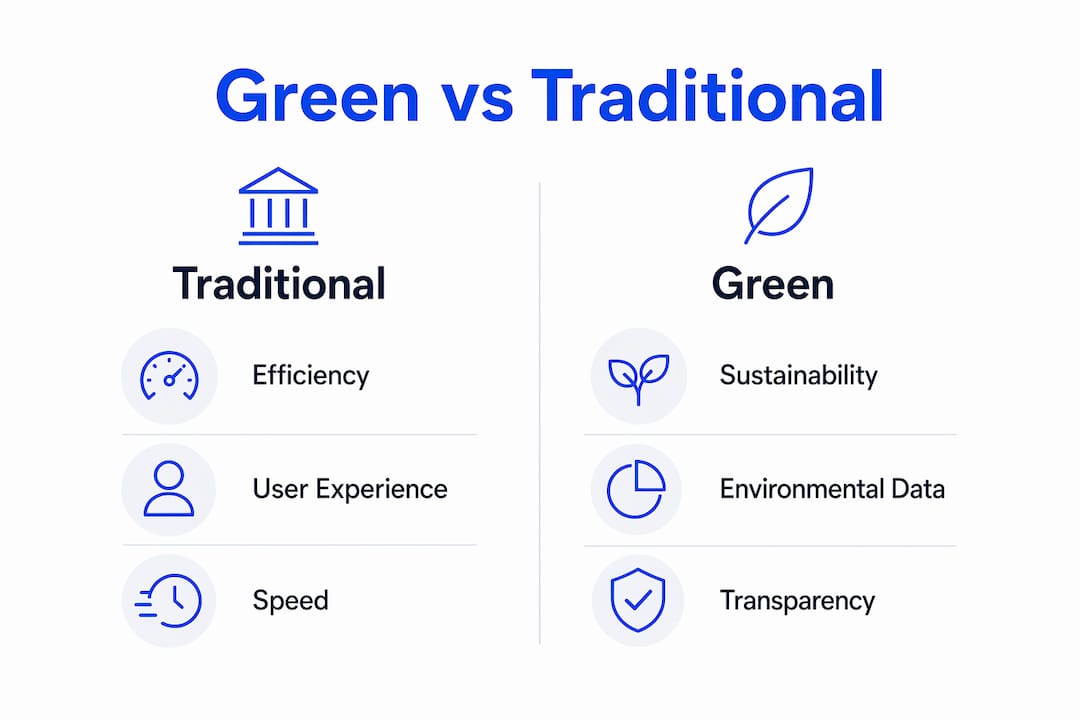
Green fintech and traditional fintech share the same digital foundations, but they serve different masters. Traditional fintech prioritises efficiency, speed, and user experience. Green fintech prioritises environmental transparency and impact measurement, integrating climate data into financial reporting with the same rigour as profit and loss figures.
The distinction matters because it changes what you build, what you measure, and what you report. A payment app that reduces paper statements is not green fintech. A platform that tracks the carbon footprint of every loan in its portfolio, reports against the EU Taxonomy, and flags non-compliant assets automatically is green fintech.

Sustainable finance is the broader discipline here. It encompasses environmental, social, and governance (ESG) factors across all capital markets. Green finance narrows to climate and biodiversity, and climate finance narrows further still to adaptation and resilience. Green fintech sits at the intersection of digital technology and this narrower environmental focus, providing the verifiable evidence trails that sustainable finance frameworks demand.
| Dimension | Traditional fintech | Green fintech |
|---|---|---|
| Primary goal | Efficiency and user experience | Environmental transparency and impact |
| Data focus | Financial transactions | Financial and climate/ESG data |
| Reporting standard | IFRS, GAAP | EU Taxonomy, SFDR, Green Deal |
| Success metric | Revenue, retention | Carbon reduction, ESG compliance |
| Greenwashing risk | Low | High without rigorous data pipelines |
Pro Tip: Before evaluating any green fintech platform, check whether it reports against a named regulatory standard such as the EU Taxonomy or SFDR. Platforms that cite only internal metrics are a greenwashing risk.
Before going deeper, the green energy investment glossary on Crowdinform is a useful reference for the core terminology you will encounter across this space.
What technologies power green fintech solutions?
The technological backbone of green fintech is more complex than most investors realise. Blockchain, AI, big data analytics, carbon tracking APIs, and ESG data platforms each play a distinct role in making environmental claims verifiable rather than aspirational.
Here is how each layer functions in practice:
- Blockchain creates immutable audit trails for carbon credits, green bonds, and sustainability-linked loans. A carbon credit issued on a blockchain cannot be double-counted or retrospectively altered.
- AI and machine learning automate ESG scoring across large asset portfolios, flagging inconsistencies that human analysts would miss at scale. AI also powers natural language processing tools that scan corporate disclosures for greenwashing signals.
- Big data analytics aggregates satellite imagery, supply chain data, and energy consumption records to build real-time environmental profiles of borrowers and projects.
- Carbon tracking APIs connect financial platforms directly to emissions databases, enabling live carbon accounting within lending and investment workflows.
- ESG data platforms standardise reporting inputs so that a solar farm in Portugal and a reforestation project in Kenya can be compared on the same metrics.
Green financial infrastructure is also advancing at scale. Decentralised finance protocols and open banking APIs now facilitate large-scale environmental financial products that were impractical a decade ago. A green bond issuance that once required months of manual due diligence can now be structured, verified, and distributed in weeks.
The digital footprint of these systems matters too. Understanding how data infrastructure supports transparency is increasingly relevant for any institution building credible green fintech products.
Pro Tip: When assessing a green fintech platform's credibility, ask specifically which carbon tracking API or ESG data provider it uses. Named, third-party data sources are a strong signal of genuine environmental accountability.
How are regulatory frameworks shaping green fintech adoption?
Regulation is the single biggest driver of green fintech adoption in 2026. Without mandatory disclosure requirements, the market would remain dominated by voluntary, unverifiable claims. The EU has led the way with three interlocking frameworks.
- The EU Green Deal sets the overarching political commitment to climate neutrality by 2050, creating the demand signal that forces financial institutions to align their portfolios with net-zero pathways.
- The EU Taxonomy defines which economic activities qualify as environmentally sustainable. It gives green fintech platforms a legal classification system to work with, replacing subjective "green" labels with technical screening criteria.
- The SFDR (Sustainable Finance Disclosure Regulation) requires asset managers and financial advisers to disclose how they integrate sustainability risks. It pushes ESG reporting from manual spreadsheets to automated data pipelines, which is precisely where green fintech earns its value.
Beyond Europe, markets such as India have introduced green finance policies that mirror the EU approach, signalling that this is a global regulatory direction rather than a regional experiment.
The balance between innovation and compliance is a live tension. Regulatory sandboxes allow green fintech startups to test products under relaxed rules before full authorisation. This is healthy. But global green fintech adoption depends on regulatory quality alongside innovation, and markets that skip rigorous ESG methodology in favour of speed tend to produce the greenwashing scandals that erode investor trust.
The Heuristik case is instructive here. As explored in Crowdinform's analysis of EU Green Deal-driven innovation, regulatory pressure can catalyse genuinely transformative financial products when the compliance infrastructure is built correctly from the start.
What are the benefits and challenges of green fintech for investors?
The business case for green fintech is concrete. Green fintech can reduce transaction costs for green projects by 20–30% in emerging markets, making previously unbankable renewable energy and agriculture projects financially viable. That cost reduction directly improves the gross annual yield available to impact investors.
Key benefits
- Improved environmental credibility. Automated ESG reporting gives investors auditable evidence that their capital is producing the environmental outcomes claimed.
- Enhanced risk management. Climate risk is financial risk. Platforms that integrate carbon data into credit scoring identify stranded asset exposure before it becomes a portfolio problem.
- Access to new asset classes. Green loans, sustainability-linked bonds, and carbon credit markets are growing rapidly. Green fintech platforms provide the infrastructure to participate efficiently.
The challenges you need to know
The obstacles are real and should not be underestimated. Many newcomers fail by relying on manual reporting and neglecting the rigorous evidence trails required by frameworks like the EU Taxonomy. Data standardisation remains inconsistent across markets, making cross-border comparison difficult.
Greenwashing is the most damaging risk. Investors increasingly reject vague climate pledges and demand detailed transition roadmaps with spending-linked timelines. A platform that cannot produce those roadmaps will lose institutional capital to one that can.
A common conceptual error compounds these challenges. Green finance is not a separate fund for ethical projects. It is a risk management approach integrated across all capital allocation decisions. Investors who treat it as a niche allocation miss the systemic value it creates.
HeavyFinance's approach to green loans as a mainstream asset class illustrates how this integration works in practice, combining competitive financial returns with measurable environmental outcomes.
Key takeaways
Green fintech turns sustainability claims into verifiable, data-driven capital allocation decisions that investors and regulators can trust.
| Point | Details |
|---|---|
| Definition matters | Green fintech requires verifiable environmental data, not just a green label on existing products. |
| Regulatory alignment | Compliance with EU Taxonomy and SFDR separates credible platforms from greenwashing risks. |
| Technology is the backbone | Blockchain, AI, and carbon APIs make ESG reporting automated, auditable, and scalable. |
| Cost reduction is real | Green fintech can cut transaction costs for green projects by 20–30% in emerging markets. |
| Risk management first | Treat green finance as a risk management discipline integrated across all investment decisions. |
Green fintech as a credibility test: my honest assessment
The most important insight I have taken from watching this market develop is that green fintech functions as a credibility filter. It turns sustainability claims into capital allocation decisions that either survive scrutiny or collapse under it. That is not a soft benefit. It is the core function.
What concerns me is how many platforms still treat ESG reporting as a marketing exercise rather than an operational discipline. Successful green fintech integration requires collaboration across finance, sustainability, and technology teams. When those three functions work in silos, the data quality degrades, the reporting becomes unreliable, and the whole credibility argument falls apart.
The regulatory direction is clear and it is accelerating. Automated ESG data pipelines are not optional for EU-regulated institutions. They are a compliance requirement. The platforms that built this infrastructure early are now attracting institutional capital at a pace that manual-reporting competitors cannot match.
My view is that the next three years will separate green fintech platforms into two groups: those with genuinely automated, third-party-verified ESG data, and those still patching together spreadsheets with a green logo on top. Investors who understand this distinction will make significantly better allocation decisions than those who do not.
— Jevgenijs
Crowdinform and green investment opportunities
Crowdinform aggregates and reviews over 500 European crowdfunding platforms, giving you a clear, data-driven view of where green fintech solutions are being deployed in real investment projects.
Whether you are interested in green loans, sustainable real estate, or impact-focused startups, Crowdinform's AI copilot helps you assess individual projects against verified ESG criteria before you commit capital. The platform combines financial return data with environmental impact metrics, so you are never choosing between yield and credibility. Explore green investment opportunities on Crowdinform and see which projects are currently open across Europe.
FAQ
What is green fintech in simple terms?
Green fintech is digital financial technology designed to measure, reduce, or offset environmental impacts. It covers green financial services, enabling technologies such as blockchain and AI, and the infrastructure that makes ESG reporting automated and verifiable.
How does green fintech differ from sustainable finance?
Sustainable finance is a broad discipline covering environmental, social, and governance factors. Green fintech is narrower, focusing specifically on digital tools that produce verifiable environmental data and support climate-related financial products.
What regulations govern green fintech in Europe?
The EU Taxonomy, SFDR, and EU Green Deal are the three primary frameworks. They require financial firms to disclose sustainability risks and align reporting with standardised environmental criteria, pushing the sector toward automated ESG data pipelines.
What are the main benefits of green fintech for investors?
Green fintech reduces transaction costs for green projects, improves environmental credibility through auditable reporting, and enhances risk management by integrating carbon data into credit and investment decisions.
How do I avoid greenwashing when choosing a green fintech platform?
Look for platforms that report against named regulatory standards such as the EU Taxonomy or SFDR, use third-party ESG data providers, and provide detailed transition roadmaps with measurable, spending-linked timelines rather than vague climate pledges.


