
Platform innovation is defined as the strategic transformation of a business from a single product provider into a multi-sided ecosystem where external participants create complementary value. Unlike a product feature or a technical upgrade, it is a leadership strategy that turns one-off transactions into compounding economic advantages. Firms that master it stop competing on product alone and start competing on the strength of their entire ecosystem. The concept spans three core archetypes: transactional, innovation, and orthogonal platforms, each with distinct mechanics and growth patterns. Understanding what is platform innovation, and which archetype fits your business, is the starting point for any serious transformation agenda.
What are the main types of platform innovation?
Platform innovation enables third parties to build complementary technologies, turning single-product firms into multi-sided ecosystems. That shift is not uniform. Platforms fall into three recognised archetypes, and each one creates value differently.
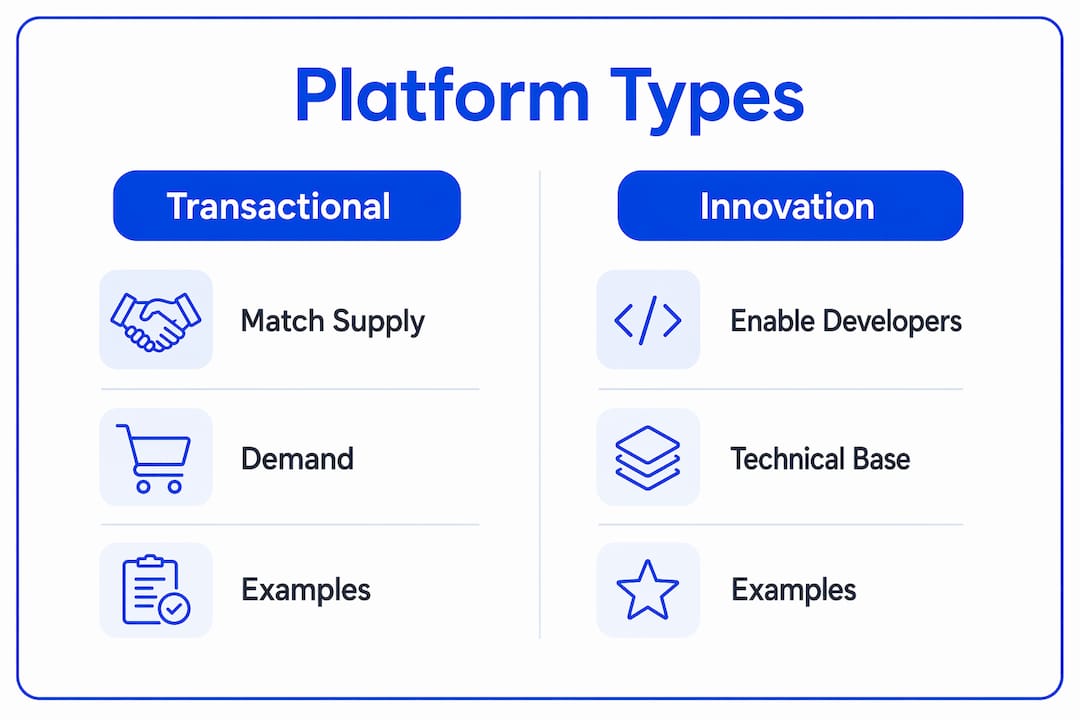
Transactional platforms match supply with demand between two or more distinct user groups. Airbnb connects property owners with travellers. The platform itself does not own the rooms; it owns the matching logic and the trust infrastructure. Revenue follows volume, and volume follows network density.

Innovation platforms give third-party developers a technical foundation to build upon. iOS and Android are the clearest examples. Apple sets the rules of engagement, provides APIs and developer tools, and earns a share of every transaction that flows through the App Store. The platform grows smarter and more valuable with every new application added.
Orthogonal platforms are the least understood archetype. They enter a market by offering a core service at cost or below, then monetise through an adjacent, unrelated value stream. The primary offering subsidises adoption while the orthogonal revenue stream scales independently.
Most mature platforms are hybrids. Platforms rarely evolve linearly; they often start as single-sided products and add platform logic gradually, combining transaction and innovation functions for maximum value compounding. The table below summarises the key differences.
| Archetype | Core mechanism | Primary value driver | Example |
|---|---|---|---|
| Transactional | Matches supply and demand | Network density | Airbnb |
| Innovation | Enables third-party development | Developer ecosystem | iOS, Android |
| Orthogonal | Subsidises entry, monetises adjacently | Cross-subsidy model | Hardware bundled with services |
| Hybrid | Combines two or more archetypes | Compounding layers | Enterprise industrial platforms |
How platform innovation transforms business models
The shift from a linear value chain to a platform model is not cosmetic. A linear business creates value in sequence: design, manufacture, sell, repeat. A platform creates value in parallel, with every new participant adding to the network rather than consuming from it. That difference compounds over time.
Firms that treat platforms as part of the CEO agenda achieve scalable, defensible growth by turning every participant into a value engine. This is the economics of compounding: each new supplier, developer, or customer makes the platform more attractive to the next one. The competitive moat widens automatically.
The concept of the core interaction sits at the centre of this model. Every platform is built around one repeatable exchange that creates value for both sides. Identifying that interaction precisely is the first design task. Teams that skip it build feature-rich products that nobody adopts at scale.
Governance is the second design task, and it is equally critical. Governance creates speed and trust; leverage layers make reuse the default; and the core interaction aligns teams around a shared purpose. Without governance, platforms attract low-quality participants and erode the trust that makes network effects possible.
Pro Tip: Avoid the feature factory trap. Before adding any new capability to your platform, ask whether it strengthens the core interaction or dilutes it. Most failed platforms died from complexity, not competition.
Successful platform innovation requires orchestration of assets, legacy data, hardware, and ecosystem governance to unlock networked innovation. Industrial platforms such as Siemens Xcelerator illustrate how complex this orchestration becomes beyond consumer-facing models. Consumer app imitation is not a strategy.
What do leading examples of platform innovation look like?
Legacy firms face a specific challenge: they have assets, relationships, and data, but their value chains are linear. The most instructive examples of platform innovation come from established companies that reframed those assets as platform foundations rather than operational inputs.
International Paper's MasterDesign platform is one of the clearest cases. The company codified its R&D knowledge into a shared library accessed by more than 250 global designers, housing 1.8 million designs. That transformed slow, fragmented transactions between R&D, marketing, and clients into a live, collaborative exchange. Client feedback now feeds directly back into the design library, creating a self-improving system.
Eli Lilly's Tempo platform took a different route. Eli Lilly leveraged decades of stakeholder trust to launch a personalised diabetes management platform connecting patients and clinicians via real-time data. The key insight was using existing relationships as idle assets. Rather than building a new audience from scratch, Lilly activated the relationships it already owned.
Both cases illustrate several shared principles:
- Idle assets are the launch fuel. Proprietary data, customer relationships, and institutional knowledge lower the cost of adoption and reduce the chicken-and-egg problem.
- The platform replaces a pain point. MasterDesign replaced fragmented design collaboration. Tempo replaced disconnected diabetes monitoring. Neither was a solution looking for a problem.
- Bi-directional network effects emerge. As more designers use MasterDesign, the library improves. As more patients use Tempo, clinicians gain richer data. Both sides benefit from the other's participation.
- Trust is a structural asset. Eli Lilly's existing clinical relationships made adoption faster than any marketing campaign could have achieved.
The pattern across both cases is what practitioners call the Digital Phoenix Effect: incumbent firms avoid disruption not by defending their existing product lines, but by platformising the assets that competitors cannot easily replicate.
Key strategies for adopting platform innovation
Platform innovation belongs on the CEO agenda, not the CTO's project list. Leadership must design governance, incentives, and interoperability from day one to avoid platform chaos and ensure scale. Treating it as a technology initiative is the most common and most costly mistake.
The practical priorities, in order, are:
- Define the core interaction. Identify the single repeatable exchange that creates value for both sides of your platform. Every subsequent decision flows from this definition.
- Map your idle assets. Audit existing customer relationships, proprietary data, and institutional knowledge. These are your adoption anchors and your competitive moat.
- Build leverage layers. APIs, policy frameworks, and interoperability standards make reuse the default behaviour for participants. Without them, every new use case requires bespoke engineering.
- Design governance as a feature. Set clear rules for who can participate, how disputes are resolved, and how value is shared. Governance is not bureaucracy; it is the trust infrastructure that makes scale possible.
- Measure network externalities. Track cross-side engagement, not just user counts. A platform with 10,000 active participants creating value for each other is healthier than one with 100,000 passive users.
Pro Tip: The chicken-and-egg adoption problem is real. Anchor your platform launch with idle assets, not with marketing spend. Eli Lilly used existing clinical relationships. International Paper used its R&D library. Find your equivalent before you open the platform to the public.
Managing indirect cross-side network effects is the core of platform thinking. Success depends on orchestrating assets and ecosystem participants effectively, not on building the most features. You can explore how investment platforms apply these principles in practice to see governance and network effects working in a live context.
How does AI accelerate platform innovation?
Generative AI is the most significant accelerator of platform innovation since the smartphone. AI acts as a catalyst by enabling organisational knowledge marketplaces and accelerating internal platform development at a pace that was previously impossible.
Fujitsu's deployment of custom GPTs as an internal platform illustrates the model. Knowledge creators across the organisation publish tools; knowledge consumers access them on demand. The result is an internal innovation platform that compounds in value as more contributors join. It mirrors the App Store model applied to enterprise knowledge.
The broader implications for platform builders are significant:
- AI reduces the cost of building leverage layers by automating API generation, documentation, and testing.
- Generative models enable platforms to personalise the core interaction at scale, increasing engagement on both sides.
- The expansion of AI-powered customisable tools by major brands parallels the early Apple App Store model, showing how innovation platforms merge rules of engagement with communities to enhance user experience.
The firms that will lead the next decade are those that treat AI not as a product feature but as a platform layer. That means building the governance, APIs, and incentive structures that allow AI capabilities to compound across an ecosystem, rather than deploying isolated AI tools within a linear product. For a practical view of how AI is reshaping platform economics, the role of AI in crowdfunding offers a grounded, sector-specific perspective.
Key takeaways
Platform innovation is a leadership strategy, not a technology project, and its success depends on governance, core interaction design, and the activation of idle assets before any marketplace is built.
| Point | Details |
|---|---|
| Platform archetypes differ fundamentally | Transactional, innovation, and orthogonal platforms each create value through distinct mechanisms. |
| Core interaction design comes first | Every platform must identify its repeatable value exchange before adding features or participants. |
| Idle assets solve the adoption problem | Existing relationships and proprietary data lower adoption barriers more effectively than marketing spend. |
| Governance is a structural feature | Incentive design, participation rules, and interoperability frameworks must be built from day one. |
| AI compounds platform value | Generative AI accelerates leverage layer development and personalises core interactions at scale. |
Why leadership is the real platform innovation challenge
I have watched organisations invest heavily in platform technology and produce nothing of lasting value. The pattern is consistent: the technology works, but the leadership model does not change. Executives approve a platform initiative, hand it to the technology team, and expect a marketplace to emerge. It does not.
The uncomfortable truth is that platform innovation fails at the governance layer far more often than at the technical layer. Incentive structures are designed as afterthoughts. Participation rules are vague. The core interaction is never properly defined, so every team builds towards a different goal. The result is a sophisticated product that nobody adopts at scale.
What I find genuinely exciting is how legacy firms like International Paper and Eli Lilly have shown that you do not need to be a technology company to build a successful platform. You need to understand your idle assets, design your governance with the same rigour you apply to your financial controls, and treat the platform as a business model, not a feature. That shift in mindset is the hardest part, and it belongs on the CEO's desk, not the CTO's backlog.
The firms that get this right build compounding advantages that are extraordinarily difficult to replicate. The firms that get it wrong spend years building features for a platform that never achieves network density. The difference is almost always leadership clarity, not technical capability.
— Jevgenijs
Crowdinform: your platform for smarter investment decisions
Understanding platform innovation is one thing. Applying it to your investment decisions is where the real advantage lies. Crowdinform aggregates reviews and data from more than 500 European crowdfunding platforms, giving you a clear, AI-assisted view of where platform-driven investment opportunities are emerging.
Whether you are assessing a new crowdfunding platform's governance model or evaluating which projects have the strongest network fundamentals, Crowdinform's AI copilot helps you cut through the noise. Explore platform investment insights and see which European platforms are building the kind of compounding ecosystems that deliver durable returns. The data is live, the reviews are real, and the AI tools are built for investors who think in systems.
FAQ
What is platform innovation in simple terms?
Platform innovation is the process of transforming a business from a single product into a multi-sided ecosystem where external participants create additional value. It replaces linear value chains with compounding networks that grow stronger as more participants join.
What are the three main types of platform innovation?
The three archetypes are transactional platforms (matching supply and demand), innovation platforms (enabling third-party development), and orthogonal platforms (subsidising entry and monetising through adjacent revenue streams). Most mature platforms combine elements of more than one archetype.
Why do so many platform innovation initiatives fail?
Many platform initiatives fail because they attempt to build marketplaces before establishing the core value interaction and governance that justify the platform's existence. Leadership treats it as a technology project rather than a business model transformation.
How do legacy companies succeed with platform innovation?
Legacy firms succeed by treating existing assets, such as customer relationships, proprietary data, and institutional knowledge, as idle assets that solve the adoption problem. Eli Lilly's Tempo platform and International Paper's MasterDesign both used this approach to overcome early adoption barriers.
How does AI fit into platform innovation?
Generative AI acts as a platform accelerator by enabling knowledge marketplaces, automating leverage layers such as APIs, and personalising core interactions at scale. Fujitsu's internal GPT platform demonstrates how AI can function as an innovation platform within an existing enterprise structure.