
An investment platform workflow is the end-to-end process that takes you from account registration through identity verification, account funding, investment selection, trade execution, and ongoing portfolio monitoring. For European investors exploring crowdfunding real estate, startups, and alternative assets, understanding this process is the difference between smooth capital deployment and frustrating delays. Platforms like AI SHIP and Invent Cloud have demonstrated that structured, automated workflows reduce processing errors significantly and accelerate time-to-investment. This guide breaks down each phase, the tools that support it, and the practical steps you can take to get the most from any platform you choose.
What are the key phases of an investment platform workflow?
The investment platform workflow follows a defined cycle, and knowing each phase helps you anticipate what is required at every step.
1. Registration and digital onboarding
Every workflow begins with identity verification. KYC/AML verification typically takes between 15 minutes and 2 business days, depending on document complexity. This phase involves identity checks, proof of address validation, and screening against international sanctions lists. Platforms that use automated document parsing, such as those built on Invent Cloud's workflow engine, complete this stage faster than those relying on manual review.
2. Account funding and money movement
Once verified, you fund your account. Funds often take 1 to 3 business days to become available for investment because they pass through omnibus accounts or virtual IBANs before reaching the platform's asset pool. This clearing delay is standard across European platforms and is not a sign of a problem. Managing your timing expectations here prevents unnecessary support queries.
3. Investment selection and order execution

This is where you browse available projects, review risk ratings, and commit capital. For crowdfunding real estate and startup deals, this phase includes reviewing offering documents, completing suitability questionnaires, and digitally signing subscription agreements. Platforms with integrated e-signature modules and pre-populated investor profiles reduce friction at this stage considerably.
4. Settlement and confirmation
After order execution, settlement confirms your ownership position. For alternative assets, this can take longer than for listed securities because documentation is non-standard and often requires manual compliance sign-off.
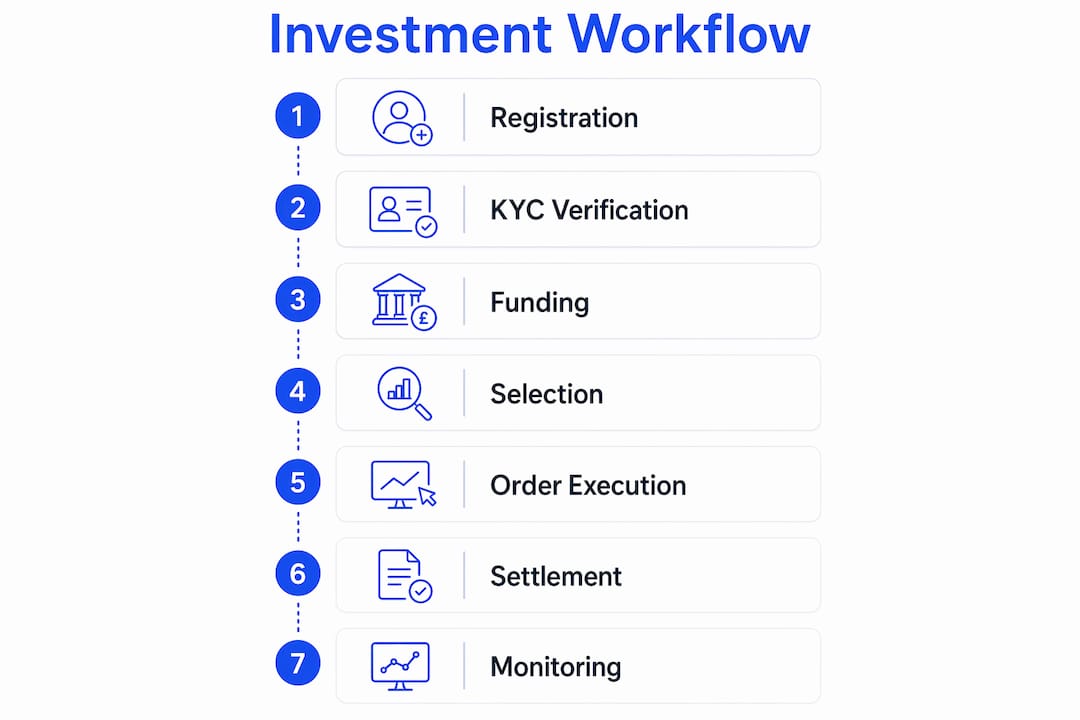
5. Portfolio monitoring and reporting
The final phase is continuous. Monitoring and rebalancing are crucial for maintaining portfolio effectiveness, and the best platforms automate alerts, generate performance reports, and flag positions that have drifted from your target allocation.
Pro Tip: Before funding any account, prepare a dedicated folder containing your passport, proof of address dated within three months, and bank statement. Having these documents ready reduces your onboarding time to the lower end of the verification window.
| Phase | What to expect |
|---|---|
| KYC/AML onboarding | Identity and address checks; 15 minutes to 2 business days |
| Account funding | Clearing via omnibus or virtual IBAN; 1 to 3 business days |
| Investment selection | Suitability check, document review, e-signature |
| Settlement | Ownership confirmation; variable for alternative assets |
| Portfolio monitoring | Automated alerts, NAV updates, rebalancing triggers |
What tools and automation technologies support efficient investment workflows?
Financial platform automation is the engine behind every fast, compliant investment workflow. Without it, even well-designed platforms collapse under the weight of manual document checks and compliance reviews.
AI-powered validation and exception handling
Platforms built on AI agents, such as the AI SHIP investor portfolio management system, use rule-based triggers to validate submissions in real time. When a document fails a check, the system flags it immediately rather than queuing it for a human reviewer. This cuts exception handling time from days to hours.
Integrated compliance and e-signature modules
The most capable platforms combine portfolio dashboards, compliance modules, and e-signature tools in a single interface. Investors on these platforms complete the entire subscription process without leaving the platform or printing a single document. This matters particularly for startup and real estate crowdfunding deals, where subscription documents can run to dozens of pages.
Automated NIGO detection
Workflow automation implementation typically takes 2 to 4 weeks and significantly reduces processing times and errors caused by incomplete submissions. The primary target is lowering the Not In Good Order (NIGO) rate, which measures how often submissions arrive with missing or mismatched information. Platforms that run automated NIGO detection catch errors before they reach the compliance team, keeping the workflow moving.
Workflow orchestration across systems
Advanced platforms connect their workflow engine to CRM systems, custodian records, and portfolio management tools. When you update your address or risk profile in one place, the change propagates across all connected systems automatically. This prevents the data inconsistencies that trigger manual compliance escalations.
Pro Tip: When evaluating platforms, ask specifically whether their compliance module is integrated or bolted on. Integrated compliance means fewer handoffs and faster approvals. Bolted-on compliance means your application may sit in a queue between two separate systems.
The investment tracking system you choose should offer real-time dashboards, automated reporting, and clear audit trails. These features are not luxuries for sophisticated investors. They are the baseline for anyone managing a portfolio across multiple crowdfunding platforms.
How do crowdfunding platforms handle alternative asset workflow challenges?
Alternative investments, including crowdfunding real estate, startup equity, and private debt, introduce workflow complexity that standard retail platforms are not built to handle. The trading interface is less critical than backend workflows, which must support complex fund lifecycle needs like waterfall structures and capital calls. This is the defining difference between a platform built for listed equities and one built for alternatives.
Suitability questionnaires and risk profiling
European regulations require platforms to assess whether each investment is appropriate for each investor. For alternative assets, this means detailed suitability questionnaires covering investment experience, financial situation, and risk tolerance. Inconsistent investor responses on risk surveys frequently cause manual compliance escalations, slowing the entire workflow. The fix is straightforward: answer every question consistently and accurately, and review your profile before each new investment category you enter.
Capital calls and waterfall structures
Real estate and private equity deals on crowdfunding platforms often involve staged capital calls rather than a single upfront investment. Platforms that handle these structures well maintain a clear schedule of call dates, automate notifications, and provide a dedicated capital call dashboard. Platforms that do not handle them well send you a PDF by email and hope for the best.
Common bottlenecks for alternative asset investors
- Documentation mismatches between your KYC file and the subscription agreement (name spelling, address format)
- Suitability questionnaire responses that contradict your stated investment experience
- Missing or expired proof of address documents at the point of subscription
- Manual compliance reviews triggered by non-standard asset structures
- Delays in settlement caused by custodian handoffs for non-listed assets
Practical steps to avoid delays
- Keep all identity documents current and stored in a single accessible folder
- Complete your regulated platform onboarding carefully, treating the suitability questionnaire as a legal document
- Confirm your bank account details match your KYC records exactly
- Read the offering document before signing, not after
Incomplete or mismatched KYC/AML documents cause most onboarding delays. Investors who maintain a repository of recent, compliant documents reduce their NIGO rate and speed up approvals across every platform they use.
How to manage and monitor investments using platform workflow features?
Effective portfolio management is not a one-time task. Investment workflows are cyclical processes designed to eliminate emotional bias through automation and disciplined monitoring. The platforms that support this best give you the tools to act on data rather than instinct.
1. Use real-time portfolio dashboards
The best platforms display net asset value (NAV), unrealised gains, income received, and risk exposure in a single dashboard. For investors holding positions across crowdfunding real estate, startup equity, and P2P loans, this consolidated view is the only way to understand your true portfolio position at any given moment.
2. Run scenario analyses before committing capital
Experts advise using platform scenario simulations to build diversification against market volatility. A "what-if" tool lets you model the impact of a single platform default, an interest rate change, or a currency movement on your overall portfolio before you make a commitment. Not every platform offers this, but it is worth prioritising when you compare options.
3. Rebalance regularly to control drift
Asset allocation drifts as individual positions perform differently. A portfolio that started at 40% real estate, 40% P2P loans, and 20% startup equity can shift significantly within 12 months as some positions mature and others grow. Automated rebalancing alerts tell you when a position has moved beyond your target band, prompting action before the drift becomes a structural problem.
4. Automate alerts and reporting
Set up automated notifications for capital call dates, maturity dates, interest payment schedules, and platform announcements. Manual tracking across multiple platforms is error-prone. Automation removes the risk of missing a capital call or failing to reinvest a matured position.
| Feature | Benefit for alternative investors |
|---|---|
| Real-time NAV dashboard | Consolidated view across asset classes |
| Scenario simulation tools | Pre-commitment risk modelling |
| Rebalancing alerts | Prevents allocation drift |
| Automated reporting | Reduces manual tracking errors |
For deeper guidance on portfolio diversification tools, Crowdinform's resource library covers practical frameworks for European investors managing multi-platform portfolios.
Key takeaways
A well-structured investment platform workflow covering onboarding, funding, execution, and monitoring is the foundation of consistent, compliant investing in crowdfunding real estate, startups, and alternative assets.
| Point | Details |
|---|---|
| Onboarding speed depends on documents | Keep current KYC documents ready to reduce verification time to 15 minutes. |
| Automation reduces NIGO errors | Platforms with integrated compliance modules catch submission errors before they reach reviewers. |
| Alternative assets need backend depth | Waterfall structures and capital calls require platforms built for non-standard lifecycles. |
| Consistent risk profiling matters | Contradictory suitability responses trigger manual reviews and slow your workflow. |
| Monitoring must be continuous | Automated dashboards and rebalancing alerts prevent portfolio drift and missed capital calls. |
Why the workflow matters more than the interface
By Jevgenijs
After reviewing hundreds of European crowdfunding platforms through Crowdinform, the pattern is consistent: investors focus on the front end and underestimate the back end. They compare interest rates, minimum investments, and platform design. They rarely ask about NIGO rates, compliance module architecture, or custodian handoff times.
The uncomfortable truth is that backend compliance and auditability define platform quality more than front-end ease of use, especially for alternative investments. A beautiful dashboard that sits on top of a manual compliance process will frustrate you every time you try to invest in a new asset class or update your profile.
What I have found actually works is treating your first investment on any new platform as a workflow test. Use a small amount, complete every step deliberately, and note where the process slows down or asks for information you were not expecting. That experience tells you more about the platform's operational quality than any marketing page.
Professional investment platforms may charge up to 5.1% in advisory-related costs, so understanding what you are paying for in terms of workflow quality is genuinely worth the effort. A platform that charges slightly more but processes your investments in hours rather than days has a real financial value that fee comparisons miss entirely.
My advice: learn the platform before you scale your investment. Read the FAQ, complete the suitability questionnaire carefully, and test the document upload process. The investors who get the most from alternative investment platforms are the ones who treat the workflow as part of the investment process, not an obstacle to it.
— Jevgenijs
Explore crowdfunding investments with Crowdinform

Crowdinform aggregates and reviews over 500 European crowdfunding platforms, covering loans (P2P), real estate, and startups, so you can compare platform workflows, fees, and project quality before committing capital. The built-in AI copilot analyses individual projects and generates structured reviews, giving you a research advantage that would otherwise take hours of manual work. Whether you are new to alternative investments or expanding an existing portfolio, explore investment opportunities across Europe's most active crowdfunding platforms through Crowdinform's verified data and community reviews. For investors focused on startup equity, the startup investment guide covers the full workflow cycle from account setup through ongoing portfolio management.
FAQ
What is an investment platform workflow?
An investment platform workflow is the structured sequence of steps covering registration, KYC/AML verification, account funding, investment selection, order execution, settlement, and portfolio monitoring. It defines how efficiently and compliantly a platform moves you from sign-up to active investor.
How long does KYC verification take on investment platforms?
KYC/AML verification takes between 15 minutes and 2 business days depending on document complexity and whether the platform uses automated or manual review. Submitting high-resolution, current documents reduces verification time to the lower end of that range.
Why do my funds take so long to become available after transfer?
Funds typically take 1 to 3 business days to become available because they pass through omnibus accounts or virtual IBANs before reaching the platform's investment pool. This clearing process is standard across European platforms and is not a platform-specific delay.
What causes delays in alternative investment workflows?
The most common causes are documentation mismatches in KYC files, inconsistent responses on suitability questionnaires, and manual compliance reviews triggered by non-standard asset structures such as capital calls or waterfall distributions. Keeping documents current and answering risk profile questions consistently prevents most of these delays.
How do I compare investment platform workflows before choosing a platform?
Focus on backend features rather than interface design: check whether compliance is integrated or separate, whether the platform supports automated NIGO detection, and how it handles capital calls for alternative assets. Crowdinform's platform reviews cover these operational details across 500 European crowdfunding platforms.


