
Bonus en cours
- Niveau de risque
- Élevé
- Risque-rendement
- Moyen
- Dès
- €10
Lien affilié · capital à risque
Voir 11 projets →Des questions sur l'investissement ? Demandez au guide IA.
Bonjour ! Je suis le guide IA de Crowdinform.
Connectez-vous gratuitement pour interroger le guide IA sur les plateformes, les projets et vos plans.
Les réponses proviennent des données vérifiées de Crowdinform. Information, et non conseil en investissement personnalisé.
Recherche en cours… Une erreur s'est produite. Veuillez réessayer. {n} questions restantes aujourd'hui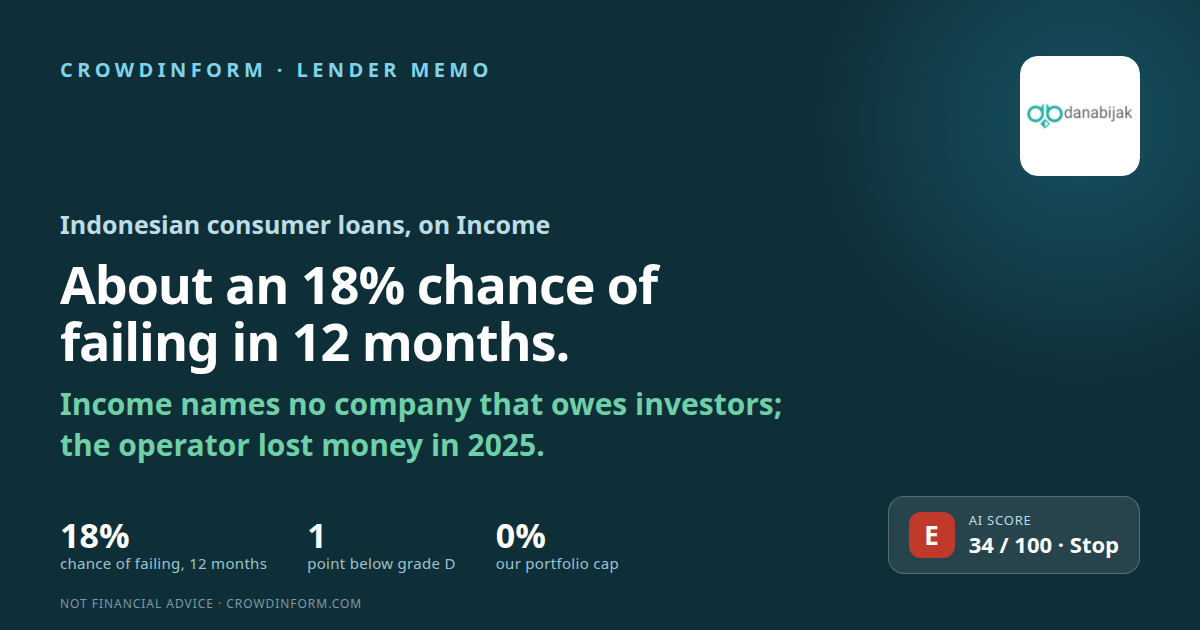
Indonésie
Capital à risque. Le taux est convenu, et non garanti : si un emprunteur fait défaut, vous pouvez perdre une partie ou la totalité de votre argent.
Notre IA attribue à ce projet 34 sur 100 : Faible. Comment fonctionne le score IA
Information, et non conseil en investissement personnalisé. Le score IA évalue les documents publiés par la plateforme, peut se tromper et ne prédit pas les rendements.
This memo is unusual, and the reason comes first. Income’s page for Danabijak names no company that owes investors. It says: “The loans are secured by assignment agreement to the investor with a local SPV controlling the cashflow.” An SPV is a special-purpose company set up to hold loans or cash. The page does not name it, does not say who owns it, and has no word “buyback” for this lender; Income’s general pages say every loan carries a buyback obligation of the lender, which is the lender’s promise, not Income’s. The only accounts Income publishes are those of PT Digital Micro Indonesia, the company licensed by Indonesia’s financial regulator (OJK) to run the Danabijak platform. We call it the operator. By its own accounts it is an agent: it connects borrowers with lenders, earns a commission, and keeps the loans off its balance sheet (“Credit risk or risk of default on loans is fully borne by the lender”). Those accounts show no debt to an SPV, to Income or to investors. So every figure and both charts below describe the operator and are labelled so. They are not the accounts of whoever owes investors, and we cannot say who that is. We have not yet asked Income. The chain as far as the documents go: investor on Income, then “a local SPV” (unnamed), then loans to borrowers in Indonesia made through the Danabijak platform, in rupiah. Income’s monthly post for October 2026 gives shares of its outstanding €33,720,192 for its five largest lenders; Danabijak is not among them, and Income publishes no amount per lender that we could read. Income’s page for Danabijak shows “Loan Portfolio € 788 K”, without a date or a definition. Income is not regulated by a financial authority. This memo asks one question: what is the chance that investors in Danabijak loans are not paid in the next 12 months, and why.
We ask six questions about every lender: does it earn enough, are its loans being repaid, does it have enough of its own money to absorb losses, how risky is its country, can we trust its numbers, and are there warning signs. Each is scored 1 to 5 and weighted. The four cards show how they land. Here five of the six score 2 and earnings scores 1. For the company that owes investors there is no evidence, which gives 2 at most on earnings, loans and cushion; on earnings the only evidence we hold is the operator’s, and its latest year is a loss. Together they give 34 out of 100, which means about 18%. The grade is E, 1 point below D (D starts at 35), so it is within 3 points of the next grade. The sub-score that decides the letter is earnings: scored 2 instead of 1, the total would be 40, a D, and the answer about 12%. Any one of the other five scores one step higher would also reach D (between 35 and 38).
For the company that owes investors: no evidence. The operator lost Rp 828,437,779 in 2025 after three small profits, with Rp 2,000,000,000 of software costs recorded as an asset instead of a cost; we score earnings 1 out of 5. Its own money, Rp 13,894,191,342, includes Rp 5,045,175,000 awaiting the regulator’s approval.
No evidence either way. The loans are not in the operator’s accounts, which give no late loans, no losses and nothing set aside. This question gets our “no evidence” score of 2.
Indonesia is grade D in our country memo of 21 September 2026: the regulator sets the price of online loans, defaults are rising, and the rupiah keeps losing ground to the euro. Investors are owed euros; the loans are in rupiah.
Three audit opinions without reservation, on the operator. But they are not on the company that owes investors, there is no 2024 report, the 2024 comparative figures do not tie, and a fine reported in the press is not in the accounts.
L'analyse complète couvre l'emprunteur ou l'entreprise, la garantie, les flux de trésorerie, les risques et un verdict. Connectez-vous pour la lire.
Information, et non conseil en investissement personnalisé. Le score IA évalue les documents publiés par la plateforme, peut se tromper et ne prédit pas les rendements.
Connectez-vous pour interroger l'IA sur les documents de ce projet.
Connexion👍 Oui · 0 👎 Non · 0
Lien affilié · capital à risque
Voir 11 projets →Mintos
Mintos
Commentaires · 0