
Reward-based crowdfunding is defined as a funding model where individuals contribute money to a project in exchange for non-financial rewards such as products, experiences, or recognition. Unlike equity crowdfunding, backers receive no ownership stake. Platforms like Kickstarter and Indiegogo have made this model mainstream, with the market reaching $1.03 billion in transaction value in 2024. That figure reflects genuine demand from entrepreneurs who want to raise capital without giving away equity. Kickstarter alone has funded over 270,000 projects, cementing reward crowdfunding as a dominant early-stage financing route.
What is reward-based crowdfunding and how does it work?
Reward-based crowdfunding operates as both a financing mechanism and marketing tool, allowing creators to validate product demand while raising capital simultaneously. The platform acts as an intermediary, not a retailer. Creators set a funding goal, define reward tiers, and publish a campaign page. Backers pledge money in exchange for a promised reward, typically the product itself or an exclusive experience.
Here is how a typical campaign unfolds in practice:
- Define your funding goal. Most campaigns target between $10,000 and $500,000, depending on product complexity and production costs. Setting a realistic minimum is more important than setting an ambitious ceiling.
- Choose a funding model. The all-or-nothing model means you only receive funds if you hit your goal. This creates social proof and urgency, which encourages backers to commit once early momentum builds. Flexible funding lets you keep whatever is raised, but it reduces that psychological pressure on backers.
- Structure reward tiers. Tiers typically range from a simple thank-you at £5 to a full product bundle or exclusive experience at £200 or more. Each tier should feel proportionate to the pledge amount.
- Launch and promote. Campaigns that launch with pre-commitments from personal networks gain early traction, which feeds platform algorithms and attracts organic backer interest.
- Manage fulfilment. Once the campaign closes, creators must deliver rewards on time and within budget. This is where many campaigns struggle, particularly with physical goods.
Campaigns typically take 2 to 4 weeks to prepare for launch, which is significantly faster than the regulatory process required for equity crowdfunding. That speed is one of the model's most practical advantages for pre-launch startups.

What are the benefits and drawbacks for entrepreneurs?
Reward-based crowdfunding offers a genuinely attractive set of advantages for early-stage creators, but it carries real risks that are easy to underestimate.
Benefits worth knowing:
- No equity dilution. Backers receive rewards or perks, not ownership, which means you retain full control of your company. This is a significant advantage over equity crowdfunding for founders who are not yet ready to take on investors.
- Market validation. A funded campaign proves that real people will pay for your product before you commit to full production. This is ideal for pre-launch startups testing concepts with minimal upfront investment.
- Community building. Backers become advocates. They share campaigns, provide feedback, and often become loyal customers. That community has long-term marketing value beyond the campaign itself.
- Pricing intelligence. Reward tiers function as a live pricing experiment. You can observe which pledge levels attract the most backers and adjust your commercial pricing accordingly.
Drawbacks to plan for:
- Low success rates. The average campaign success rate is 39.6%, meaning more than half of all campaigns fail to reach their goal. In competitive sectors like video games, that rate drops to around 37%.
- Fulfilment risk. Promising physical rewards creates manufacturing and shipping obligations that can erode your entire budget if costs are underestimated.
- Reputational exposure. A failed or delayed delivery damages trust publicly, on the very platform where your campaign lives.
Pro Tip: Set your minimum funding goal to cover only what you genuinely need to deliver rewards. Campaigns that overshoot their goal by a large margin often struggle with fulfilment costs that were never budgeted for.
What types of rewards work best for campaign success?
The design of your reward tiers is not a secondary concern. It directly determines whether backers feel motivated to pledge and whether you can actually deliver what you promise.
| Reward type | Advantages | Challenges |
|---|---|---|
| Physical product (the item itself) | High perceived value, strong backer motivation | Manufacturing delays, shipping costs, customs |
| Digital rewards (in-game perks, digital art, early access) | Low fulfilment cost, instant delivery | Lower perceived value for some audiences |
| Exclusive experiences (factory tours, creator calls) | Unique and memorable, low cost | Difficult to scale, time-intensive |
| Limited edition merchandise | Creates urgency and collector appeal | Inventory risk if demand is misjudged |
Physical rewards can become a financial liability when manufacturing and ongoing shipping costs exceed what was budgeted during the campaign. Experienced creators increasingly prioritise digital rewards to protect margins. A video game campaign, for example, might offer in-game character names, digital soundtracks, or early beta access at higher tiers, keeping fulfilment costs near zero.
Campaigns also perform better when rewards align with social or environmental values. A sustainable product campaign that offers rewards tied to its mission, such as a tree planted in a backer's name, attracts supporters who are motivated by impact, not just the product itself. This lowers perceived risk and increases pledge conversion. You can explore how socially aligned rewards connect to broader sustainable crowdfunding trends.
Pro Tip: Offer one digital reward tier at every campaign, even if your product is physical. It gives budget-conscious backers a way to support you without adding to your fulfilment burden.
How does reward-based crowdfunding compare to equity crowdfunding?
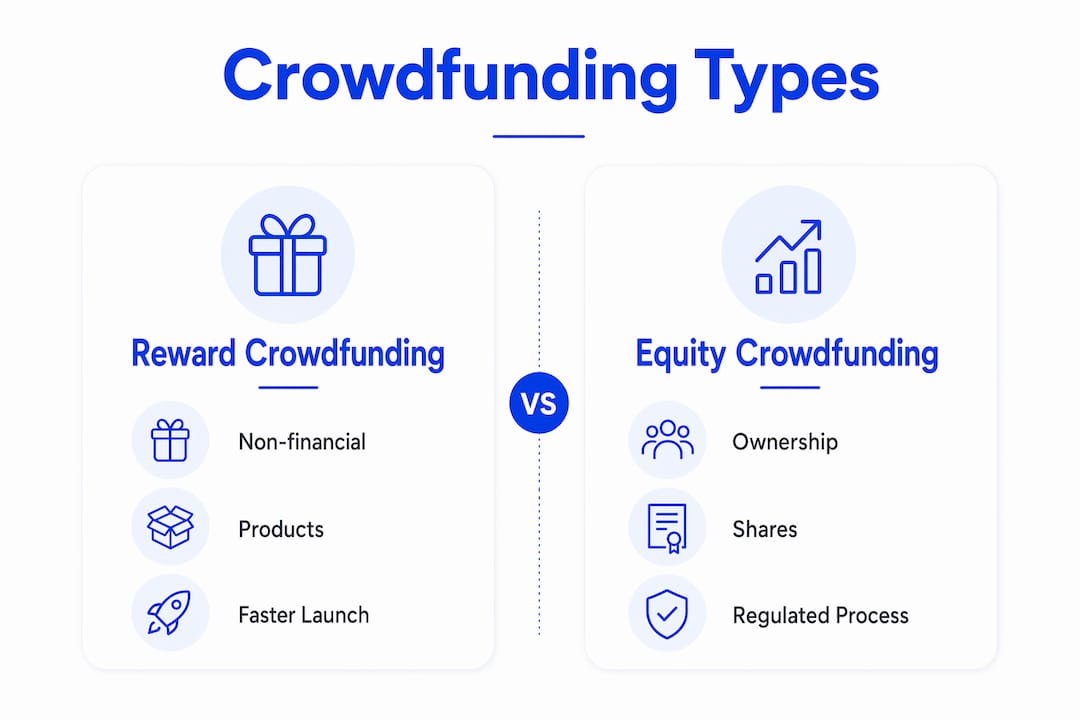
Understanding the difference between crowdfunding types is critical before you choose a model. The two most common options for startups are reward-based and equity crowdfunding, and they serve different purposes at different stages.
| Aspect | Reward crowdfunding | Equity crowdfunding |
|---|---|---|
| What backers receive | Products, perks, or experiences | Ownership shares in the company |
| Regulatory complexity | Low. No securities law involvement | High. Requires compliance with financial regulations |
| Typical funding range | £10,000 to £500,000 | £100,000 to several million |
| Best suited for | Pre-launch products, concept validation | Growth-stage startups seeking investment |
| Equity dilution | None | Yes, founders give up a percentage |
| Backer relationship | Customer or supporter | Investor with legal rights |
Reward crowdfunding is the right choice when you have a product concept and want to test demand before committing to production. Equity crowdfunding suits companies that have already validated their product and need growth capital in exchange for a share of future returns. The regulatory gap is significant. Reward campaigns operate outside securities law in most jurisdictions, which means you can launch in weeks rather than months. For a deeper look at how regulated crowdfunding platforms differ across Europe, Crowdinform's platform guide covers the key distinctions.
Choosing the wrong model at the wrong stage is a common and costly mistake. A startup that raises equity too early gives away ownership before its valuation reflects the product's true potential.
How to set up a successful reward crowdfunding campaign
Preparation determines outcomes far more than the campaign page itself. The most common reason campaigns fail is not a weak product. It is poor planning before launch.
- Build your audience before you launch. Achieving early campaign momentum via pre-commitments from your personal network is the single most reliable predictor of success. Platform algorithms surface campaigns that gain traction quickly. If your first 48 hours are slow, your campaign becomes invisible.
- Use phased funding goals. Experts recommend segmented phased goals to make large financial targets feel achievable. A campaign targeting £100,000 might set a minimum goal of £30,000 to cover initial production, with stretch goals unlocking additional features.
- Budget for fulfilment from day one. Calculate your per-unit production cost, packaging, and shipping before you set a single reward tier price. Many creators discover post-campaign that their reward pricing did not account for international shipping or import duties.
- Use a pledge manager. Tools like BackerKit or Pledge Manager help creators manage shipping logistics post-campaign, collect final backer details, and handle tax complexities. This prevents the budget overruns that sink otherwise successful campaigns.
- Communicate consistently. Backers who receive regular updates are significantly less likely to request refunds or post negative reviews. Weekly updates during fulfilment build trust and reduce support requests.
Pro Tip: Send a campaign preview to your 20 closest contacts at least two weeks before launch. Their feedback will surface problems with your reward tiers and campaign copy before they become public.
Key takeaways
Reward-based crowdfunding succeeds when campaign design, reward fulfilment planning, and pre-launch audience building are treated as equally important as the product itself.
| Point | Details |
|---|---|
| Definition and scale | Reward crowdfunding exchanges perks for pledges, with the market valued at $1.03 billion in 2024. |
| Success rates are modest | Only 39.6% of campaigns succeed on average, making preparation and pre-launch momentum critical. |
| No equity dilution | Creators retain full ownership, making this model ideal for pre-launch concept validation. |
| Reward design matters | Digital rewards reduce fulfilment risk; socially aligned rewards improve backer conversion rates. |
| Fulfilment planning is non-negotiable | Use pledge managers and phased goals to avoid post-campaign budget overruns. |
Why reward crowdfunding is more than just a funding tool
I have reviewed hundreds of crowdfunding campaigns across Europe through Crowdinform's platform, and the pattern is consistent. The campaigns that struggle are rarely the ones with weak products. They are the ones where the creator treated the campaign as a funding exercise rather than a launch strategy.
Reward-based crowdfunding forces you to articulate your value proposition clearly, price your product publicly, and commit to a delivery timeline. That discipline is genuinely useful, even if the campaign falls short of its goal. The market validation alone, knowing whether real people will pay for your idea before you invest in production, is worth the effort of running a campaign.
What I find most overlooked is reward tier design. Creators spend weeks on their campaign video and days on their reward tiers. That ratio should be reversed. A poorly priced physical reward can turn a successful campaign into a financial loss. I have seen creators raise three times their goal and still lose money because they underestimated fulfilment costs.
My honest advice: treat your minimum funding goal as a break-even calculation, not an aspiration. Set it at the exact amount you need to deliver your rewards and cover platform fees. Everything above that is genuine upside. And if you are unsure whether reward crowdfunding is the right model for your stage, compare it carefully against different crowdfunding types before committing.
— Jevgenijs
Explore crowdfunding opportunities with Crowdinform
Crowdinform aggregates and reviews over 500 crowdfunding platforms across Europe, giving entrepreneurs and investors a single place to compare options, read verified platform reviews, and explore active projects. Whether you are planning your first reward campaign or evaluating platforms for your next launch, Crowdinform's AI copilot helps you analyse projects and identify the best fit for your goals.
Find here a list of the best reward-based crowdfunding platforms.

The platform covers reward-based, equity, lending, and real estate crowdfunding models, so you can make informed decisions across all crowdfunding investment types. If you are an entrepreneur at the concept stage, Crowdinform's project data and platform comparisons give you the context to choose the right model and the right platform from the start. Start exploring today and put your next campaign on solid ground.
FAQ
What is reward-based crowdfunding in simple terms?
Reward-based crowdfunding is a model where people pledge money to a project in exchange for non-financial rewards such as the finished product, exclusive merchandise, or experiences. Backers receive no equity or financial return.
How does reward-based crowdfunding differ from equity crowdfunding?
In reward crowdfunding, backers receive products or perks and hold no ownership stake. In equity crowdfunding, backers receive shares in the company and become investors with legal rights and financial expectations.
What is the average success rate for reward crowdfunding campaigns?
The average success rate across reward crowdfunding campaigns is approximately 39.6%, with some sectors such as video games sitting slightly lower at around 37%.
Which platforms are most popular for reward-based crowdfunding?
Kickstarter and Indiegogo are the two dominant platforms globally. Kickstarter has funded over 270,000 projects and mobilised more than $8.4 billion in pledges since its launch.
Is reward-based crowdfunding suitable for early-stage startups?
Yes. Reward crowdfunding is particularly well suited to pre-launch startups because it tests product concepts with real buyers, requires no equity dilution, and carries significantly less regulatory complexity than equity crowdfunding.
Recommended
- Crowdfunding best practices 2026: a European investor's guide - Article | Crowdinform Investment Guides crowdfunding how to
- What is debt crowdfunding? A guide for investors - Article | Crowdinform Investment Guides Invest in loans
- Regulated crowdfunding platforms: your guide for 2026 - Article | Crowdinform Investment Guides Crowdfunding
- Crowdfunding ROI explained: Maximising returns in Europe - Article | Crowdinform Investment Guides Crowdfunding


