
Reguliert
Bonus läuft
Vorzeitig verkaufbar
- Risikostufe
- Hoch
- Risiko-Rendite
- Mittel
- Start ab
- €50
Empfehlungslink · Kapitalverlustrisiko
42 Projekte ansehen →Fragen zum Investieren? Fragen Sie den KI-Guide.
Hallo! Ich bin der KI-Guide von Crowdinform.
Melden Sie sich kostenlos an, um den KI-Guide zu Plattformen, Projekten und Ihren Plänen zu fragen.
Die Antworten stammen aus den geprüften Daten von Crowdinform. Information, keine persönliche Anlageberatung.
Wird nachgeschlagen… Etwas ist schiefgelaufen. Bitte versuchen Sie es erneut. Heute noch {n} Fragen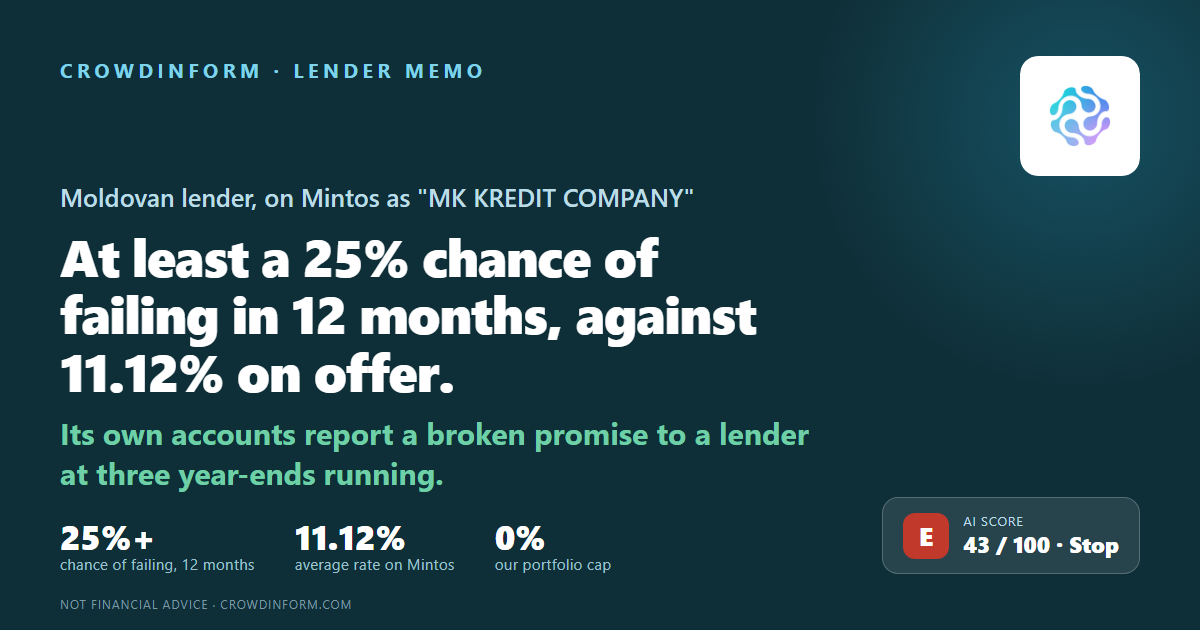
Moldau
Kapitalverlustrisiko. Der Zins ist vereinbart, nicht garantiert: Fällt ein Kreditnehmer aus, können Sie Ihr Geld teilweise oder vollständig verlieren.
Unsere KI gibt diesem Projekt 43 von 100 Punkten: Niedrig. So funktioniert der KI-Score
Informationen, keine persönliche Anlageberatung. Der KI-Score bewertet die von der Plattform veröffentlichten Dokumente, kann falsch sein und sagt keine Renditen voraus.
O.C.N. MK Kredit Company S.R.L. lends to businesses, farmers and homeowners across Moldova from ten branches, with seventy staff. About half its lending has been to farmers. It was founded in 2013 as Credit CMB, traded until recently as Mikro Kapital Company, and is supervised by the National Bank of Moldova. It is wholly owned by ALTERNATIVE, a Luxembourg fund that is also its largest lender. Mintos investors buy its business loans. This memo asks one question: what is the chance it fails to pay its lenders back in the next 12 months, and why.
This is the only memo in our set where the grade does not come from the marks. Note 19 of the 2024 accounts, audited by Crowe, says in terms: "At 31.12.2024, some funds were classified as short term, because of breach of a financial covenant." The 2023 accounts, audited by Grant Thornton, report a breach too, and so do the 2025 financial statements, which Mintos lists as audited: "At 31.12.2025, some funds were classified as short term, because of breach of a financial covenant." A covenant is a promise to a lender about how the business will be run, and breaking one normally lets that lender ask for its money back early. Under our method a breach sets the answer to at least 1 in 4 and the grade to E, whatever the other marks say.
For the 2023 breach, the lender Lendahand granted a waiver in April 2024. No waiver is disclosed for the 2024 or the 2025 breach. The 2024 and 2025 accounts also say the company breached covenants with other creditors whose contracts allow penalties rather than early repayment.
What makes the answer uncomfortable rather than simple is that the rest of the company is not in crisis. Owners' money is 160.6m lei, a third of everything it owns — a thicker cushion than almost any lender we cover. It made a profit in all three years. It has paid no dividend since 2022. The problem is not solvency. It is that cash was 9.0m lei against 314.0m lei of borrowings, that the lending is barely profitable now, and that a promise to a lender has been broken at three year-ends in a row.
Six things would stop us scoring at all and send the answer straight to E — a default, a missed payment to a platform, a regulator pulling a licence, an auditor doubting the company can continue, a broken promise to a lender, or accounts we cannot rely on. One of them does apply, and it is why the answer is an E. It is the fifth one, and section 4 says exactly what it rests on and as of when. Two things would pull the answer the other way, a guarantee from a stronger owner or a credit rating. Neither applies here.
A thick cushion and a thin profit. Keeps 2.96 lei of every 100, down from 11.01 in 2023. Cash covers under 3% of borrowings.
Shrinking and being cleaned. 115m lei written off in two years. Loans over 90 days late rose from 5.32% to 6.66%.
One of Europe's poorest economies, next to a war, with a farm book at the weather's mercy. Two drought years in a row.
The covenant breaches, a central-bank fine it is still appealing, and lenders that have been reluctant to resume financing.
Every investment carries risk, and risk is not really a letter or a mark out of ten. It is two plain questions: how likely is it that this company fails, and how much of your money would you lose if it did. Put those together and you can see whether the reward is worth it.
For MK Kredit Company: at least a 25% chance of failing in the next 12 months. If we assume about 30% of the money comes back in that case, the risk costs roughly 17.5% a year. Mintos showed an average rate of 11.12% on these notes on 9 November 2026. So the risk costs well over what the rate pays, and the gap is not close. Note the words "at least": the veto sets a floor on the chance of failure, not an estimate of it.
An advertised 10% is what you are promised if everything goes well. What you keep is that rate minus what failures cost you. So the rate on its own tells you very little.
Risk cost = chance of failing × share of your money you would not get back. Nobody knows the second number in advance. How much comes back has varied widely from case to case. We use 30% back, 70% lost, as our own working assumption so that memos can be compared with each other — it is not a measured figure, and the answer moves a lot if you choose differently.
Take two imaginary lenders. One pays 14% but has a 17% chance of failing within the year: the risk costs about 11.9% a year, leaving roughly 2%. The other pays 9% with a 2.5% chance: the risk costs about 1.8%, leaving about 7%. The lower rate is the better deal. That is the whole idea.
Supervised by the National Bank of Moldova. Founded in 2013 as Credit CMB and known until recently as Mikro Kapital Company. It takes no deposits.
A securitisation fund with over €550m under management, managed since January 2026 by MK Global Kapital and controlled by a Hungarian foundation. It owns all of this company and supplies 48% of its funding.
Ten branches, seventy staff at the end of 2025, and the Cahul branch closed during the year. About half the lending has been to farmers.
About €22.7m. Down from 580m lei of principal at the end of 2023. Income 135.8m lei in 2025, profit 4.0m lei.
Read on 9 November 2026 (€6,984,952; €7.4m on 13 September, €3.7m at the end of 2025), at an average rate of 11.12%. Business loans from Moldova. Mintos Risk Score 7.8, updated by Mintos on 9 October 2026 (loan performance 9.4, servicing 8.4, buyback 6.0, structure 5.0) — Mintos's own score, not ours.
At the end of 2025, by the company's own chart: the parent fund 48%, Mintos 24%, and Moldovan banks with a state farm-credit programme 28%.
Die vollständige Analyse behandelt den Kreditnehmer bzw. das Unternehmen, die Sicherheit, den Cashflow, die Risiken und ein Fazit. Melden Sie sich an, um sie zu lesen.
Informationen, keine persönliche Anlageberatung. Der KI-Score bewertet die von der Plattform veröffentlichten Dokumente, kann falsch sein und sagt keine Renditen voraus.
Melden Sie sich an, um der KI Fragen zu den Dokumenten dieses Projekts zu stellen.
Anmelden👍 Ja · 0 👎 Nein · 0
Empfehlungslink · Kapitalverlustrisiko
42 Projekte ansehen →Mintos
Mintos
Mintos