
Reguliert
Bonus läuft
Vorzeitig verkaufbar
- Risikostufe
- Hoch
- Risiko-Rendite
- Mittel
- Start ab
- €50
Empfehlungslink · Kapitalverlustrisiko
42 Projekte ansehen →Fragen zum Investieren? Fragen Sie den KI-Guide.
Hallo! Ich bin der KI-Guide von Crowdinform.
Melden Sie sich kostenlos an, um den KI-Guide zu Plattformen, Projekten und Ihren Plänen zu fragen.
Die Antworten stammen aus den geprüften Daten von Crowdinform. Information, keine persönliche Anlageberatung.
Wird nachgeschlagen… Etwas ist schiefgelaufen. Bitte versuchen Sie es erneut. Heute noch {n} Fragen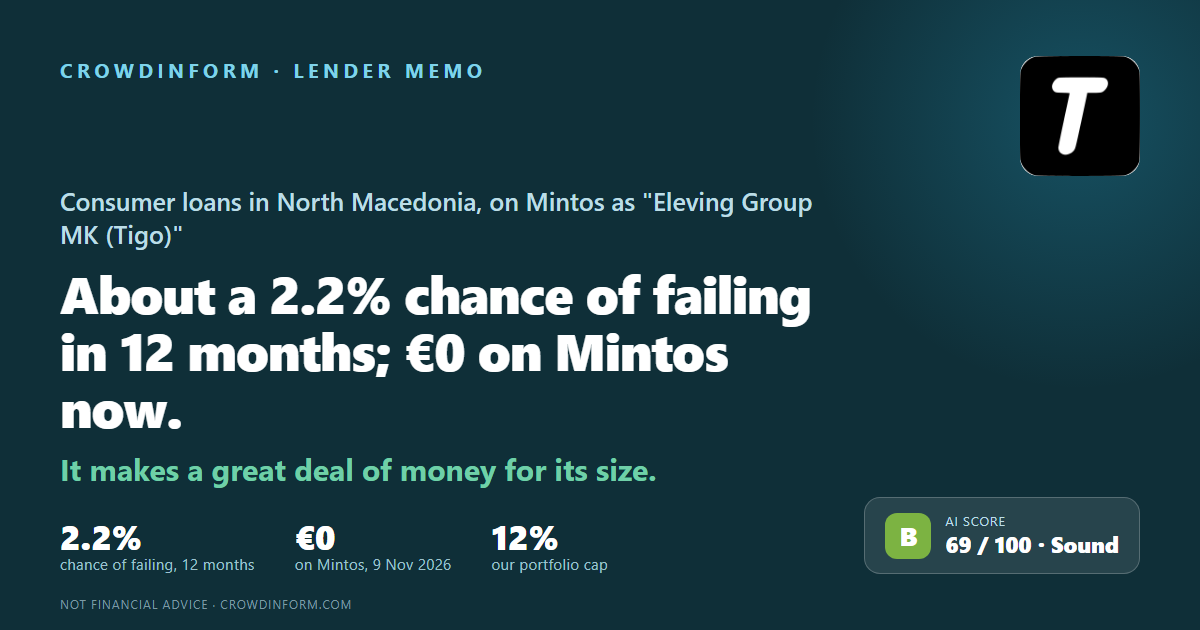
Nordmazedonien
Kapitalverlustrisiko. Der Zins ist vereinbart, nicht garantiert: Fällt ein Kreditnehmer aus, können Sie Ihr Geld teilweise oder vollständig verlieren.
Unsere KI gibt diesem Projekt 69 von 100 Punkten: Mittel. So funktioniert der KI-Score
Informationen, keine persönliche Anlageberatung. Der KI-Score bewertet die von der Plattform veröffentlichten Dokumente, kann falsch sein und sagt keine Renditen voraus.
This memo answers one question: the chance that Tigo Finance DOO Skopje — Eleving Group's lender in North Macedonia, called Finmak until recently — fails to pay its lenders in the next 12 months, and why. It replaces our memo of 13 September 2026.
It makes a great deal of money for its size. It kept 26.10 denars of every 100 in 2024 and about 24.97 in 2025 — profit of 350.6m denars (€5.70m) and then 271.7m (€4.42m), against 161.0m (€2.62m) in the hard year of 2023. Owners' money funds 53.6% of the balance sheet, up from 49.5% a year earlier, and nothing is lent to its group.
A quarter of its loan book has defaulted, and that is close to the business model. Loans more than ninety days late were 27% of the book at the end of 2024 and 24% at the end of 2025. It keeps defaulted loans on its books, provided for, until it sells them in bulk — so the share looks alarming by construction. What matters is the cover: 34.7% of the whole book was set aside at the end of 2024, which the audited accounts put at 93% of their own defaulted loans — a wider set than the ageing table above.
The thing we cannot settle is on the funding side. The 2025 summary shows 741m denars of liabilities and names only 128m of them. The other 613m denars — €10.0m, and the largest single item on that side of the balance sheet — is not labelled at all. It is not platform money: the group's own table shows none in North Macedonia at that date. A loan from the group is the likeliest reading, and the audited accounts would say.
And the 2025 figures are not audited. They come from a one-page management summary in the group's format, which counts only customer interest as income — so it is not like-for-like with the two audited years. The figures filed with the company register agree with it on profit to within 0.11%. In earlier years, filed and audited profits differed by 12% to 17%, so agreement between two unaudited sources is not the same as an audit.
Six things would stop us scoring at all and send the answer straight to E — a default, a missed payment to a platform, a regulator pulling a licence, an auditor doubting the company can continue, a broken promise to a lender, or accounts we cannot rely on. None of them applies, on the accounts we have. Two things would pull the answer the other way, a guarantee from a stronger owner or a credit rating. One of them exists — its parent group guarantees this company’s obligations to the company that issues the notes — but this company’s own odds are better than its parent’s, so the guarantee confirms the answer rather than improving it.
Kept about a quarter of its income in each of the last two years; owners' money 53.6% of assets; interest covered 4.13 times.
24% of the book is more than ninety days late — down from 27%, provided for, and sold on in bulk.
3.09 out of 5. A currency pegged to the euro, and a state that rewrites the rules for fast loans.
Guarantor of its parent's 2030 bonds with its own shares pledged, and the unnamed liability above.
Every investment carries risk, and risk is not really a letter or a mark out of ten. It is two plain questions: how likely is it that this company fails, and how much of your money would you lose if it did. Put those together and you can see whether the reward is worth it.
For Tigo the sum looks like this. Our odds are 2.2% — about 1 in 45. If a lender fails, our house assumption is that about 70% of the money is lost, so the risk costs about 1.5% a year. The average rate on the platform was 7.4% in September 2026, when notes were on offer, which leaves about 5.9% once the risk is paid for. That is one of the thinner margins in this series — not because the company is weak, but because the rate is low: this is a B-grade lender paying less than several D-grade ones.
This lender holds its bad loans, provided for, until it sells them in bulk — 14,990 of them in 2024 for €6.1m, at a gain. A lender that wrote them off monthly would show a far prettier book and the same economics.
The management summary and the filed figures agree on 2025 profit to 0.11%. In earlier years, filed figures differed from audited ones by 12%–17%. Agreement tells you the filing was consistent, not that it was right.
It guarantees €270.0m of its parent's bonds with its own shares pledged. That is many times its equity, and it is the one exposure its own good management cannot reduce.
Ministry of Finance licence held since August 2017. Renamed back to Tigo Finance from Finmak by April 2026. 26 branches plus online, 178 staff.
Thirty-day loans and three- to forty-eight-month instalment loans, from 500 to 400,000 denars. A first home-secured loan was launched in August 2026.
After provisions, at the end of 2025 — €25.8m by June 2026 on the group's figures, 19% more in six months.
Through a Latvian holding company, with 5.45% held by minority shareholders.
Listed as "Eleving Group MK (Tigo)", with the notes issued by SIA Mintos Finance No. 6.
Read on 9 November 2026 — Mintos's own figure, not independently checked. On 13 September 2026 our capture showed €8.6m (another sheet of it €8.9m); the group reported €5.9m at June 2026 and at 30 September 2026.
As read on 13 September 2026; on 9 November 2026 Mintos showed no average rate, because nothing was outstanding. With a buyback, the receivables pledged to the issuing company, and the parent group's guarantee to that company.
Mintos, updated 9 October 2026, read on 9 November 2026 — a platform figure. Its parts: loans performing 7.9, collections 7.8, buyback 9.3, structure 5.5. It was 7.9 in September.
Die vollständige Analyse behandelt den Kreditnehmer bzw. das Unternehmen, die Sicherheit, den Cashflow, die Risiken und ein Fazit. Melden Sie sich an, um sie zu lesen.
Informationen, keine persönliche Anlageberatung. Der KI-Score bewertet die von der Plattform veröffentlichten Dokumente, kann falsch sein und sagt keine Renditen voraus.
Melden Sie sich an, um der KI Fragen zu den Dokumenten dieses Projekts zu stellen.
Anmelden👍 Ja · 0 👎 Nein · 0
Empfehlungslink · Kapitalverlustrisiko
42 Projekte ansehen →Mintos
Mintos
Mintos