
Regulada
Bono activo
Venta anticipada
- Nivel de riesgo
- Alto
- Riesgo-rentabilidad
- Media
- Desde
- €50
Enlace de afiliado · capital en riesgo
Ver 42 proyectos →¿Preguntas sobre inversión? Pregunte a la guía IA.
¡Hola! Soy la guía de IA de Crowdinform.
Inicia sesión gratis para preguntar a la guía IA sobre plataformas, proyectos y tus planes.
Las respuestas proceden de los datos verificados de Crowdinform. Información, no asesoramiento de inversión personalizado.
Buscando… Algo ha fallado. Inténtelo de nuevo. {n} preguntas restantes hoy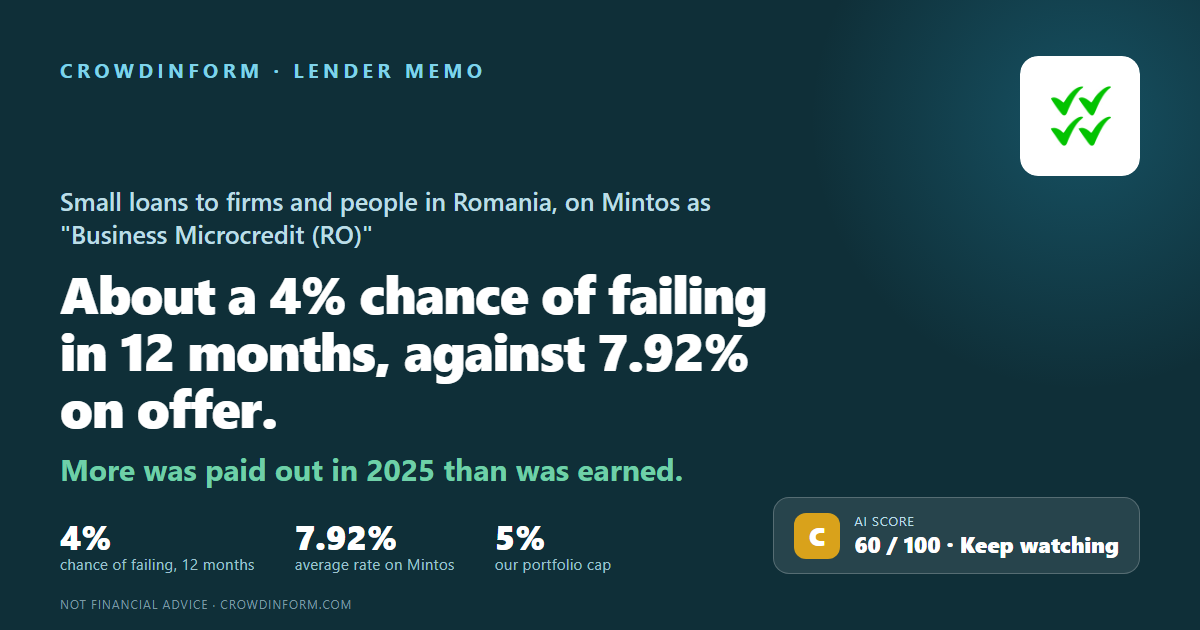
Rumanía
Capital en riesgo. El tipo está pactado, no garantizado: si un prestatario incurre en impago, puede perder una parte o la totalidad de su dinero.
Nuestra IA da a este proyecto 60 de 100: Media. Cómo funciona la puntuación de la IA
Información, no asesoramiento personalizado de inversión. La puntuación IA valora los documentos que publica la plataforma, puede equivocarse y no predice la rentabilidad.
Business Microcredit IFN S.A. lends small sums to firms and to people in Romania, from an office in Iași — money for equipment, for stock, for working capital, over one to six years, at 17% to 40% a year. It has been a licensed non-bank lender since March 2019 and on the National Bank's special register since February 2020. It takes no deposits. Mintos lists it as "Business Microcredit (RO)". This memo asks one question: what is the chance it fails to pay its lenders back in the next 12 months, and why.
Two things pull in opposite directions here. Business Microcredit is better capitalised than almost any lender we cover: at the end of 2024 the owners' money was $10.6m against $16.4m of assets, about two-thirds of everything the company owns. Very little can go wrong in a loan book that is not absorbed before a lender is reached. That is what holds the score at 60.
Against it, 2025 was a worse year than any figure in the audited accounts shows. Turnover fell 21% to 17.0m lei and profit fell 63% to 3.07m lei. The first half alone earned about 4.7m lei, which means the second half lost about 1.6m. Borrowing rose from 26.3m lei to 49.2m. The filings do not say why any of this happened, and the 2025 accounts have not been audited.
Six things would stop us scoring at all and send the answer straight to E — a default, a missed payment to a platform, a regulator pulling a licence, an auditor doubting the company can continue, a broken promise to a lender, or accounts we cannot rely on. None applies here. Two things would pull the answer the other way, a guarantee from a stronger owner or a credit rating. Neither applies here.
Profitable in every period we can see, and the owners' money is about two-thirds of what the company owns. Interest was covered 7.3 times in 2024. But the 2025 profit fell 63%.
The cost of bad loans was 3.4% of the book in 2024 — modest against rates of 17–40%. But defaulted loans leave the company at 90 days, sold to a sister firm, so the arrears you can see are not the whole story.
The leu, not the euro. The largest budget deficit in the European Union. A cap on the cost of credit that covers its consumer loans but not its business loans.
Income down a fifth in 2025, a loss in the second half, borrowing up 87%, and the staff count in the filing down from 40 to 11.
Every investment carries risk, and risk is not really a letter or a mark out of ten. It is two plain questions: how likely is it that this company fails, and how much of your money would you lose if it did. Put those together and you can see whether the reward is worth it.
For Business Microcredit: about a 4% chance of failing in the next 12 months. If we assume about 30% of the money comes back in that case, the risk costs roughly 2.6% a year. Mintos showed an average rate of 7.92% on these notes on 9 November 2026, so that rate is worth about 5.3% once the risk is paid for. Check the rate you are actually offered: what is left over after the 2.6% is what you are paid for taking the risk.
An advertised 10% is what you are promised if everything goes well. What you keep is that rate minus what failures cost you. So the rate on its own tells you very little.
Risk cost = chance of failing × share of your money you would not get back. Nobody knows the second number in advance. How much comes back has varied widely from case to case. We use 30% back, 70% lost, as our own working assumption so that memos can be compared with each other — it is not a measured figure, and the answer moves a lot if you choose differently.
Take two imaginary lenders. One pays 14% but has a 17% chance of failing within the year: the risk costs about 11.9% a year, leaving roughly 2%. The other pays 9% with a 2.5% chance: the risk costs about 1.8%, leaving about 7%. The lower rate is the better deal. That is the whole idea.
Listed there as "Business Microcredit (RO)", under the Credius brand with its two sister companies, which have their own memos. Platform figures read on 9 November 2026.
Mintos's own figure, read on 9 November 2026. The accounts do not say how much of what the company borrows is owed to Mintos investors.
The average rate Mintos showed on these notes on 9 November 2026. Mintos lists them with a buyback.
Mintos's own score, not ours, as Mintos last updated it on 9 October 2026, read on 9 November 2026. Its four parts: 8.1 for how the loans perform, 7.0 for servicing, 6.5 for buyback strength and 4.2 for the structure of the arrangement.
El análisis completo cubre al prestatario o la empresa, la garantía, el flujo de caja, los riesgos y un veredicto. Inicie sesión para leerlo.
Información, no asesoramiento personalizado de inversión. La puntuación IA valora los documentos que publica la plataforma, puede equivocarse y no predice la rentabilidad.
Inicie sesión para preguntar a la IA sobre los documentos de este proyecto.
Iniciar sesión👍 Sí · 0 👎 No · 0
Enlace de afiliado · capital en riesgo
Ver 42 proyectos →Mintos
Mintos
Mintos