
Reguliert
Bonus läuft
Vorzeitig verkaufbar
- Risikostufe
- Sehr hoch
- Risiko-Rendite
- Schlecht
- Start ab
- €1
Empfehlungslink · Kapitalverlustrisiko
1 Projekt ansehen →Fragen zum Investieren? Fragen Sie den KI-Guide.
Hallo! Ich bin der KI-Guide von Crowdinform.
Melden Sie sich kostenlos an, um den KI-Guide zu Plattformen, Projekten und Ihren Plänen zu fragen.
Die Antworten stammen aus den geprüften Daten von Crowdinform. Information, keine persönliche Anlageberatung.
Wird nachgeschlagen… Etwas ist schiefgelaufen. Bitte versuchen Sie es erneut. Heute noch {n} Fragen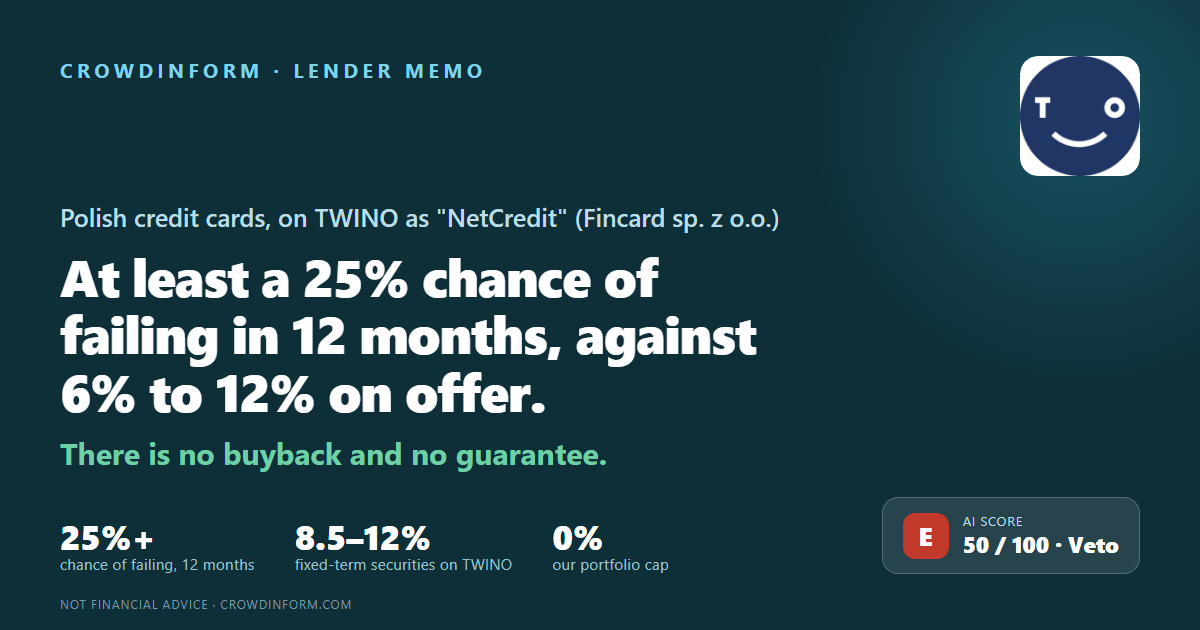
Polen
Kapitalverlustrisiko. Der Zins ist vereinbart, nicht garantiert: Fällt ein Kreditnehmer aus, können Sie Ihr Geld teilweise oder vollständig verlieren.
Unsere KI gibt diesem Projekt 50 von 100 Punkten: Mittel. So funktioniert der KI-Score
Informationen, keine persönliche Anlageberatung. Der KI-Score bewertet die von der Plattform veröffentlichten Dokumente, kann falsch sein und sagt keine Renditen voraus.
On TWINO you are not lending to TWINO. You buy a security that is paid only if Fincard sp. z o.o. — a Polish credit-card lender in Warsaw, with 56 staff — repays a loan. This memo asks one question: what is the chance that company fails to pay in the next 12 months, and why. Everything else in the chain matters only because it decides who you can turn to if it does not.
First, what you actually own. Not a loan to TWINO. You own a limited-recourse security issued by SIA TWINO Investments Poland, a Latvian company with €31,400 of assets. Your money buys a claim on a business loan to Fincard. The prospectus is plain: "No collateral, pledge or other types of guarantees will be available for the Securityholders", and you are paid "only from and to the extent of" what Fincard repays. There is no buyback. So the question that matters is Fincard's, and section 0 sets out the chain.
On the six questions Fincard scores 50 out of 100 — a C, about 1 in 17, or 6.0%. It is profitable: it kept 18.66 of every 100 of income in 2025 and made PLN 43.7m, up 29%. Owners' money is 42.5% of what it owns. On the numbers alone it is an ordinary, rather good consumer lender.
Two things in its own audited accounts override that. BDO qualified its opinion on both 2024 and 2025, because no provision was made for a penalty the Polish consumer regulator may impose and the auditor could not estimate it. And at the end of 2025 Fincard had lent PLN 74.8m (€17.7m) to companies in the same ownership — 65% of its owners' money, including PLN 47.6m to its own parent. Each of those is a veto in our method on its own. Together they take the answer to at least 25%.
And behind both sits one fee. PLN 172.9m of Fincard's PLN 228.3m of sales in 2025 — 76% — is a commission charged on the card limit. On 15 June 2026 the regulator said such fees "are in reality hidden capital interest" and announced charges. Those are charges, not a decision, and Fincard says it acted lawfully. But if a year's commission went, PLN 69.5m of profit would become a loss of about PLN 103m — close to all of the owners' money.
Six things would stop us scoring at all and send the answer straight to E — a default, a missed payment to a platform, a regulator pulling a licence, an auditor doubting the company can continue, a broken promise to a lender, or accounts we cannot rely on. Two of them apply, and both are in Fincard’s own audited accounts: the auditor would not sign off cleanly, and more than half the owners’ money is lent to connected companies. Two things would pull the answer the other way, a guarantee from a stronger owner or a credit rating. Neither applies here: nobody guarantees these securities, and the money moves from Fincard up to its owner rather than the other way.
Keeps 18.66 of every 100; profit PLN 43.7m (€10.4m), up 29%. But 76% of sales is the fee the regulator calls hidden interest.
Bad debts take 36.10 of every 100. Late loans are sold to collectors after 35 days, and no arrears table is published anywhere.
Graded C (3.22 out of 5): tight caps on interest and on fees, and a regulator that treats a fee working like interest as interest.
Qualified audits two years running; charges from the consumer regulator; and the group took more than four years to repay investors caught in Russia-linked loans.
Every investment carries risk, and risk is not really a letter or a mark out of ten. It is two plain questions: how likely is it that this company fails, and how much of your money would you lose if it did. Put those together and you can see whether the reward is worth it.
For TWINO's Polish securities: the fixed-term securities are offered at 8.5% to 12% a year and FLEXI at 6%. On our reading the chance of the company behind them failing in the next twelve months is at least 25%. If a quarter of lenders like this one fail and about 70% of the money is gone when they do, the risk costs about 17.5% a year — which is more than any of those rates pays. On those numbers nothing is left once the risk is paid for. That is our arithmetic on our own scale, and you are entitled to disagree with the scale; what you should not do is read the rate on its own.
Nothing here says Fincard is about to stop trading. It made PLN 43.7m last year. The question our test asks is different: what would absorb a shock, and is it actually still in the company.
76% of sales is a commission on the card limit, and the regulator has charged that it is interest by another name. The loan losses would not fall if the fee did.
Not from TWINO, not from the issuer, not from the owner. Your claim is limited to what Fincard repays. That is unusual enough to be worth saying twice.
Fincard sp. z o.o., licensed by the Polish regulator KNF since 22 November 2024. Warsaw, 56 staff in 2025. Poland only.
Virtual Mastercard credit lines, for 360 days. Priced as capital interest at the legal maximum plus a separate commission on the limit granted.
PLN 176.0m net at the end of 2025. Sales of PLN 228.3m, against PLN 192.5m in 2024.
Owned by Armands Broks, who also owns TWINO. The issuer, the lender, the borrower and the broker are all his.
AS TWINO Investments, a Latvian investment firm licensed by the Bank of Latvia since 31 August 2021. It sells the securities and holds them for you off its own balance sheet.
On TWINO on 13 September 2026, on the platform's own figure. AS TWINO Investments held €34.4m of these securities for clients at the end of 2025.
Fixed-term securities and FLEXI, which has been 6% since April 2026. Limited recourse: there is no buyback and no guarantee from anyone. Rates read on twino.eu on 5 November 2026.
The loan to Fincard is to be secured on its card loans, capped at 95% of that book and standing at 66% at the end of 2025. Whether the pledge is registered and enforceable in Poland, we could not confirm.
Die vollständige Analyse behandelt den Kreditnehmer bzw. das Unternehmen, die Sicherheit, den Cashflow, die Risiken und ein Fazit. Melden Sie sich an, um sie zu lesen.
Informationen, keine persönliche Anlageberatung. Der KI-Score bewertet die von der Plattform veröffentlichten Dokumente, kann falsch sein und sagt keine Renditen voraus.
Melden Sie sich an, um der KI Fragen zu den Dokumenten dieses Projekts zu stellen.
Anmelden👍 Ja · 0 👎 Nein · 0
Empfehlungslink · Kapitalverlustrisiko
1 Projekt ansehen →Mintos
Mintos
Mintos