
Hottest startups you can invest starting from a few hundred euros! 23.09.2024
We reviewed 90+ equity crowdfunding platforms and prepared a list of the hottest (in our opinion) startups you can invest starting from a few hundred euros!
Questions about investing? Ask the AI guide.
You are chatting with an AI assistant, not a person. It answers from Crowdinform's data and can make mistakes. Information, not personal investment advice. About this AI
Hi! I'm the Crowdinform AI guide.
Sign in free to ask the AI guide about platforms, projects and your plans.
AI answers from Crowdinform's checked data. It can make mistakes. Information, not personal investment advice.
Looking it up… Something went wrong. Please try again. {n} questions left todayArticle
Discover why benchmark investment returns are crucial for UK investors. Gain performance insights, assess risk, and hold managers accountable.

Benchmarking investment returns means comparing your portfolio's performance against a relevant market index or standard, giving you an objective frame of reference rather than just a raw number. Without that context, a 7% annual return could look impressive or disappointing depending entirely on what the broader market delivered over the same period.
The core reasons to benchmark are practical and immediate:
In the UK context, the FTSE 100 (the 100 largest companies listed on the London Stock Exchange) is the most widely recognised equity benchmark, though it covers only a slice of the market. Broader indices and fixed income standards like UK Gilts round out the picture for diversified portfolios.
A benchmark is a reference portfolio against which investment performance is measured. In its simplest form, it is a market index that tracks a defined set of securities on a buy-and-hold basis. Investors cannot invest directly in an index, but they can use one to judge whether their own portfolio is keeping pace, lagging, or genuinely outperforming.
The major UK-relevant benchmarks span equities and fixed income:
| Index | Asset class | Coverage |
|---|---|---|
| FTSE 100 | UK large-cap equities | 100 companies, London Stock Exchange |
| FTSE All-Share | Broad UK equities | ~600 companies, large/mid/small cap |
| MSCI UK Index | UK large and mid-cap equities | Institutional standard for UK equity |
| UK Gilts | Fixed income | UK government bonds, sterling denominated |
Beyond these, sector-specific and asset-class benchmarks exist for property, commodities, and alternatives. The right choice depends on what your portfolio actually holds, not on which index sounds most familiar.
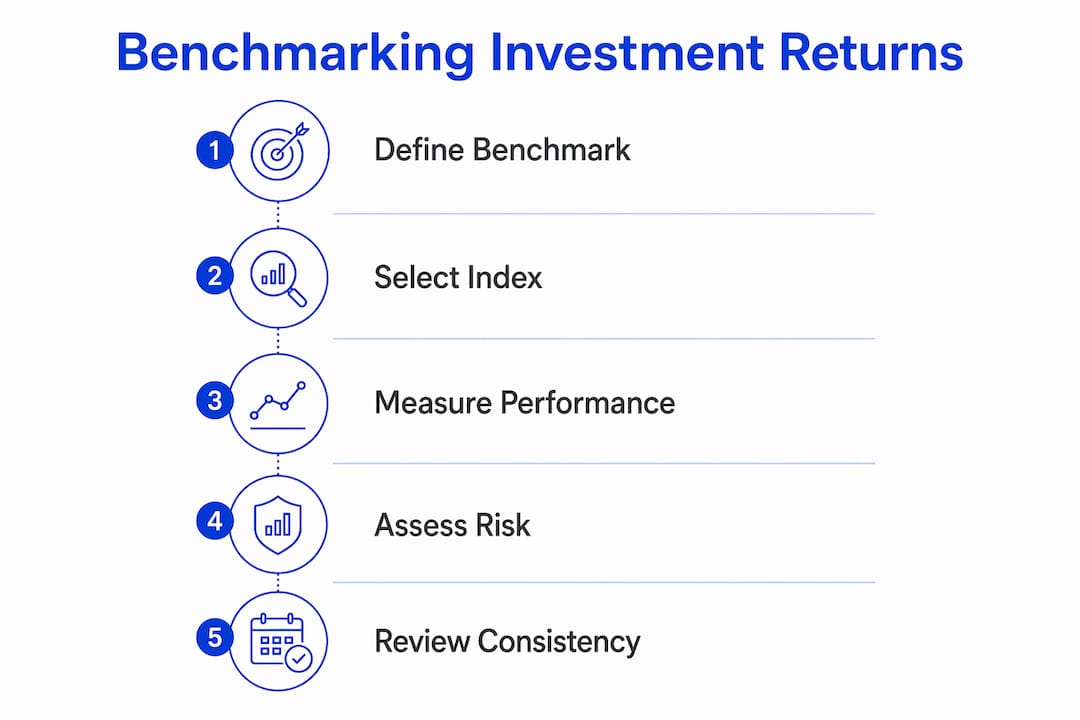
Comparing your portfolio's returns to a benchmark is only the starting point. The more telling analysis comes from risk-adjusted measures that reveal whether you are being adequately compensated for the volatility you are accepting.
Three metrics do most of the work here:
Key insight: Benchmarks allow investors to identify whether an active manager genuinely adds value or whether passive investing aligned with the benchmark would deliver better net results.
When an actively managed fund consistently posts positive tracking error, the manager is adding value above the index. Negative tracking error over multiple years, particularly after fees, is a clear signal to reassess. The Sharpe ratio adds another layer: a portfolio that outperforms its benchmark but does so by taking on disproportionate risk has not necessarily made a sound trade-off.

The benchmark you choose shapes every performance conclusion you draw. A benchmark that is too easy to beat inflates apparent performance; one misaligned with your strategy obscures whether genuine value is being added.
Practical criteria for selection:
Pro Tip: Define your benchmark before you start measuring performance, not after. Selecting a benchmark that makes your track record look favourable is one of the most common sources of misleading self-assessment in portfolio management.
For UK investors assessing investment risk, the risk-free rate represented by short-term UK Gilts serves as the minimum meaningful benchmark. If your strategy cannot beat the risk-free rate on a risk-adjusted basis over a full cycle, it is not generating value for the risk you are taking on.
Not all benchmarks are built the same way, and the methodology behind an index directly affects how you interpret your portfolio's performance against it.
Differences in index construction affect measured portfolio alpha, beta, and tracking error, which in turn affects how you evaluate active management. A portfolio that appears to have positive alpha against one index may show negative alpha against another, so the benchmark is never a neutral choice.
Index rebalancing also matters. When an index's constituents change, active managers incur trading costs to replicate those changes, while the index itself does not. This creates a structural drag that shows up in tracking error and makes it harder to match index returns precisely in practice.
The most persistent misconception is that the goal of benchmarking is always to beat the benchmark. It is not. The primary purpose is transparency: understanding whether your portfolio is delivering returns appropriate to its risk level and cost structure.
Best practice: Evaluate performance over a full market cycle of several years to avoid reactive decisions driven by short-term volatility. Predefined benchmarks, risk-adjusted comparisons, and net-of-fee analysis are the three pillars of meaningful benchmarking.
For investors exploring whether index funds suit their strategy, consistent underperformance relative to an appropriate benchmark is often the clearest signal that a passive approach would deliver better net results.
Raw outperformance or underperformance is only the first data point. Interpreting benchmarking results well means asking why the gap exists, not just whether it does.
Start with attribution. If your portfolio outperformed the FTSE All-Share by 3% last year, identify whether that came from asset selection, sector allocation, or simply holding a higher proportion of an asset class that happened to perform well. Outperformance driven by concentrated sector bets carries different implications than outperformance from consistent stock selection across a diversified portfolio.
Then consider risk. A portfolio that returned 12% against a benchmark of 10% looks attractive until you discover the portfolio's volatility was twice that of the benchmark. The Sharpe ratio resolves this by expressing return per unit of risk, giving you a cleaner comparison. If the risk-adjusted return does not justify the active management approach, the data is pointing you towards a lower-cost alternative.
Finally, look at consistency. A single year of outperformance is noise. Three to five years of consistent results across different market conditions, including downturns, is the kind of evidence that supports continuing with an active strategy. Anything less and you are drawing conclusions from too small a sample.
The benchmarking logic is consistent across asset classes, but the specific indices and metrics shift depending on what you hold.

Equities: UK equity portfolios typically benchmark against the FTSE 100, FTSE All-Share, or MSCI UK Index depending on market-cap focus. For global equity exposure, the MSCI All Country World Index (ACWI) covers equities across 47 markets and is the standard for internationally diversified portfolios.
Bonds and fixed income: UK Gilts serve as the primary benchmark for sterling fixed income. For corporate bond exposure, indices tracking investment-grade or high-yield sterling bonds provide a more appropriate comparison than government bonds alone. Inflation-linked portfolios use indices such as the Bloomberg UK Gilt Inflation-Linked Index to measure real returns against inflation-adjusted liabilities.
Alternatives: Property portfolios often benchmark against real estate investment trust (REIT) indices. Commodities exposure is typically measured against broad commodity indices. For multi-asset or absolute return strategies, the risk-free rate (short-term UK Gilts) is often the most honest benchmark, since these strategies explicitly aim to generate positive returns regardless of market direction.
The key principle across all asset classes is the same: the benchmark must reflect what the portfolio actually holds. Benchmarking a bond-heavy portfolio against an equity index produces a comparison that serves no analytical purpose.
UK regulatory requirements make benchmarking a formal obligation for many fund managers, not just a best practice. The Financial Conduct Authority (FCA) requires authorised funds to disclose performance against an appropriate benchmark in their Key Investor Information Documents (KIIDs) and ongoing charges disclosures, giving retail investors a standardised basis for comparison.
For discretionary portfolio managers operating under FCA authorisation, MiFID II-derived rules require periodic performance reporting that includes benchmark comparisons. This means the benchmark is not just an internal management tool but a disclosed, auditable reference point that clients can use to hold managers accountable.
Benchmarking also supports Treating Customers Fairly (TCF) obligations. A manager who consistently underperforms a relevant benchmark without adequate justification faces scrutiny over whether the service delivered represents fair value. The FCA's asset management market study highlighted benchmark-relative performance as a central metric for assessing value for money in actively managed funds.
For individual investors tracking investment performance over time, maintaining clear benchmark records supports tax reporting, particularly when calculating gains relative to market conditions for Capital Gains Tax purposes. It also provides the documentation needed for any formal portfolio audit or adviser review.
Benchmarking investment returns is the most reliable way to assess whether your portfolio is delivering value relative to its risk level, costs, and the broader market.
| Point | Details |
|---|---|
| Define benchmarks upfront | Set your benchmark before measuring performance to avoid biased or misleading self-assessment. |
| Match benchmark to portfolio | Use the FTSE All-Share, MSCI UK Index, or UK Gilts depending on your actual asset allocation. |
| Account for fees | A fund must outperform its benchmark by at least its expense ratio to justify active management net of costs. |
| Evaluate over full market cycles | Short-term comparisons distort results; several years of data across different conditions is the meaningful standard. |
| Use risk-adjusted measures | Sharpe ratio and beta reveal whether outperformance reflects skill or simply higher risk-taking. |
Capital at risk. Crowdfunding investments are not covered by deposit guarantee schemes, can lose part or all of their value, and may be hard to sell before the end of their term. This guide is information, not personal investment advice.
Was this helpful?

Eugene Sokolovs Expert
Founder of Crowdinform
Keep reading
We reviewed 90+ equity crowdfunding platforms and prepared a list of the hottest (in our opinion) startups you can invest starting from a few hundred euros!
· 1
If you want to invest part of your crypto portfolio in safer /regulated instruments but yet ready to take higher risk with higher returns than traditional investing - crowdfunding is the best option for that!
Private equity explained for beginners: funds, GPs and LPs, buyouts and venture, IRR and the J-curve, fees, lock-ups and how to invest in Europe via ELTIFs.

Comments · 0