
Regulated
Bonus running
Can sell early
- Risk level
- High
- Risk-return
- Medium
- Start from
- €50
Referral link · capital at risk
See 42 projects →Questions about investing? Ask the AI guide.
Hi! I'm the Crowdinform AI guide.
Sign in free to ask the AI guide about platforms, projects and your plans.
Answers come from Crowdinform's checked data. Information, not personal investment advice.
Looking it up… Something went wrong. Please try again. {n} questions left today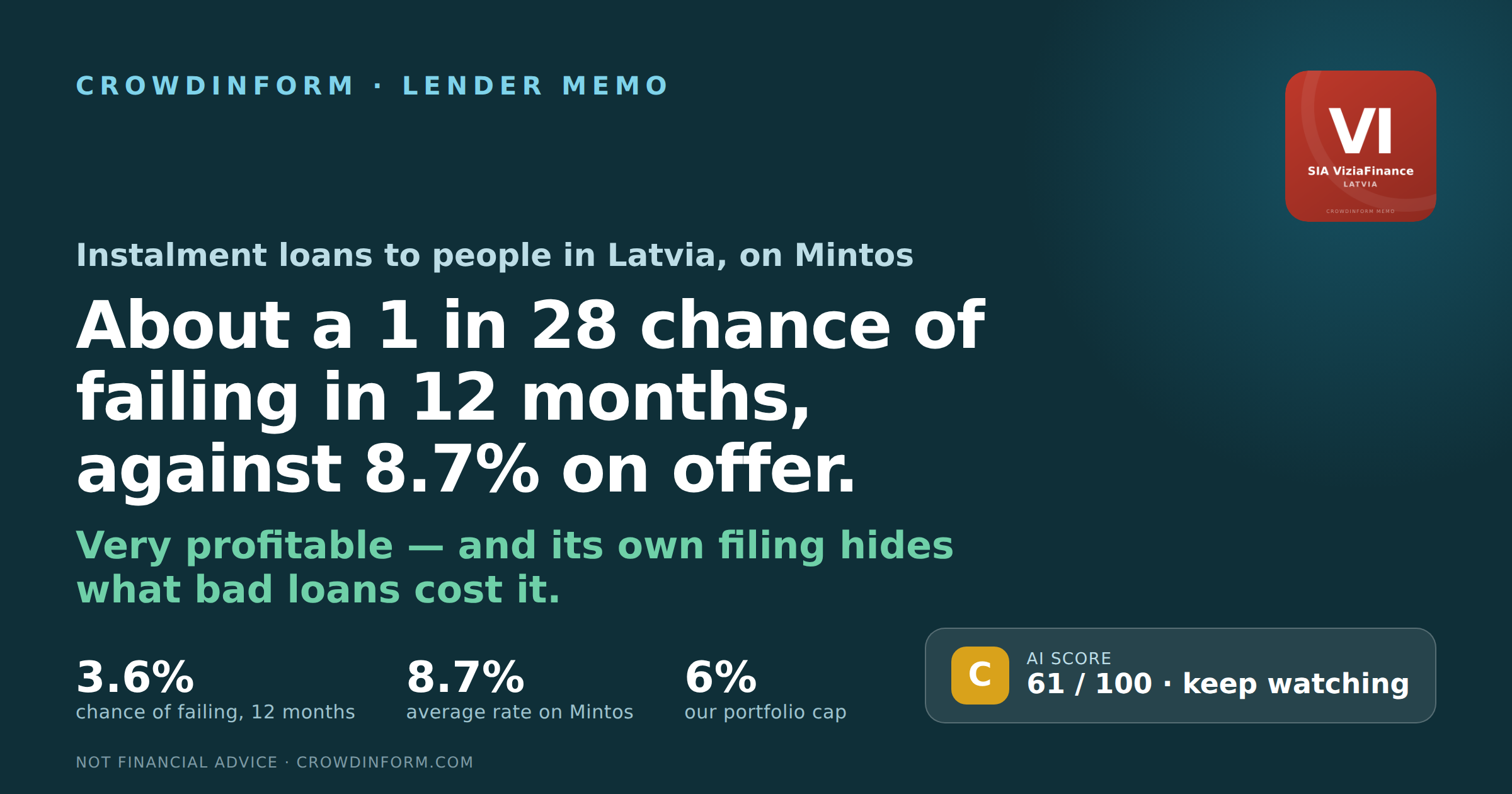
Latvia
Capital at risk. The rate is agreed, not guaranteed: if a borrower defaults you can lose some or all of your money.
Our AI gives this project 61 out of 100: Medium. How the AI score works
Information, not personal investment advice. The AI score rates the documents the platform publishes, can be wrong, and does not predict returns.
SIA ViziaFinance is a Latvian company that lends money to people. Its borrowers pay it back in monthly instalments. It trades under the name VIZIA. Separately, investors on Mintos lend money to ViziaFinance. This memo asks one question: what is the chance that ViziaFinance fails to pay those investors back in the next 12 months, and why.
We have used ViziaFinance’s own accounts as filed for 2023, 2024 and 2025, its 2022 accounts as audited by KPMG, and its parent’s audited group accounts. The audit opinions on 2023, 2024 and 2025 are behind a paywall and we have not read them.
ViziaFinance has kept every euro it has earned for three years. But its own accounts add interest together with the cost of bad loans in a single line, so the one number that would show how well it lends is missing. And the regulator has fined it for checking only one of Latvia’s two credit databases before lending.
We ask six questions about every lender: does it earn enough, are its loans being repaid, does it have enough of its own money to absorb losses, how risky is its country, can we trust its numbers, and are there warning signs. Each is scored 1 to 5 and weighted. The four cards below show the results — but they are not meant to be added up. The weighted result is the about 3.6% at the top of this page.
It keeps about €28 of every €100 of income, and it has kept all of that profit inside the company: the owners’ money has grown to three times its size in three years, with nothing of any size paid out. We traced that back to an audited 2022 starting figure and the figures match.
Nothing about VIZIA’s own loans appears in its filed accounts or in its parent’s reports. Across the whole group, loans more than 90 days late rose from 3.09% to 4.35% during 2025. The regulator also found that since 2019 ViziaFinance had been checking only one of Latvia’s two credit databases, so it could not see everything its borrowers already owed elsewhere.
The euro, so no currency risk for an investor whose own money is in euros. Courts that work. A cost cap unchanged since 2019. The government fell in May 2026, an election was due on 3 October 2026, and from January 2027 a new supervisor takes over. None of that changes the rules a lender must follow today.
One employee: its parent does all the lending, runs the loans day to day and chases late payments. ViziaFinance has promised to pay its parent’s bank debts if the parent does not, and the parent has given no such promise in return. And the audit opinions on all three years we report on are unread.
Every investment carries risk, and risk is not really a letter or a mark out of ten. It is two plain questions: how likely is it that this company fails, and how much of your money would you lose if it did. Put those together and you can see whether the reward is worth it.
For ViziaFinance: about a 3.6% chance of failing in the next 12 months. If we assume about 30% of the money comes back in that case, the risk costs roughly 2.5% a year — so the 8.7% rate on offer is worth about 6.2% once the risk is paid for.
An advertised 8.7% is what you are promised if everything goes well. What you keep is that rate minus what failures cost you. So the rate on its own tells you very little.
Risk cost = the chance of failing × the share you do not get back. We assume 30% comes back and 70% is lost. That 30% is an assumption we apply to every lender so they can be compared with each other — it is not a measured figure, and the answer moves a lot if you choose differently.
Take two imaginary lenders. One pays 14% but has a 17% chance of failing within the year: the risk costs about 11.9% a year, leaving roughly 2%. The other pays 9% with a 2.5% chance: the risk costs about 1.8%, leaving about 7%. The bigger number on the screen can easily be the worse one.
| With our figures | |
|---|---|
| Chance of failing in a year | 3.6% |
| Loss if it fails (70%) | × 0.7 |
| Risk cost a year | 2.5% |
| Rate offered on Mintos | 8.7% |
| Left after the risk cost | about 6.2% |
Not a bank, and it takes no deposits. Licensed by Latvia’s Consumer Rights Protection Centre — the regulator — since November 2016. From 1 January 2027 the Bank of Latvia supervises it instead.
Loans of €50 to €10,000. Its own worked example is €1,000 at 45.6% a year, repaid in 36 monthly payments totalling €1,735.05. The company also quotes 56.4% a year: that is the same rate, worked out as if the interest each month is added to the amount owed and then itself earns interest. It is not an extra charge, and the company’s own website says there is no separate fee for setting up the loan. Section 3 explains why we could not make the total and the rate agree.
At the end of 2025, up about half in the year from about €25.5m. Income was €16.7m and profit after tax — what is left once tax is paid — was €4.8m. The company has one employee.
Which owns 100% of it and does all the lending. DelfinGroup is itself about 72% owned by INDEXO — a Latvian pension manager that also owns a bank — as at 30 June 2026, up from about 67% in December 2025.
Listed there as “DelfinGroup (VIZIA) (LV)”. We cover the parent, DelfinGroup, in a separate memo. All the figures in this memo are ViziaFinance’s own, unless we say otherwise.
This is the average rate the group paid on its Mintos funding. About €10.4m was outstanding on 4 November 2026. That is the platform figure for ViziaFinance alone; Mintos lists the group’s two originators separately, and the other, Banknote, had €18.9m outstanding on the same date, so €29.2m for the group together. The €10.4m is measured on a later date than the €12.8m of “Mintos investors and other lenders” in the chart below, and measured a different way. Note that a second, unrelated €12.8m appears in this memo: the loan DelfinGroup has made to ViziaFinance. The two are different things that happen to be the same size. Platform data as published by Mintos; we have not verified it independently.
Mintos’s own mark, not ours, in the Mintos register as read on 4 November 2026. The four parts behind it are 9.0 for how the loans perform, 10.0 for servicing, 9.7 for buyback strength and 7.0 for the structure of the arrangement — the structure is much the weakest of the four. Mintos lowered one part of the score twice during 2025 — in April and again in October, both times because the company had less of its own money behind its loans — then raised it again in January 2026, and made no change in the two rounds that followed. In its update of 9 October 2026 Mintos raised the servicing part from 9.5 to 10.0, and the score from 9.1 to 9.2.
The full review covers the borrower or company, the security, the cash flow, the risks and a verdict. Sign in to read it.
Information, not personal investment advice. The AI score rates the documents the platform publishes, can be wrong, and does not predict returns.
Sign in to ask the AI about this project's documents.
Sign in👍 Yes · 0 👎 No · 0
Referral link · capital at risk
See 42 projects →Mintos