
European crowdfunding is defined as a regulated method of raising or investing capital through online platforms that connect project owners with individual investors across EU member states. Knowing how to join European crowdfunds is simpler than most people expect, provided you understand the regulatory framework that governs the process. The EU Crowdfunding Service Providers Regulation (ECSPR) standardises the rules across all member states, meaning one set of steps applies whether you are investing in a Polish renewable energy project or a Spanish property development. Crowdfunding volumes exceeded €1 billion EU-wide in 2023, and that figure reflects a market with real depth and genuine opportunity for individual investors.
How to join European crowdfunding platforms: what you need first
Before you commit a single euro, you must meet a set of eligibility requirements that apply across all ECSPR-licensed platforms. These requirements exist to protect you and to keep the market transparent.

Identity and residency verification
Investors must complete identity verification including proof of residency and tax status before joining any European crowdfunding platform. Practically, this means submitting a valid passport or national ID card, a recent utility bill or bank statement as proof of address, and your tax identification number. Preparing these documents in advance saves you days of delay.
Investor classification
European crowdfunding platforms distinguish between retail investors and sophisticated investors. Retail investors receive additional disclosures and protections, including investment limits and mandatory risk warnings. Sophisticated investors, who meet specific financial thresholds, gain access to a broader range of opportunities but with fewer automatic safeguards. Understanding which category applies to you shapes every subsequent decision you make on a platform.
Minimum investment amounts and payment methods
Minimum investment amounts vary by platform but typically start from a few hundred euros. Most platforms accept bank transfers and SEPA payments; some accept debit cards. Check the payment options before registering, as currency conversion fees can erode returns if you are investing from outside the eurozone.
Technical requirements
You need a valid email address, a compatible web browser, and access to a bank account in your name. Most platforms also require a mobile number for two-factor authentication during account setup.
Pro Tip: Gather your identity documents, proof of address, and tax number before you begin registration. Platforms time-out incomplete applications, and restarting the process can delay your first investment by a week or more.
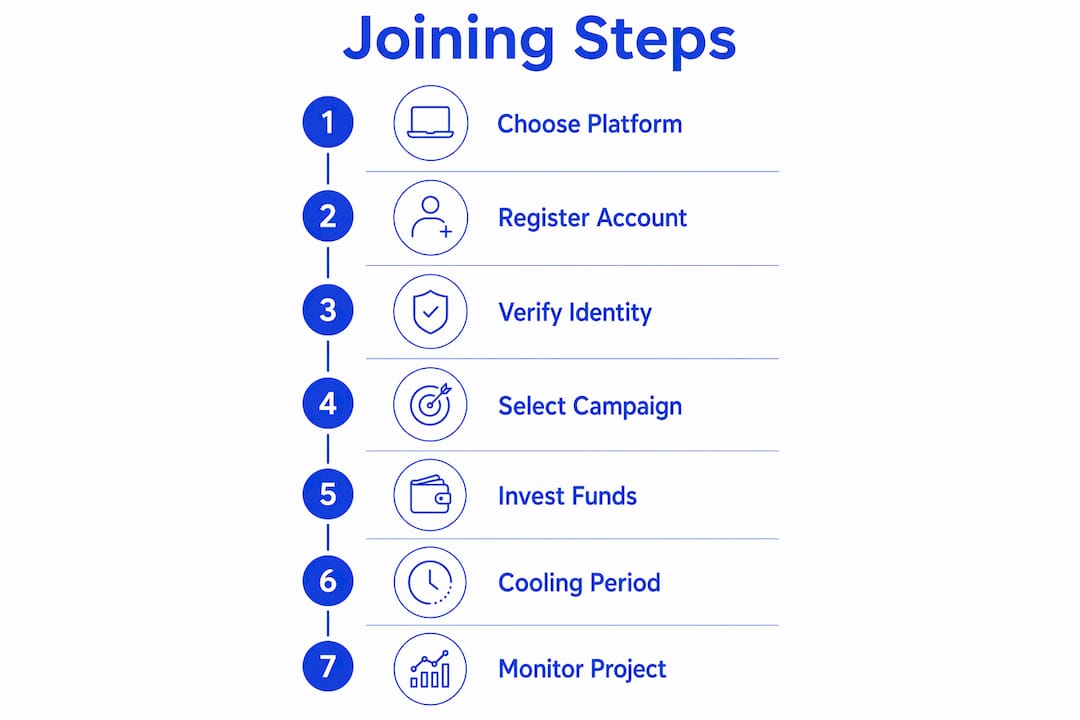
Step-by-step process for joining a European crowdfunding campaign
Joining a campaign follows a clear sequence. Each step builds on the last, and skipping any one of them will stall your investment.
1. Select a licensed platform
Choose a platform that holds an ECSPR licence. A single EU licence authorises platforms to serve investors across all member states, so you are not restricted to platforms based in your home country. Crowdinform aggregates reviews of over 500 European crowdfunding platforms, making it straightforward to compare track records, sectors, and fee structures before committing. You can also consult a platform comparison guide to weigh eligibility and compliance differences across your shortlist.
2. Create your account
Register with your email address and set a strong password. Most platforms send a verification link before you can proceed. Complete this step promptly, as verification links typically expire within 24 hours.
3. Complete KYC and your investor profile
Upload your identity documents and proof of address. The platform's compliance team reviews these, usually within one to three business days. Once approved, you complete an investor profile that records your financial situation, investment experience, and risk appetite. This profile determines your investor classification and the disclosures you receive.
4. Browse campaigns and select an opportunity
Licensed platforms publish key investment information sheets (KIIS) for every campaign. Read the KIIS carefully. It covers the project's financial projections, the risks involved, the fees charged, and the expected timeline for returns. Crowdinform's AI copilot can generate a structured project review to help you assess opportunities faster.
5. Make your investment commitment
Enter the amount you wish to invest and confirm your commitment. At this point, your funds are reserved but not yet transferred to the project owner.
6. Use the 4-day cooling-off period
The ECSPR mandates a 4-day cooling-off period for all non-sophisticated retail investors. During this window, you can withdraw your commitment without any penalty. This protection is standardised across all EU member states, which means it applies regardless of which licensed platform you use. Use this time to re-read the KIIS and confirm you are comfortable with the risk.
7. Fund disbursal and monitoring
Once the cooling-off period ends and the campaign reaches its funding target, the platform releases funds to the project owner. You then monitor your investment through the platform's dashboard, which typically shows repayment schedules, interest accrued, and any project updates from the owner.
What investor protections apply when you participate in European crowdfunding?
The ECSPR embeds several protections directly into the investment process. These are not optional features offered by individual platforms. They are legal requirements.
- 4-day cooling-off period. Retail investors can withdraw any commitment within four days, penalty-free, before funds are disbursed. This applies to every campaign on every ECSPR-licensed platform.
- Mandatory risk disclosures. Platforms conduct due diligence on project owners and publish clear risk warnings and fee disclosures. You must acknowledge these before completing an investment.
- Investor classification safeguards. Retail investors receive more information and face investment limits that reduce exposure to high-risk projects. Sophisticated investors opt out of some limits but must meet defined financial criteria to do so.
- Key investment information sheets. Every campaign must publish a KIIS that explains the project, the risks, the fees, and the exit options in plain language.
- Platform vetting of project owners. Platforms verify the identity and financial standing of project owners before listing a campaign. This reduces, though does not eliminate, the risk of fraud.
"The ECSPR's standardised protections mean that retail investors across the EU benefit from the same baseline rights, regardless of which licensed platform they use or which country the project is based in. The cooling-off period alone represents a meaningful shift in how individual investors are treated in the crowdfunding market."
Understanding these protections also helps you spot platforms that fall outside the ECSPR framework. If a platform does not offer a cooling-off period or does not publish a KIIS, treat that as a warning sign. You can review regulatory requirements for investors under the ECSPR to understand the full scope of your rights before committing funds.
Common mistakes when joining European crowdfunding campaigns
Most problems investors encounter are avoidable. Knowing where others go wrong is the fastest way to protect yourself.
- Underestimating KYC timelines. Verification delays are a common challenge. Platforms can take up to five business days to approve documents, and campaigns with limited capacity fill up quickly. Submit your documents the moment you register, not when you find a campaign you want to join.
- Ignoring investor classification. Overlooking your investor classification can mean missing key protections or, worse, exceeding permitted investment limits. Read the classification criteria on each platform and confirm your status before browsing campaigns.
- Skipping the fee structure. Platforms charge fees in different ways: some take a percentage of returns, others charge annual management fees, and some apply both. A campaign offering a 9% gross annual yield can deliver considerably less after fees are deducted. Always calculate net returns.
- Wasting the cooling-off period. Many first-time investors treat the cooling-off period as a formality. Use it actively. Re-read the KIIS, check for any project updates, and confirm the campaign has reached its funding target before the window closes.
- Concentrating in a single campaign or sector. Diversification across sectors, geographies, and loan types reduces the impact of any single default. Crowdinform's guides on increasing crowdfunding returns cover practical diversification strategies for European investors.
Pro Tip: Set a calendar reminder for the last day of your cooling-off period. Platforms do not always send reminders, and missing the window means your commitment becomes binding.
Key takeaways
Joining European crowdfunds successfully requires choosing an ECSPR-licensed platform, completing identity verification promptly, and using every investor protection the regulation provides, including the 4-day cooling-off period.
| Point | Details |
|---|---|
| Choose a licensed platform | Only invest through ECSPR-licensed platforms to access standardised EU investor protections. |
| Prepare documents early | Submit your ID, proof of address, and tax number before browsing campaigns to avoid delays. |
| Know your investor classification | Your retail or sophisticated status determines your limits, disclosures, and protections. |
| Use the cooling-off period | Retail investors have four days to withdraw any commitment, penalty-free, before funds are released. |
| Diversify across campaigns | Spreading investments across sectors and geographies reduces the impact of a single project default. |
My view on where European crowdfunding is heading
I have watched the European crowdfunding market develop steadily since the ECSPR came into force, and the shift it has produced is genuinely significant. Before harmonised licensing, investing across borders meant navigating a patchwork of national rules that discouraged most retail investors from looking beyond their home market. The single licence framework changed that. Most ECSPR-licensed platforms now accept investors from across the EU after a single verification process, and that inclusivity has expanded the range of projects available to individual investors enormously.
What I find most encouraging is the growing diversity of sectors. Renewable energy, sustainable agriculture, social housing, and early-stage technology ventures now sit alongside traditional property lending on many platforms. That breadth gives you real choice when building a portfolio, and it means impact investing is no longer the preserve of institutional funds.
My honest advice for first-time investors is this: start with one platform, invest a modest amount in a single campaign, and use the entire cooling-off period to read everything the platform publishes about that project. The learning you gain from that first investment is worth more than any return. Once you are comfortable with the process, use a resource like Crowdinform to compare platforms and identify projects across the wider European market. The guide to investing in European startups is a solid next step for anyone ready to expand their scope.
The market is expanding. The regulation is maturing. The opportunity for individual investors has never been more accessible.
— Jevgenijs
Crowdinform: your starting point for European crowdfunding
Crowdinform is the reference point for investors who want to participate in European crowdfunding with confidence. Think of it as a TripAdvisor for crowdfunding platforms: it aggregates reviews and data from over 500 European platforms, so you can compare track records, fee structures, and sector focus before you register anywhere.

The platform's built-in AI copilot generates structured project reviews, helping you assess opportunities faster and with greater depth than reading raw campaign pages alone. Whether you are joining your first campaign or expanding an existing portfolio, Crowdinform gives you the context to make better decisions. Visit the Crowdinform platform to browse platform reviews, explore current investment projects, and access curated guidance on European crowdfunding opportunities across every major sector.
FAQ
What is the ECSPR and why does it matter?
The ECSPR (EU Crowdfunding Service Providers Regulation) is the EU regulation that standardises crowdfunding rules across all member states. It requires platforms to hold a single EU licence, publish risk disclosures, and provide retail investors with a 4-day cooling-off period.
How long does verification take on European crowdfunding platforms?
Verification typically takes one to three business days, though some platforms take up to five. Submitting complete, legible documents at registration avoids the most common delays.
Can I invest on European platforms if I live outside the EU?
Eligibility for non-EU residents varies by platform. Most ECSPR-licensed platforms focus on EU-resident investors, but some accept investors from outside the EU subject to additional compliance checks. Confirm the platform's residency policy before registering.
What is the minimum amount needed to join a European crowdfund?
Minimum investment amounts vary by platform but typically start from a few hundred euros. Check each platform's terms before registering, as minimums differ significantly between loan-based and equity-based campaigns.
What happens if a project fails after I have invested?
If a project defaults, the platform's recovery process determines how much, if anything, investors recoup. Platforms are required to disclose their default handling procedures in the KIIS. Reading this section carefully before investing is one of the most important steps you can take.


