
Many European investors are quietly earning double-digit annual returns through crowdinvesting, yet a surprising number still confuse it with donation pages or reward campaigns. Crowdinvesting is equity crowdfunding where investors receive shares or ownership stakes in startups, SMEs, or projects in exchange for funding, making it fundamentally different from backing someone’s passion project on Kickstarter. This guide cuts through the noise, covering what crowdinvesting actually means, which sectors are delivering the strongest yields, what the real risk picture looks like, and how to choose a platform you can trust. 🚀
Key Takeaways
| Point | Details |
|---|---|
| Crowdinvesting means equity | Investors participate as shareholders and can earn through dividends or capital gains. |
| Varied sector returns | Real estate and renewable energy yield double-digit returns but come with sector-specific risks. |
| Regulation improves safety | European platforms now offer greater transparency and investor protections under new rules. |
| Risk and due diligence | Successful investing requires platform research, diversification, and awareness of default rates. |
| Practical access | Crowdinvesting platforms enable broad access to alternative assets for European investors. |
Understanding crowdinvesting: Definition and distinction
With the basics signposted, it’s worth taking a moment to see exactly how crowdinvesting stands apart from the crowdfunding models most people already know.
Crowdinvesting is equity crowdfunding where you receive shares or an ownership stake in a company or project rather than a product sample, a thank-you note, or a loan repayment. That distinction matters enormously. When you buy equity, you become a part-owner, and your return depends on the venture’s performance, not a fixed interest schedule.
Investors can earn through two main routes: dividends paid from company profits, or capital gains when they sell their shares at a higher price than they paid. Some platforms also combine equity with revenue-sharing structures, giving you a proportional slice of income generated. Startups and small businesses commonly raise up to €1 million through these platforms before moving on to venture capital or public markets.
It helps to see the differences clearly:
| Feature | Crowdinvesting (equity) | Reward crowdfunding | Donation crowdfunding | Crowdlending |
|---|---|---|---|---|
| What you receive | Shares / ownership stake | Product or perk | Nothing financial | Principal + interest |
| Return potential | Dividends, capital gain | None | None | Fixed yield |
| Risk level | Medium to high | Low (financial) | Low (financial) | Medium |
| Typical minimum | €100+ | €10+ | Any | €50+ |
| Regulatory oversight | ECSP, national rules | Minimal | Minimal | ECSP, national rules |
The key features that set crowdinvesting apart include:
-
Ownership rights: You hold a genuine stake, not just a promise of a future product.
-
Upside potential: If the startup succeeds, your equity value can multiply significantly.
-
Liquidity constraints: Unlike publicly traded shares, crowdinvesting positions are often illiquid until a liquidity event (such as an IPO or acquisition).
-
Transparency requirements: EU-regulated platforms must disclose financial data and project risks.
You can explore crowdinvesting versus reward-based crowdfunding in greater depth if you want a side-by-side breakdown of the legal and financial mechanics. Understanding these structural differences is your first line of defence against misplacing capital.
Crowdinvesting sectors: Real estate, startups, renewable energy
Knowing the type of instrument you hold is step one. Step two is understanding which sectors are generating real returns, and which carry pitfalls that are easy to miss. 🌱
Real estate crowdinvesting
Real estate remains the most established sector in European crowdinvesting, offering relatively transparent risk profiles because the underlying assets are tangible and valued regularly.

Platforms like Fintown offer investors exposure to Prague real estate projects, with advertised annual returns often positioned around 8% to 13%, depending on the project. It can be attractive for investors looking for property-backed income, but the structure should be understood as real estate-backed investing rather than simple direct property ownership. InRento focuses on rental real estate projects, allowing investors to finance income-generating properties and receive monthly passive income, with the platform currently reporting an average annual return of 11.82% and 0% defaulted projects. Urbanitae, one of Spain’s largest real estate crowdfunding platforms, gives investors access to real estate projects from €500 and reported more than €280 million transacted in 2025, with cumulative returns to investors reaching €180 million and an average return above 12%. Walliance offers real estate crowdfunding and investment opportunities mainly across Italy and other European markets, with reported average realised returns around 9% annualised on completed projects, making it more moderate than the highest-yield Baltic platforms but relevant for investors seeking exposure to established real estate markets.
The sector is also evolving structurally. Platforms are beginning to explore the real estate tokenisation framework, where property assets are represented as digital tokens on a blockchain, potentially improving liquidity and fractional ownership. This is still early-stage but worth watching closely.
Renewable energy crowdinvesting
Enerfip is one of the strongest examples of renewable-energy crowdinvesting in Europe, giving investors access to solar, wind, hydro and broader energy-transition projects from as little as €10. While many Enerfip opportunities are structured as bonds or debt instruments, the platform also highlights its role as a pioneer in equity financing for renewable energy projects, which makes it relevant for investors looking beyond simple fixed-interest loans. Typical advertised project yields can sit around the high single digits, with recent examples showing returns around 8.5% per year, but investors should remember that equity-style exposure carries more uncertainty than senior-secured lending because returns depend more directly on project and company performance.
Solarify.ch offers a different and very tangible model: investors can buy shares in Swiss solar panels and receive regular payouts from the electricity those panels produce. The platform has reportedly raised more than CHF 24 million since 2016, funded more than 35,000 solar panels across 150 projects, and surpassed 20 GWh of solar electricity generation, making it one of the clearest examples of “own a piece of the energy transition” investing in Switzerland. Returns appear more moderate than high-yield mezzanine platforms, with investor discussions and platform descriptions pointing to regular income rather than double-digit headline yields, so Solarify may appeal more to investors seeking stable solar-production-linked cash flow and direct impact visibility.
Invesdor sits closer to the classic equity crowdfunding and growth-company investment model, allowing investors to back startups, SMEs, and impact-oriented companies from €250. Unlike fixed-yield renewable energy loans, Invesdor equity investments do not usually promise predictable annual returns; instead, investors take company-level risk and may benefit if the business grows, raises later rounds, pays dividends, or exits. This can create higher upside than standard green bonds, but it also means higher uncertainty, lower liquidity, and a real possibility of losing part or all of the investment if the company underperforms.
Emerging innovations in tokenisation in renewable energy crowdinvesting are also beginning to reshape how solar and wind assets are structured for retail investors.
Startup equity crowdinvesting
Startup platforms carry the highest uncertainty but also the highest potential upside. Research from Cosma Pedrazzoli and colleagues found that industrial shareholders increase success odds sevenfold compared with startups lacking institutional backing. Practically, this means scanning each campaign for co-investors with genuine operating experience, not just financial credentials.
The three sectors in summary:
-
Real estate: Established returns of 5 to 13%, tangible assets, exposure to property market cycles.
-
Renewable energy: Growing rapidly, 9 to 12% returns, strong policy tailwinds from EU green mandates.
-
Startups: Highest potential return, highest risk, success strongly influenced by co-investor quality.
Benchmark returns, default rates, and investor experiences
With sector specifics addressed, it’s crucial to understand how crowdinvesting performs in practice — returns, risks, and what experienced investors have learnt.
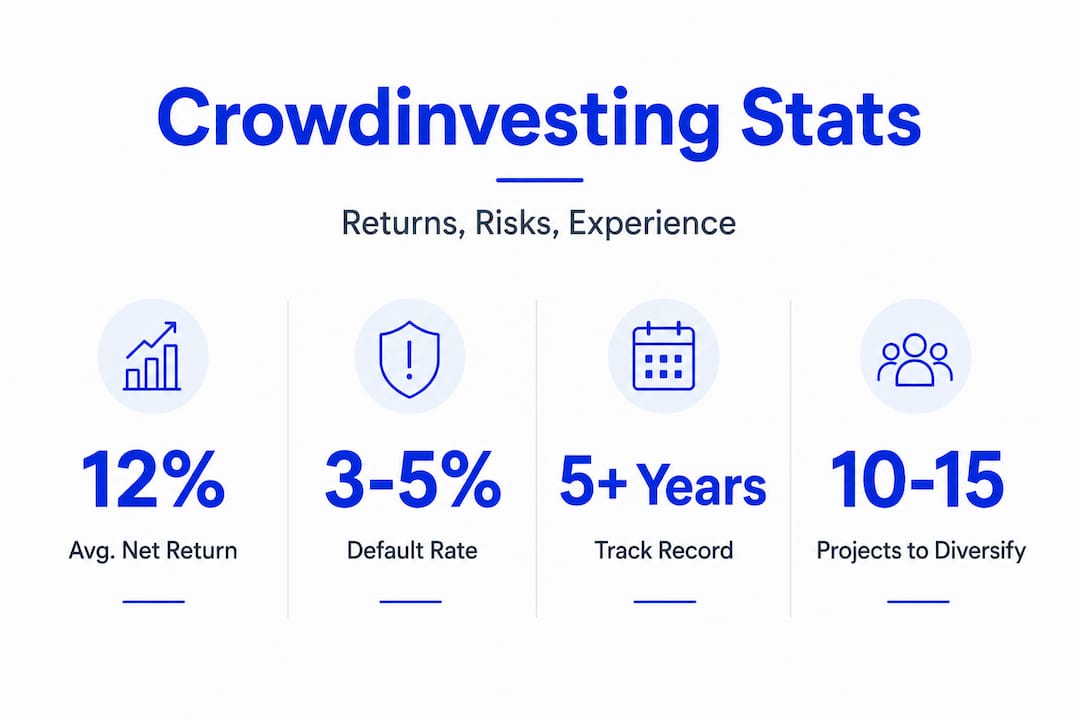
The most instructive real-world data comes from long-term investor accounts. One detailed investor report tracked 12% net annual returns over five years after accounting for defaults, platform fees, and reinvestment compounding. That figure sits well above the long-term average for European government bonds and comparable to the upper end of equity index performance, though with a very different risk structure.
Default rates across European crowdinvesting platforms typically range from 3% to 5% of deployed capital annually. That range sounds manageable, but it compounds meaningfully over time if you concentrate funds in just a few projects. A 5% default rate on a €10,000 portfolio costs you €500 per year before any recovery proceedings.
| Platform type | Avg gross yield | Typical default rate | Liquidity | Best suited for |
|---|---|---|---|---|
| Real estate (senior) | 5–10% | 1–3% | Low | Conservative investors |
| Real estate (mezzanine) | 10–14% | 3–7% | Low | Yield-focused investors |
| Renewable energy | 9–18% | 2–4% | Low to medium | ESG-focused investors |
| Startup equity | Highly variable | 10–30%+ | Very low | Risk-tolerant investors |
Cross-border factors add another layer. Research published in a ScienceDirect study on ESG and crowdinvesting found that cross-border campaigns typically achieve lower returns of around 8%, partly due to home bias (investors favouring domestic projects they understand better). ESG labelling, however, enhances performance on international platforms, suggesting that sustainability credentials genuinely help campaigns attract global capital.
“Crowdinvesting is not passive income on autopilot. The investors who consistently outperform are those who treat it like a part-time research job, reviewing financials, reading borrower histories, and diversifying across sectors and geographies.”
Pro Tip: Spread your capital across at least 10 to 15 projects spanning two or more sectors and two or more countries. This combination of sector and geographic diversification meaningfully reduces the impact of any single default on your overall portfolio performance.
Understanding risk factors in real estate crowdinvesting in detail will help you build a more resilient allocation strategy, particularly if real estate forms the core of your crowdinvesting portfolio.
Risks, regulations, and how to choose a platform
Before you take action, evaluating platform choice and understanding risk management is essential. The good news is that the regulatory environment in Europe has improved dramatically since 2021. The bad news is that many investors still choose platforms based on advertised yields alone, which is a reliable way to learn about defaults the hard way.
Key risks to keep on your radar:
-
Project delays: Common in real estate and infrastructure crowdinvesting, delays push expected returns into future periods without necessarily reducing them, but they do affect your liquidity.
-
Platform risk: If the platform itself becomes insolvent, your investments may be frozen or managed by a third-party administrator. Always check whether the platform operates a segregated account structure.
-
Regulatory changes: Shifts in national or EU-level rules can affect platform operations, tax treatment, and your rights as an investor.
-
Valuation opacity: In startup equity crowdinvesting, early-stage valuations are often aspirational rather than grounded in verified revenue data.
-
Currency and cross-border risk: Investing in projects denominated in currencies other than euros introduces exchange rate exposure.
Research published in Springer’s environmental economics journal highlights an important nuance: regulations improve platform safety but can compress yields, as platforms bear higher compliance costs. Additionally, investor risk-aversion tends to favour lower-risk offerings even when ESG features are present, meaning that high-yield ESG products do not automatically attract more capital than conventional low-risk ones.
How to evaluate a platform before investing:
-
✅ Check for ECSP licence: The European Crowdfunding Service Provider (ECSP) regulation requires platforms to hold a licence, meet capital requirements, and provide standardised risk disclosures. A licensed platform is not risk-free, but it operates under enforceable rules.
-
✅ Review the default history: Reputable platforms publish detailed statistics on funded projects, defaults, and recovery rates. If a platform does not share this data, treat that as a red flag.
-
✅ Assess track record and volume: A platform with €50 million or more in funded projects and multiple years of operation has a meaningful track record. New entrants with no history require extra scrutiny.
-
✅ Examine fee structures: Management fees, success fees, and exit fees all erode your net return. Model your actual net yield after all fees before committing capital.
-
✅ Read the Key Investment Information Sheet (KIIS): EU regulations require platforms to provide this document for each project. It summarises risk factors, financial projections, and investor rights in plain language.
Pro Tip: Use a platform aggregator or review site to compare default rates, fee structures, and investor reviews across multiple platforms before committing. This saves hours of individual platform research and surfaces problems that marketing materials never will.
Why crowdinvesting works, and where investors go wrong
Having explored sector data and risk frameworks, it’s worth stepping back for a candid view of why crowdinvesting genuinely delivers for disciplined investors — and where most people quietly stumble.
Crowdinvesting’s growth is not accidental. It emerged from two structural shifts: the democratisation of access to asset classes previously reserved for institutional investors, and a dramatic improvement in financial data transparency enabled by digital platforms. For the first time, a retail investor in Warsaw or Valencia can review the same financial information as a professional fund manager considering the same deal. That is genuinely powerful.
But here is what most new investors underestimate. The information asymmetry has not disappeared — it has simply moved. It used to exist between platforms and investors. Now it exists between investors who do rigorous due diligence and those who skim the headline yield and click invest. The 12% net returns reported by experienced long-term crowdinvestors are not random luck. They reflect disciplined research, sector diversification, and patience through project cycles.
The two most common mistakes we see European investors make are these. First, they over-weight ESG credentials. Sustainability labels are valuable, and the data confirms that ESG features help international campaigns raise more capital. But ESG compliance does not protect you from project delays or a weak sponsor’s balance sheet. Always assess financial fundamentals before sustainability credentials.
Second, investors underestimate home bias. There is a behavioural tendency to favour local platforms and projects you feel you understand, even when the evidence suggests that cross-border diversification (despite slightly lower gross returns) reduces volatility at the portfolio level. Holding 80% of your crowdinvesting capital on a single national platform is a concentration risk most investors would never accept in public equities but routinely accept here.
The investors who consistently outperform are those who treat crowdinvesting as a structured alternative allocation within a broader portfolio, not as a replacement for index funds or a get-rich-quick mechanism. Discipline, diversification, and regulatory vetting are the three pillars of crowdinvesting success. Everything else is noise.
Explore crowdinvesting with expert guidance
Crowdinvesting in Europe has never been more accessible, and the data shows that informed investors are capturing genuinely competitive returns across real estate, renewable energy, and startup equity. The key is pairing that opportunity with thorough research and a clear-eyed view of risk.
Crowdinform is your dedicated research partner for navigating the European crowdinvesting landscape. Think of it as the TripAdvisor of crowdfunding — aggregating reviews, yield data, and project intelligence from over 500 platforms across Europe, with an AI copilot that helps you evaluate individual projects before you commit a single euro. Whether you are comparing platform track records, assessing default histories, or exploring sector-specific opportunities, you can start exploring crowdinvesting platforms through Crowdinform’s live data and expert review system. Make your next investment decision with confidence, not guesswork. 🎂
Frequently asked questions
How does crowdinvesting differ from traditional crowdfunding?
Crowdinvesting gives you equity stakes or shares in a company or project, whereas traditional crowdfunding typically offers only rewards, products, or donations with no financial ownership or return. Crowdinvesting is equity crowdfunding where investors receive shares or ownership stakes in startups, SMEs, or projects in exchange for funding.
Are crowdinvesting returns guaranteed?
No, returns are never guaranteed. Platforms report 12% net annual returns over five years in favourable conditions, but defaults (typically 3 to 5% annually) and project delays can materially affect outcomes.
What sectors offer the best crowdinvesting returns?
Real estate and renewable energy platforms show the strongest double-digit yields, with Crowdestate reporting 14% yields and Ventus Energy offering 16 to 18% on mezzanine deals, though each sector carries distinct risk characteristics.
How do regulations protect crowdinvestors in Europe?
EU frameworks such as the ECSP regulation require platforms to hold licences, meet capital standards, and publish standardised disclosures. Research confirms that regulations improve platform safety though they can also compress advertised yields as compliance costs rise.
What is the minimum investment in crowdinvesting platforms?
Minimum investments vary by platform but commonly start at €100, making crowdinvesting accessible to a wide range of European investors, from those just starting out to those building diversified alternative asset portfolios.


