
An investor community is a structured group of individuals who pool knowledge, networks, and sometimes capital to improve their investment outcomes. These groups range from informal online forums and angel syndicates to in-person meetups and regulated crowdfunding collectives. Platforms like Angel Squad and ii Community have demonstrated that shared investing knowledge accelerates learning and opens doors to deals most individuals would never access alone. Whether you are a complete beginner or a seasoned portfolio holder, understanding what is investor community means understanding one of the most practical tools in modern investing.
What is an investor community and how does it work?
An investor community is defined as a collective of like-minded individuals, ranging from novices to professionals, who share knowledge and sometimes capital to improve investment outcomes. The industry term for the most formalised version is an angel syndicate or investment circle, though the broader concept covers everything from Reddit threads to regulated co-investment vehicles.
Investor communities operate via three primary formats:
- Online forums and digital platforms: Discussion boards, Slack groups, and dedicated apps where members share research, news, and portfolio updates in real time.
- Angel syndicates: Formalised groups led by an experienced syndicate lead who manages deal flow, due diligence, and legal structures on behalf of members.
- In-person meetups and investor networking events: Regular gatherings, pitch nights, and workshops where members meet founders and fellow investors face to face.
Each format serves a different need. Online forums suit continuous learning and broad networking. Angel syndicates suit those ready to deploy capital into early-stage startups. In-person events build the social capital that underpins long-term investing relationships.
| Format | Best For | Typical Commitment |
|---|---|---|
| Online forum | Learning and networking | Low (hours per month) |
| Angel syndicate | Deal access and co-investment | Medium to high |
| In-person meetup | Relationship building | Variable |
| Investment circle | Peer portfolio review | Low to medium |

Syndicates use Special Purpose Vehicles (SPVs) to simplify investment structures and cap tables. This means each deal sits inside its own legal wrapper, protecting members from liabilities in other deals. The Dingman Center Angels at the University of Maryland, for example, operates a structured membership model with defined fees and a formal screening process for both members and startups.
Pro Tip: Before joining any community, check whether it uses SPVs for syndicated deals. SPVs protect your liability and simplify your tax reporting considerably.
What benefits do investor communities offer members?
The core investor group benefits fall into four categories: deal access, risk reduction, education, and network effects.
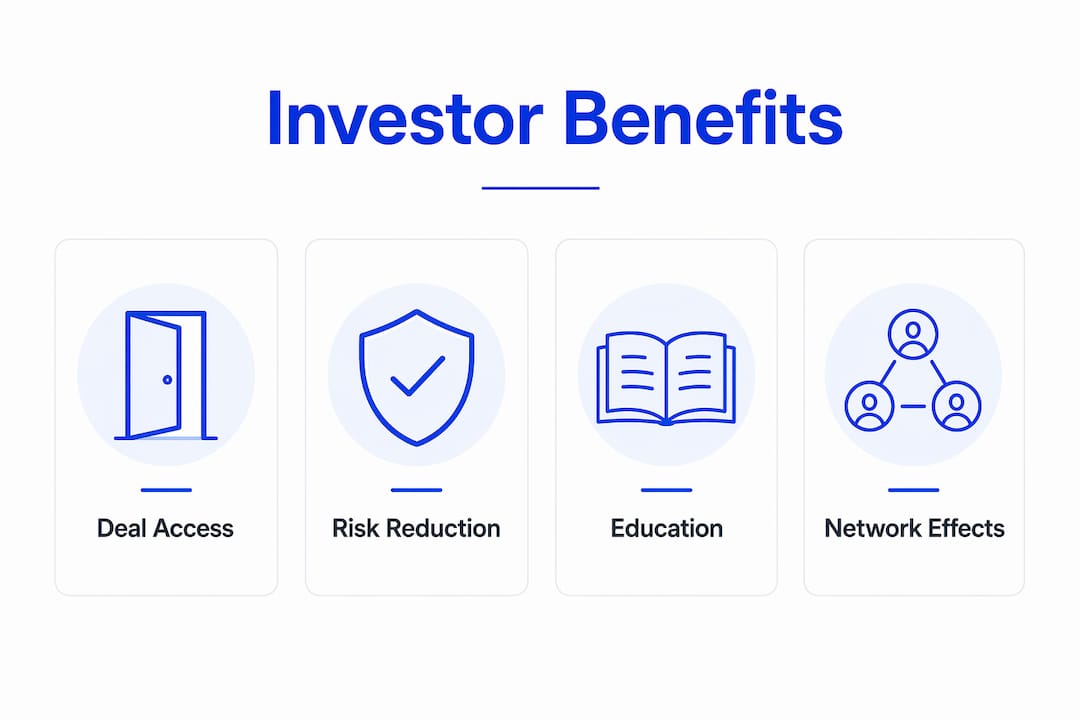
Deal access is the most immediate advantage. Angel Squad, with over 2,000 members investing collectively over £24 million in 70+ startups, demonstrates the scale of opportunity available inside a well-run community. Individual investors rarely see these deals independently.
Shared due diligence is equally valuable. When 20 members each spend two hours researching a startup, the group produces the equivalent of 40 hours of analysis. That collective effort reduces individual workload and surfaces risks one person might miss. Portfolio diversification also improves naturally, since communities expose members to sectors and geographies outside their usual focus.
The educational advantages are significant too:
- Members from diverse professions, including doctors, pilots, and engineers, contribute sector-specific knowledge that generalist investors lack.
- Regular pitch events and post-mortem discussions build analytical skills faster than solo investing.
- Mentorship from experienced lead investors accelerates the learning curve for newcomers.
"The most successful angel investor communities value curiosity and willingness to learn over prior venture capital experience." — Angel Squad research
This insight matters because it removes the intimidation barrier. You do not need a finance degree or a track record to contribute meaningfully. A pilot's understanding of aviation regulation, for instance, is genuinely useful when evaluating an aerospace startup.
Pro Tip: Track which community members have sector expertise relevant to your investment focus. Their questions during pitch events are often more revealing than the founders' presentations.
The tax advantages within certain structures are worth noting too. UK-based angel syndicates frequently invest through SEIS (Seed Enterprise Investment Scheme) and EIS (Enterprise Investment Scheme) vehicles, offering income tax relief of up to 50% and 30% respectively on qualifying investments.
How to join an investor community: what to expect
Joining an investor community is more accessible than most people assume. The process varies by community type, but most follow a recognisable pattern.
- Identify the right format. Decide whether you want a learning-focused forum, a deal-flow syndicate, or a local meetup group. Your choice should match your current knowledge level and capital availability.
- Complete an application or expression of interest. Curated communities like Angel Squad require you to demonstrate investment focus and history, but many accept learning members with no prior experience.
- Assess cultural fit. Many communities use a trial period, sometimes a 14-day free trial, to assess whether your communication style and values align with the group. Simple behavioural filters, such as the informal rule of "don't be an a-hole," are used to maintain trust and quality.
- Engage before you invest. Attend events, ask questions, and contribute to discussions before committing capital. Seasoned members notice who listens carefully and who rushes to invest.
- Start with observation. Spend your first one to three months understanding how the group evaluates deals, who the trusted voices are, and what the community's risk appetite looks like.
Cultural fit is the critical requirement for joining exclusive investor communities. Groups that ignore this tend to fracture when a deal goes wrong, because trust dissolves under pressure. Communities that screen carefully maintain cohesion through both wins and losses.
The barriers to entry are lower than they appear. Many digital communities charge modest monthly or annual fees, and some offer free tiers for observers. The real currency is contribution, not capital. Members who share useful research, flag relevant news, or introduce quality founders are valued regardless of how much they invest.
Pro Tip: Attend at least two or three investor networking events as a guest before applying for full membership. You will learn more about a community's real culture in a room than on its website.
What are the challenges inside investor communities?
Investor communities carry genuine risks that members rarely discuss openly. The same social dynamics that accelerate learning can also distort judgement.
Digital trading communities reduce uncertainty through collective learning but may amplify behavioural biases such as overconfidence and herding. When a respected lead investor backs a deal enthusiastically, less experienced members often follow without independent analysis. This is herding behaviour, and it has caused significant losses in communities where social pressure outweighs critical thinking.
"Strong social interactions can negatively affect financial decision quality if critical independence is lacking." — Research on digital investor behaviour
Overconfidence is the second major risk. Communities that have backed several successful deals develop a shared belief that their process is superior. That belief reduces scrutiny on subsequent deals, precisely when scrutiny matters most.
Experienced investors manage this by treating community input as one data source among several. They balance social learning with independent analysis, and they are willing to pass on deals the group finds exciting if their own research does not support the valuation. Pitch events, as seasoned members understand, aim to secure follow-up due diligence rather than immediate investment commitments. Treating them as the end of the process rather than the beginning is a common and costly mistake.
The healthiest communities actively encourage dissent. Members who ask uncomfortable questions about a startup's unit economics or founder background are assets, not obstacles.
Key takeaways
An investor community is most valuable when members contribute actively, maintain independent thinking, and choose a format that matches their experience and goals.
| Point | Details |
|---|---|
| Definition matters | An investor community pools knowledge and capital across formats including syndicates, forums, and meetups. |
| Deal access is the top benefit | Communities like Angel Squad unlock vetted deal flow and shared due diligence unavailable to solo investors. |
| Cultural fit drives success | Communities screen for behaviour and values, not just investment experience, to preserve trust. |
| Herding is the primary risk | Social dynamics can amplify poor decisions; independent analysis must complement community input. |
| Entry barriers are low | Many communities accept learning members with no prior experience, prioritising curiosity over credentials. |
Why i think most people join investor communities for the wrong reason
People join investor communities expecting better returns. That is the wrong starting point. The real value is in what you learn before you invest a single pound.
I have observed that the members who extract the most from these groups are not the ones writing the biggest cheques. They are the ones asking the sharpest questions at pitch events, flagging the regulatory risk nobody else noticed, and building genuine relationships with founders over months rather than minutes. The financial returns follow from that quality of engagement, not the other way around.
The behavioural risks are real and underappreciated. I have seen communities where a single charismatic lead investor effectively decided every deal, with the rest of the group providing social validation rather than independent analysis. That is not a community. That is a fan club with a shared brokerage account.
The communities worth joining are the ones that celebrate the member who passed on a deal the group loved, and was right to do so. Dissent, when grounded in research, is the most valuable contribution any member can make. If a community punishes that, leave quickly.
For anyone starting out, my honest advice is to spend the first three months as a student, not an investor. Use the platform comparison tools available to you, attend every event you can, and resist the pressure to deploy capital before you understand the group's real decision-making culture. Patience at the start compounds just as reliably as capital over time.
— Jevgenijs
Explore investor communities through Crowdinform
Crowdinform aggregates and reviews over 500 European crowdfunding platforms, giving you a clear, independent view of where investor communities are most active and which platforms offer the strongest deal flow.

Whether you are interested in loans, real estate, and startups or want to compare platforms before committing, Crowdinform's AI copilot reviews individual projects and surfaces the data you need to make informed decisions. You can explore top investment projects across Europe, read verified platform reviews, and identify communities that match your investment focus. Think of it as your research base before you walk into any investor networking event or syndicate application. Start exploring at Crowdinform today.
FAQ
What is an investor community in simple terms?
An investor community is a group of individuals who share knowledge, research, and sometimes capital to improve their investment decisions. Formats include online forums, angel syndicates, and in-person meetup groups.
How do i join an investor community as a beginner?
Many communities accept learning members with no prior investment experience, prioritising curiosity and cultural fit over credentials. Start by attending investor networking events as a guest, then apply for membership once you understand the group's values and process.
What is an investment circle and how does it differ from a syndicate?
An investment circle is an informal peer group that shares portfolio insights and research without necessarily co-investing. An angel syndicate is a formalised structure where a lead investor manages due diligence and members co-invest through a Special Purpose Vehicle (SPV).
What are the main risks of joining an investor community?
The primary risks are herding behaviour and overconfidence, where social dynamics lead members to follow group sentiment rather than independent analysis. Maintaining your own research process alongside community input reduces these risks significantly.
Are there tax advantages to investing through a community?
UK-based angel syndicates frequently structure deals through SEIS and EIS vehicles, offering income tax relief of up to 50% and 30% respectively on qualifying investments. Always confirm the tax structure of any deal with a qualified adviser before committing capital.


