
Investment aggregators are digital platforms that consolidate all your financial accounts into one accessible dashboard, giving you a complete picture of your net worth, asset allocation, and portfolio performance at a glance. If you manage investments across multiple brokers, crowdfunding platforms, and pension accounts, the question of why use an investment aggregator has a direct answer: fragmented data costs you time, money, and clarity. Average investors manage finances across 3–5 different apps, and that fragmentation creates blind spots that aggregation resolves. Crowdinform, which aggregates data from over 500 European crowdfunding platforms, is one example of how this principle applies specifically to alternative investments.
Why use an investment aggregator for portfolio tracking?
Portfolio tracking without aggregation means logging into multiple platforms, exporting spreadsheets, and manually reconciling figures that are already out of date. Aggregation replaces that process with a single, live dashboard. Saving several hours monthly is a direct result of reducing multi-app management to one platform. Those hours compound over a year into meaningful time you can redirect toward actual investment research.
The practical benefits of centralised tracking include:
- One login covers all accounts, from brokerage and P2P lending to real estate crowdfunding and pension funds.
- Real-time net worth calculation updates automatically as asset values change, removing the lag of manual entry.
- Performance attribution shows which holdings drive returns and which drag on the portfolio, across all custodians simultaneously.
- Fee visibility surfaces total costs across platforms, which are easy to miss when accounts sit in separate dashboards.
- Allocation snapshots reveal how much of your portfolio sits in equities, fixed income, or alternative assets at any given moment.
Manual tracking introduces errors. A mistyped figure or a forgotten account can distort your allocation view entirely. Aggregation removes that error source by pulling data directly from connected accounts.
Pro Tip: When setting up an aggregator, include every account, even small or dormant ones. A forgotten P2P lending account or an old ISA can skew your true risk exposure if left out of the consolidated view.

What hidden risks does investment aggregation reveal?
Fragmented accounts mask risk concentrations in specific sectors or stocks, often without the investor realising it. You might hold technology stocks in a brokerage account, technology-heavy index funds in a pension, and equity crowdfunding stakes in tech startups, each appearing diversified in isolation. Viewed together, the concentration becomes obvious. This is one of the most compelling investment aggregation advantages, and one of the least discussed.
Fragmented view vs aggregated view
| Risk factor | Fragmented view | Aggregated view |
|---|---|---|
| Sector concentration | Invisible across accounts | Visible as a combined percentage |
| Duplicated holdings | Counted separately per platform | Identified and flagged as overlap |
| Currency exposure | Assessed per account only | Calculated as total portfolio weight |
| Liquidity profile | Unknown across asset classes | Mapped across all holdings |
| True risk tolerance alignment | Based on partial data | Based on complete portfolio picture |
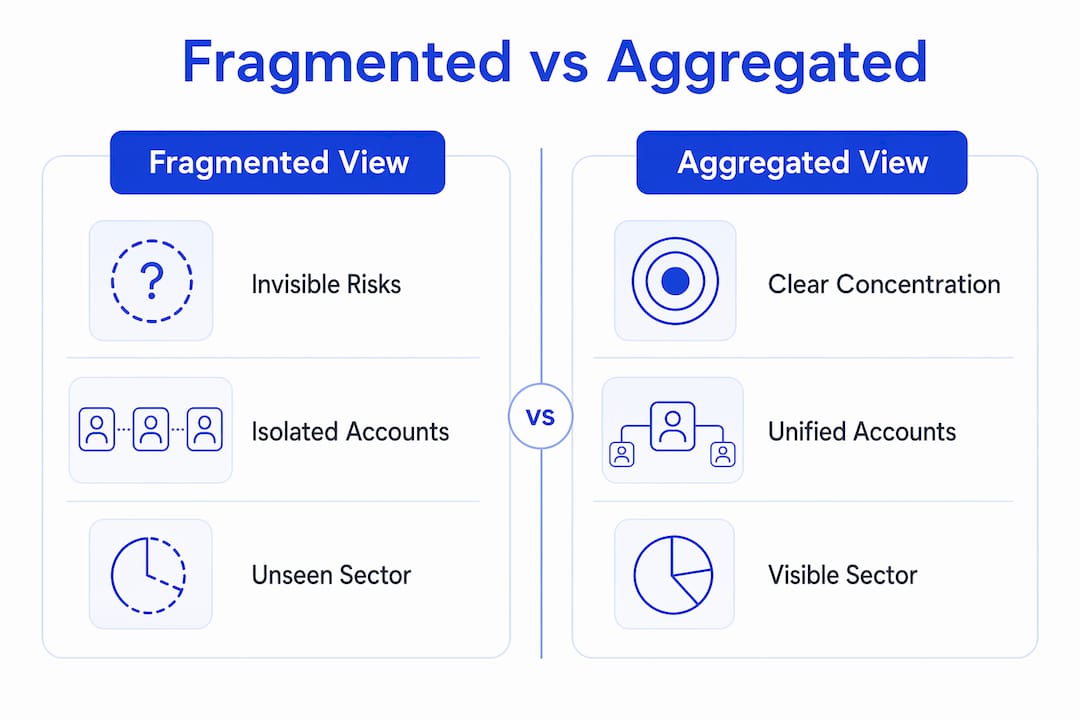
Aggregation tools enable advisors and investors to assess total portfolio risk and align recommendations with real risk tolerance, not assumed tolerance based on incomplete data. That distinction matters enormously when markets move sharply. Understanding why diversify investments is only half the equation. Knowing whether you have actually achieved diversification requires a consolidated view.
Pro Tip: Run a sector concentration check quarterly using your aggregated dashboard. If any single sector exceeds 25% of your total portfolio, that warrants a rebalancing review regardless of how the individual accounts look in isolation.
How do investment aggregators improve efficiency for investors and advisors?
Operational efficiency is one of the clearest, most measurable benefits of investment aggregators. Financial firms using aggregation tools spend 30% less time on administrative tasks and increase client interaction by 20%. That shift matters because the time saved from manual reconciliation goes directly into higher-value work: portfolio analysis, tax planning, and strategic rebalancing.
For self-directed investors, the efficiency gains are equally significant:
- Automated data reconciliation removes the need to manually update spreadsheets after every transaction.
- Consolidated reporting produces a single performance report covering all accounts, useful for tax preparation and annual reviews.
- Alert systems notify you when an allocation drifts beyond a set threshold, so you act on data rather than gut feeling.
- Shared dashboards allow you to share a complete financial picture with a financial adviser without emailing multiple statements.
Sharing aggregated data transforms advisor relationships from guesswork to precision guidance. When an adviser sees your full picture, including alternative investments and crowdfunding positions, they give better advice. A unified view of assets and transactions also increases investor loyalty and engagement through trust and transparency. That trust is built on completeness, not summaries.
For investors in alternative assets specifically, this efficiency is critical. Crowdfunding positions, P2P loans, and real estate investments often sit on separate platforms with different reporting formats. Aggregation brings them into a single, comparable view. Learning how to analyse investment platforms becomes far more productive when you can compare them side by side.
What separates basic aggregators from advanced investment platforms?
Basic aggregators show account balances only, while advanced platforms offer tax-lot tracking, rebalancing tools, and cross-asset exposure analysis. That distinction separates a simple data display from a genuine decision-support system. The difference matters most when you are managing a complex portfolio across multiple asset classes and custodians.
Feature comparison by platform type
| Feature | Basic aggregator | Advanced platform |
|---|---|---|
| Account balance display | ✅ | ✅ |
| Performance tracking | Limited | Full attribution |
| Tax-lot accounting | ❌ | ✅ |
| Rebalancing tools | ❌ | ✅ |
| Equity compensation tracking | ❌ | ✅ |
| Cross-asset exposure analysis | ❌ | ✅ |
| AI-assisted project review | ❌ | ✅ (e.g. Crowdinform) |
Aggregation depth varies widely. Decision-support features like tax-lot accounting, rebalancing tools, and equity compensation tracking separate simple from advanced systems. For investors managing alternative assets alongside traditional holdings, those advanced features are not optional extras. They are the tools that turn data into decisions.
Crowdinform sits in the advanced category for alternative investments specifically. Its AI copilot reviews individual crowdfunding projects and provides structured analysis, going well beyond a balance display. That capability reflects the direction the broader investment management platform market is moving: from data aggregation toward AI-assisted interpretation.
How to implement aggregation in your investment workflow
Getting the most from portfolio consolidation requires a deliberate setup. These steps give you a clear, complete financial picture from day one.
-
List every account you hold. Include brokerage accounts, ISAs, SIPPs, P2P lending accounts, real estate crowdfunding positions, and any equity compensation plans. Missing one account undermines the whole exercise.
-
Connect accounts via open banking or API where available. Manual entry works for illiquid assets like property, but automated connections reduce errors and keep data current.
-
Categorise each holding by asset class and geography. This enables meaningful allocation analysis rather than a simple balance total.
-
Set concentration thresholds. Decide in advance what percentage in any single sector, geography, or asset class triggers a review. Your aggregator can then alert you automatically.
-
Review fee drag across all platforms. Investment fragmentation causes hidden tax inefficiencies and duplicated investments, costing investors in unnecessary drag annually. Aggregation is the only way to see total fee exposure across custodians.
-
Schedule a monthly allocation review. Use the consolidated dashboard to check whether your actual allocation still matches your target. Rebalance where it has drifted.
-
Share the view with your adviser. A complete picture enables better advice. If you work with a financial adviser, give them read access to your aggregated dashboard rather than sending fragmented statements.
The transparency in crowdfunding principle applies equally to your own portfolio management. The more clearly you can see your positions, the better your decisions become. Transparency in trading tools reinforces this point: complete data visibility is the foundation of informed decision-making, not a nice-to-have feature.
Key takeaways
Investment aggregation is the most direct way to convert fragmented financial data into clear, actionable portfolio intelligence.
| Point | Details |
|---|---|
| Centralise all accounts | Include every account, including alternative investments, for an accurate financial picture. |
| Reveal hidden concentration | Aggregation exposes sector and asset overlaps invisible in fragmented views. |
| Reduce administrative time | Firms using aggregation tools spend 30% less time on admin and engage clients 20% more. |
| Choose advanced features | Tax-lot tracking, rebalancing, and AI review separate decision-support tools from basic balance trackers. |
| Review allocations monthly | Use consolidated data to check drift against your target allocation and act on real figures. |
Why I think aggregation is the most underrated tool in alternative investing
Most investors I speak with focus on finding the right deal. They research platforms, compare yields, and assess borrower quality. What they rarely do is step back and look at the whole picture. That gap is where aggregation earns its value.
I have seen investors hold five different P2P lending positions across five platforms, each believing they were diversified. Viewed together, all five were lending to similar borrower profiles in the same geography. The concentration was invisible until someone consolidated the data. Aggregation does not just save time. It changes what you can see.
The discipline that comes from a monthly consolidated review is also underappreciated. When you see your full allocation in one place, emotional decisions become harder to justify. The data either supports a move or it does not. That clarity reduces the kind of reactive trading that erodes returns over time.
The future of aggregation points toward AI-assisted interpretation, not just data display. Platforms like Crowdinform are already moving in that direction, using AI to review individual crowdfunding projects and surface insights that would take hours to compile manually. That shift from aggregation to interpretation is where the real value lies for alternative investors in 2026 and beyond. If you want a practical guide to smart investing, aggregation is the foundation worth building first.
— Jevgenijs
Crowdinform: aggregated intelligence for alternative investors
Crowdinform brings investment aggregation principles directly to the European alternative investment market.
The platform aggregates data from over 500 European crowdfunding platforms, covering loans, real estate, and startup equity. Its built-in AI copilot reviews individual investment projects and delivers structured analysis, so you spend less time researching and more time deciding. For investors managing positions across multiple crowdfunding platforms, Crowdinform provides the consolidated, transparent view that fragmented platform dashboards cannot. Explore the platform to see how aggregated data and AI-assisted project review work together for alternative asset investors.
FAQ
What is an investment aggregator?
An investment aggregator is a platform that connects multiple financial accounts into one dashboard, displaying net worth, asset allocation, and performance data in a single view.
Why use an investment aggregator for alternative investments?
Alternative investments sit across multiple platforms with different reporting formats. Aggregation brings them into a single, comparable view, revealing concentration risks and fee drag that are invisible in isolation.
How does aggregation reduce portfolio risk?
Aggregation provides a true portfolio-wide risk profile by combining data from all accounts, exposing unintentional sector concentrations and duplicated holdings that fragmented views hide.
What is the difference between a basic and an advanced aggregator?
Basic aggregators display account balances. Advanced platforms add tax-lot tracking, rebalancing tools, cross-asset exposure analysis, and, in some cases, AI-assisted project review.
How much time does aggregation save?
Financial firms using aggregation tools spend 30% less time on administrative tasks. Self-directed investors save several hours monthly by replacing multi-platform logins and manual spreadsheets with a single automated dashboard.


