
Regulated
Bonus running
Can sell early
- Risk level
- High
- Risk-return
- Medium
- Start from
- €50
Referral link · capital at risk
See 42 projects →Questions about investing? Ask the AI guide.
Hi! I'm the Crowdinform AI guide.
Sign in free to ask the AI guide about platforms, projects and your plans.
Answers come from Crowdinform's checked data. Information, not personal investment advice.
Looking it up… Something went wrong. Please try again. {n} questions left today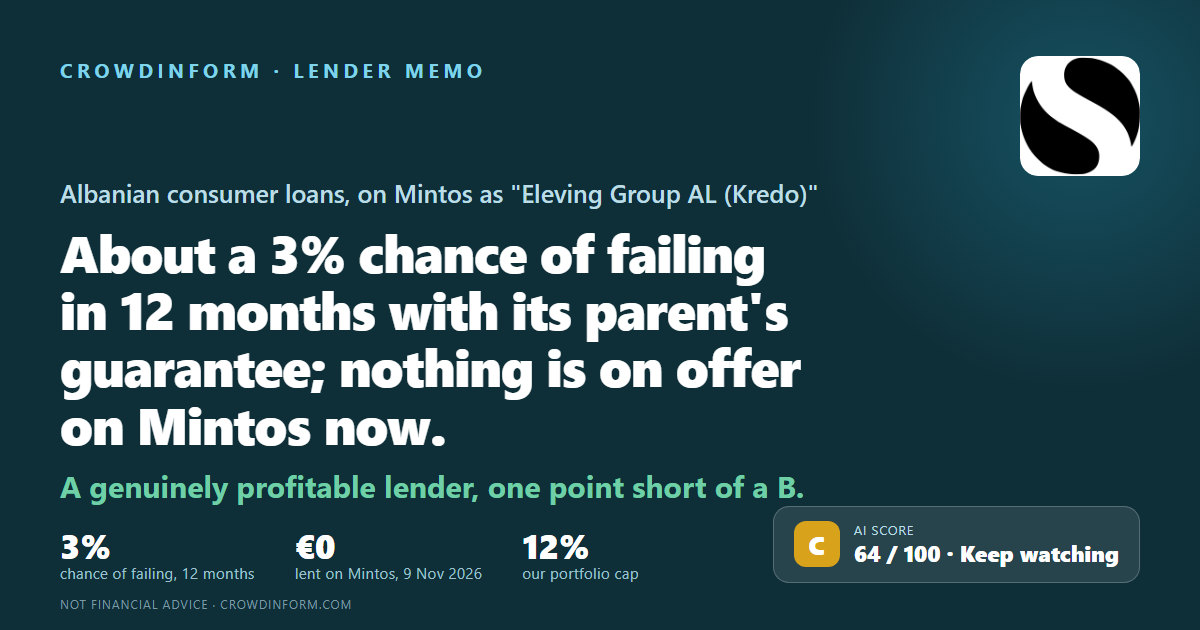
Albania
Capital at risk. The rate is agreed, not guaranteed: if a borrower defaults you can lose some or all of your money.
Our AI gives this project 64 out of 100: Medium. How the AI score works
Information, not personal investment advice. The AI score rates the documents the platform publishes, can be wrong, and does not predict returns.
ECFA Sh.A. makes small consumer loans in Albania — typically €960 over 21 months. Mintos investors know it as Kredo, and it is owned by Eleving Group. It was called Kredo Finance until December 2024. This memo asks one question: what is the chance it fails to pay its lenders back in the next 12 months, and why.
This is a solidly profitable lender. It makes real money from lending, keeps a thick cushion, and its parent, Eleving Group, is rated B by Fitch (affirmed December 2025) and guarantees its obligations to the Mintos company that issues the notes. The weak point is that the owners take out almost everything it earns. Each figure below shows the odds as if that were the only risk the company faced.
It kept €19.83 of every €100 of income in 2025, down from €33.23 — still a good year for a lender.
About a seventh of the book by value is in default — high, but stable, and more than covered by money set aside.
A sound economy, but a regulator cutting the legal price cap on exactly this product, every six months.
The owners take out nearly all the profit, and the company guarantees its parent’s bonds.
Every investment carries risk, and risk is not really a letter or a mark out of ten. It is two plain questions: how likely is it that this company fails, and how much of your money would you lose if it did. Put those together and you can see whether the reward is worth it.
For ECFA: about a 3% chance of failing in the next 12 months. If we assume about 30% of the money comes back in that case, the risk costs roughly 2.1% a year — against the 8.59% the loans pay. That leaves about 6.5% as the reward for taking the risk.
An advertised 8.59% is what you are promised if everything goes well. What you keep is that rate minus what failures cost you. So the rate on its own tells you very little — and the highest rates on a platform are usually high for a reason.
Risk cost = chance of failing × share of your money you would not get back. Nobody knows the second number in advance. How much comes back has varied widely from case to case. We use 30% back, 70% lost, as our own working assumption so that memos can be compared with each other — it is not a measured figure, and the answer moves a lot if you choose differently.
Take two imaginary lenders. One pays 14% but has a 17% chance of failing within the year: the risk costs about 11.9% a year, leaving roughly 2%. The other pays 9% with a 2.5% chance: the risk costs about 1.8%, leaving about 7%. The bigger number on the screen can easily be the worse one.
| With guarantee | Alone | |
|---|---|---|
| Chance of failing in a year | 3.0% | 3.1% |
| Loss if it fails (70%) | × 0.7 | × 0.7 |
| Risk cost a year | 2.1% | 2.2% |
| Rate offered on Mintos | 8.59% | 8.59% |
| Left after the risk cost | about 6.5% | about 6.4% |
Three things this arithmetic leaves out. The guarantee behind the 3.0% column is given to the Mintos company, not to you, so it reaches you only through that chain (section 5). The guarantee barely moves the number here anyway — the company scores almost as well on its own. And a real failure does not arrive as a yearly cost; it arrives all at once, which is why how much you put in one place matters as much as the rate.
The 8.59% is Mintos’s average rate across its outstanding ECFA notes. That is the rate on 13 September 2026; on 9 November 2026 nothing was outstanding.
Where our number comes from: we score six questions out of five, weight them into a score out of 100, and convert that score into a chance of failure using the long-run default rates that S&P publishes for companies of each credit quality. Small lenders fail more often than rated companies, so we treat every figure as a floor rather than a best guess. It is our own estimate from public documents — not a credit rating, not a market price, and not a promise about what will happen.
Bank of Albania licence since November 2017. 38 branches plus online and 222 staff at the end of 2024.
Average €960 over 21 months — small, short and expensive, which is what the loss rates reflect.
End of 2025, after money set aside for bad debts, down 7.5% in lek over the year. Before that deduction the book was €42.7m.
Through a Latvian holding company, which holds all the voting shares; staff hold 4.63% without votes. The parent is rated B by Fitch.
Listed there as "Eleving Group AL (Kredo)".
Read on 9 November 2026 — Mintos’s own figure. See the update at the top.
13 September 2026 — Mintos’s own figure. On 9 November 2026 Mintos showed no rate, because nothing was outstanding.
Buyback at 60 days late; Eleving Group guarantees ECFA to the Mintos company, and the underlying loans are pledged to it.
Updated 9 October 2026, read on 9 November 2026 — Mintos’s own score, not ours. We found no downgrade since 2023.
The full review covers the borrower or company, the security, the cash flow, the risks and a verdict. Sign in to read it.
Information, not personal investment advice. The AI score rates the documents the platform publishes, can be wrong, and does not predict returns.
Sign in to ask the AI about this project's documents.
Sign in👍 Yes · 0 👎 No · 0
Referral link · capital at risk
See 42 projects →Mintos