
Regulated
Bonus running
Can sell early
- Risk level
- High
- Risk-return
- Medium
- Start from
- €50
Referral link · capital at risk
See 42 projects →Questions about investing? Ask the AI guide.
Hi! I'm the Crowdinform AI guide.
Sign in free to ask the AI guide about platforms, projects and your plans.
Answers come from Crowdinform's checked data. Information, not personal investment advice.
Looking it up… Something went wrong. Please try again. {n} questions left today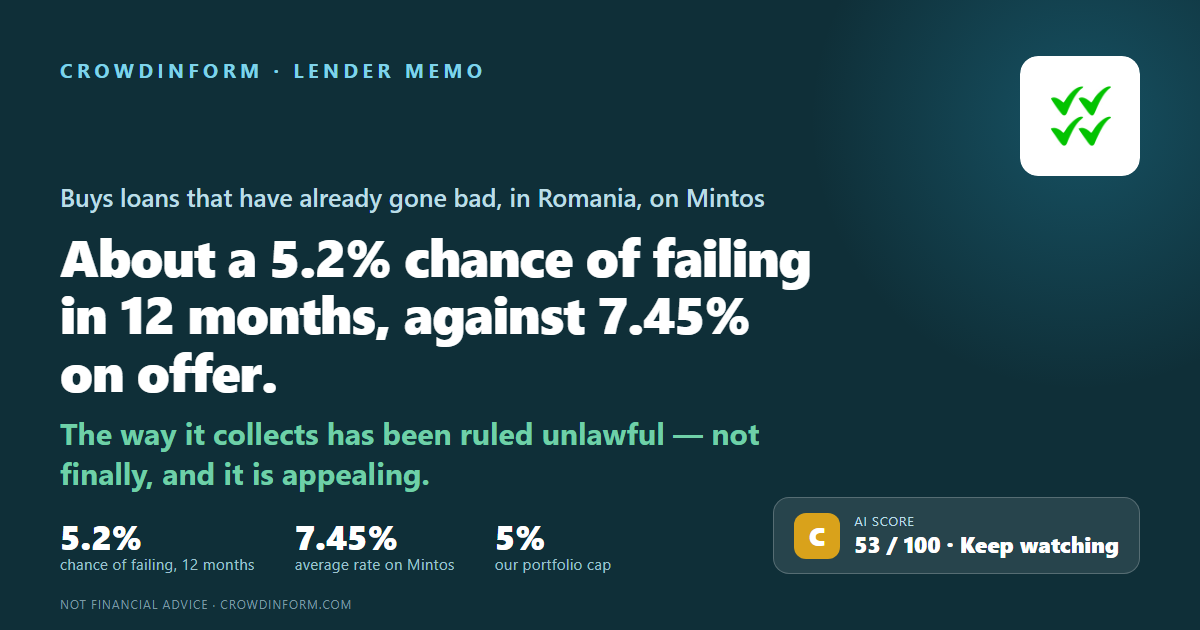
Romania
Capital at risk. The rate is agreed, not guaranteed: if a borrower defaults you can lose some or all of your money.
Our AI gives this project 53 out of 100: Medium. How the AI score works
Information, not personal investment advice. The AI score rates the documents the platform publishes, can be wrong, and does not predict returns.
Finopro IFN S.A. does not make ordinary loans. It buys loans that have already gone bad from two companies in its own group, and tries to collect them. Investors on Mintos lend money to it. This memo asks one question: what is the chance it fails to pay those lenders back in the next 12 months, and why.
We ask six questions about every lender: does it earn enough, are its loans being repaid, is there a cushion of the owners’ own money, how risky is the country, can we trust the numbers, and are there warning signs. Here is how Finopro answers them, in four cards — the first and last each cover two of the six. The percentage on each card is the chance of failing if that card were the only thing we knew about this company. They are not the answer, and they do not add up to it; the answer at the top weighs all six together.
Very profitable, and on the audited figures almost debt-free at the end of 2024: owners’ money of RON 58.5m against RON 74.4m of everything it owns, 79 lei in every 100. Nobody sets a minimum for that cushion and nobody watches it — not the central bank, and not the company itself. But the profit doubled because a contract with its sisters ended, not because it collected more — and the unaudited 2025 figures show borrowings appearing and the cushion thinner.
Almost every loan it owns was already in default when it bought it. What they are worth is the company’s own forecast of what it will collect — and its accounts record no change at all while collections run anywhere between 75% and 125% of that forecast.
The leu, not the euro. No settled government since May 2026, and parliament rejected a third prime minister on 30 September. Today Finopro can send a bailiff straight to a borrower’s door using the loan contract alone, without going to court first. A Romanian law, already a year late and due in force by 20 November 2026, would take that away. Mostly for loans signed after that date, so the effect builds over years — though the drafting may also reach older open-ended credits — overdrafts and revolving lines — at the point they are sold on.
It has no customer it won and no supplier it chose. The price it pays its sisters is set inside the group and has already been changed once by agreement between them. Its own related-party note does reconcile, but it still does not give the price it pays them.
Every investment carries risk, and risk is not really a letter or a mark out of ten. It is two plain questions: how likely is it that this company fails, and how much of your money would you lose if it did. Put those together and you can see whether the reward is worth it.
For Finopro: about a 5.2% chance of failing in the next 12 months. If we assume about 30% of the money comes back in that case, the risk costs roughly 3.7% a year — so the 7.45% rate on offer is worth about 3.8% once the risk is paid for.
An advertised 7.45% is what you are promised if everything goes well. What you keep is that rate minus what failures cost you. So the rate on its own tells you very little.
Risk cost = the chance of failing × the share you do not get back. We assume 30% comes back and 70% is lost. That 30% is an assumption we apply to every lender so they can be compared with each other — it is not a measured figure, and the answer moves a lot if you choose differently.
Take two imaginary lenders. One pays 14% but has a 17% chance of failing within the year: the risk costs about 11.9% a year, leaving roughly 2%. The other pays 9% with a 2.5% chance: the risk costs about 1.8%, leaving about 7%. The bigger number on the screen can easily be the worse one.
| With our figures | |
|---|---|
| Chance of failing in a year | 5.2% |
| Loss if it fails (70%) | × 0.7 |
| Risk cost a year | 3.7% |
| Rate offered on Mintos | 7.45% |
| Left after the risk cost | about 3.8% |
Its own accounts say it plainly: its main activity is debt collection. It is registered with Romania’s central bank in the special register of non-bank finance companies. It employed 17 people on average in 2024, the same as in 2023.
It buys them from two companies in its own group, Credius and Business Microcredit. Its accounts treat the portfolios it buys as impaired from the day they are bought. It also refinances people who are already behind on payments; it does not say how much of its business that is.
About €14.3m at 5.1 lei to the euro. That is 98 lei in every 100 of everything it owns. The figure is not a market price. It is the company’s own estimate of what it will collect, brought back to what that is worth today — so it is less than the cash it hopes to collect, and it moves when the estimate moves.
A debt-collection company at the same address holds 99.96%, and two individuals hold the rest. The accounts name NCH Balkan Fund L.P., of the Cayman Islands, as the party that ultimately benefits; we found no credit rating for it. The two sisters that sell to Finopro are held through a different company, Lapworth Holdings of Cyprus, which the accounts do not place above Finopro’s own owner. Finopro’s accounts say in terms that nobody above it, up to and including the ultimate beneficiary, prepares combined accounts.
It appears under the Credius brand; the legal entity named is FINOPRO IFN S.A. Its two sister companies sit under the same brand, and their own figures are not in this memo.
The average rate on Mintos when we read it on 9 November 2026, when about €1.6m was outstanding to investors. Platform figures read on 9 November 2026. It is the smallest of the three companies in this group.
Mintos’s own mark, not ours, read on 9 November 2026; Mintos last updated it on 9 October 2026 (it was 7.0 when we read it on 13 September 2026). The four parts behind it are 7.9 for how the loans perform, 7.9 for servicing, 5.6 for buyback strength and 7.2 for the structure of the arrangement — buyback strength being much the weakest, and it is the part that speaks to being paid.
The figure that follows is not about this company on its own. Mintos publishes it only for all three group companies together, so it tells you nothing about Finopro on its own. For the three together it was about €33,000 on €23.3m at 13 September 2026 — about 0.14%, against about 0.98% across the whole platform, so roughly a seventh of the platform figure. We have not given a comparison with the middle lender on the platform, because that figure moves depending on how the brands are counted and we could not settle it. Nothing in it says what Finopro’s own figure is.
The full review covers the borrower or company, the security, the cash flow, the risks and a verdict. Sign in to read it.
Information, not personal investment advice. The AI score rates the documents the platform publishes, can be wrong, and does not predict returns.
Sign in to ask the AI about this project's documents.
Sign in👍 Yes · 0 👎 No · 0
Referral link · capital at risk
See 42 projects →Mintos