
The role of AI in crowdfunding is to optimise campaign creation, sharpen investor forecasting accuracy, and automate personalised communication at scale. Platforms like GoFundMe have already demonstrated this concretely: their AI Smart Fundraising Coach increased campaign sharing by 10% and predicted an incremental $125 million funding increase in its launch year. Meanwhile, large language models like Gemini 2.5 Pro are outperforming human forecasters in predicting which tech ventures will succeed on crowdfunding platforms. For investors and entrepreneurs, understanding the impact of AI in fundraising is no longer optional. It is the competitive edge that separates informed decisions from expensive guesses.
How does AI improve crowdfunding campaign creation and management?
AI tools for crowdfunding are reshaping the entire campaign lifecycle, from the first blank page to post-launch follow-up. The biggest barrier most creators face is not a lack of ideas but the friction of translating those ideas into compelling, structured content that converts backers. AI removes that friction directly.

Platforms are embedding AI content generation natively into their workflows. RallyUp’s AI content generator produces donor-facing campaign copy with a single click, removing the need for a separate AI subscription or technical knowledge. GoFundMe’s Smart Fundraising Coach goes further by lowering the social awkwardness of the “ask,” reducing the psychological stress that causes many campaigns to stall before they even publish. This is a meaningful UX shift, not a cosmetic one.
The practical benefits of AI in campaign management include:
-
Automated content drafting: AI generates campaign descriptions, reward tiers, and donor thank-you messages, cutting creation time from hours to minutes.
-
Social sharing optimisation: AI schedules and personalises outreach across channels, increasing exposure without manual effort.
-
Follow-up automation: Timed backer communications maintain momentum during the critical mid-campaign dip.
-
Workflow completion tracking: Platform UX telemetry data, such as draft-to-publish completion rates, is as important an indicator of AI’s impact as the algorithm’s predictive quality.
Pro Tip: Test your AI-generated campaign copy against a human-written version before publishing. Research shows that an overly “machine-like” narrative tone can reduce backer trust and lower funding outcomes, so tune the voice to sound personal and specific rather than generic.
What evidence supports AI’s accuracy in predicting crowdfunding success?
The most striking finding in 2026 crowdfunding research is not that AI helps. It is that AI outperforms humans outright. A prediction tournament involving 870 LLM comparisons against 346 managers’ predictions across 30 live crowdfunding tech ventures found that the top AI model achieved a 0.74 correlation with actual outcomes, correctly predicting winners four out of five times. Human forecasters were less accurate than the leading models.
What makes this finding particularly useful for investors is the “augmentation trap.” Mixing human judgement with AI predictions did not improve accuracy. It frequently reduced it. Human involvement added noise to an already well-calibrated signal. This means the conventional assumption that human-in-the-loop AI is always better than AI alone is demonstrably wrong in this context.
| Forecasting approach | Accuracy (correlation) | Correct winner predictions |
|---|---|---|
| Gemini 2.5 Pro (top AI model) | 0.74 | 4 out of 5 |
| Human managers alone | Below AI benchmark | Below AI benchmark |
| Human-AI hybrid | Reduced vs. AI alone | Variable, often lower |
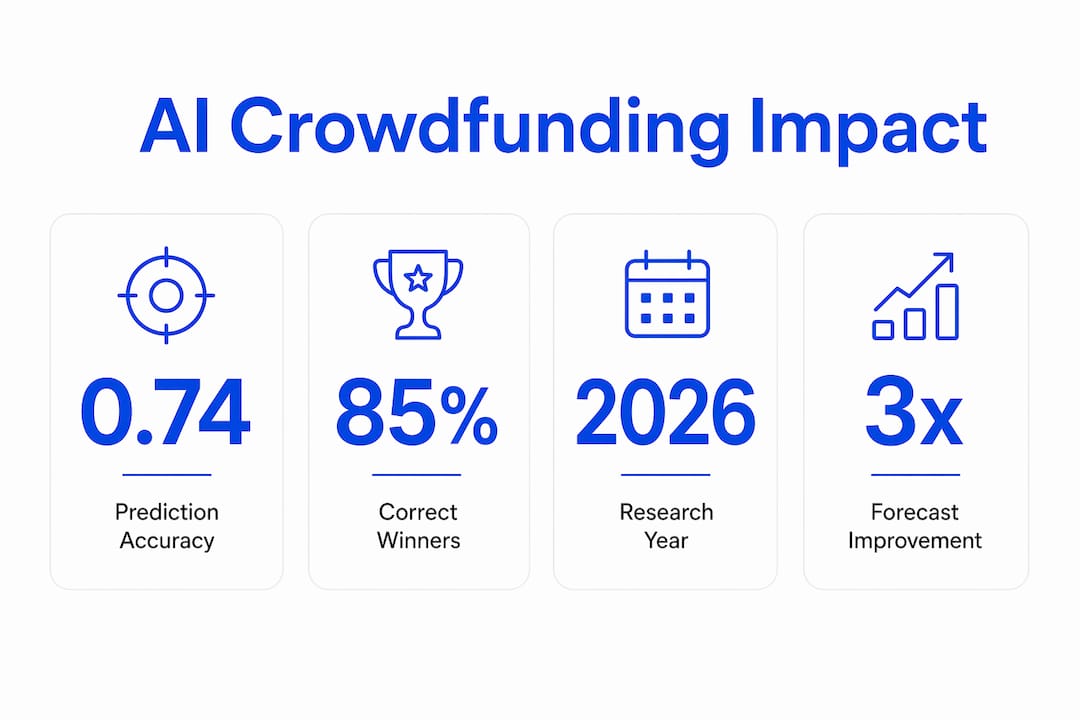
The data above illustrates a counterintuitive reality: AI reduces cognitive limits inherent in human forecasting by offering broader knowledge and greater consistency, qualities that human judgement can actually disrupt when layered on top.
Pro Tip: Treat human-AI hybrid forecasting as an experiment, not an assumption. Run A/B tests comparing AI-only predictions against your team’s adjusted forecasts across multiple campaigns before deciding which approach to standardise.
What challenges affect the role of AI in crowdfunding outcomes?
AI does not guarantee better results simply by being present. The 2026 peer-reviewed study of US Kickstarter data found that AI projects saw lower pledged amounts and fewer backers than non-AI projects when AI replaced rather than supported human creativity. The distinction matters enormously for how you position and manage your campaign.
Several nuances shape whether AI helps or hinders crowdfunding outcomes:
-
Narrative tone risk: Backers react to trust signals embedded in language. An overly machine-like narrative reduces funding success because it signals low personal investment from the creator. Authenticity is a backer heuristic, not just a stylistic preference.
-
Trust frictions differ by audience: Professional investors evaluate AI claims differently from retail backers. Retail backers respond more emotionally to tone; professional investors scrutinise capability claims and evidence.
-
Geographic and cultural moderation: Backer sentiment towards AI-generated content varies by market. European crowdfunding audiences, in particular, tend to apply stronger scepticism towards automated communications.
-
AI as support, not substitution: The most successful campaigns use AI to handle structure and logistics while preserving the founder’s authentic voice in the core narrative. Letting AI write the story wholesale is the single most common mistake in AI-assisted campaigns.
The implication for entrepreneurs is clear. AI tools for crowdfunding work best as a scaffold, not a ghostwriter. Your story, your credibility, and your voice remain the primary conversion drivers.
How do legal frameworks shape AI use in crowdfunding disclosure?
Regulatory clarity on AI in crowdfunding is advancing quickly, and the direction is unambiguous. SEC Chair Atkins confirmed in March 2026 that the SEC maintains a principles-based materiality approach for AI disclosures in equity crowdfunding, applying existing antifraud rules rather than creating AI-specific regulations. The standard is whether a reasonable investor would find the information significant. If your AI capabilities affect investment decisions, they are material and must be disclosed accurately.
The enforcement risk that demands immediate attention is “AI washing.” Regulators including the FTC and SEC are cracking down on exaggerated AI claims in fundraising materials, with penalties extending to civil and criminal liability. Overstating what your AI does, or implying algorithmic sophistication that does not exist, is now a prosecutable offence, not just a marketing misstep.
Practical compliance steps for issuers and entrepreneurs include:
-
Audit all marketing materials for AI capability claims and verify each claim against your actual system’s documented functionality.
-
Align offering documents with marketing copy precisely. Discrepancies between what your pitch deck claims and what your offering circular states create immediate regulatory exposure.
-
Disclose human involvement clearly. If a human reviews or overrides AI outputs, state that. Regulators and investors both value transparency about the human-AI division of labour.
-
Update disclosures regularly. AI systems evolve. A disclosure accurate at launch may become misleading six months later if your model changes significantly.
-
Avoid vague AI language. Phrases like “AI-powered” or “machine learning-driven” without specifics are red flags for regulators. Describe what the AI does, not just that it exists.
For a deeper understanding of disclosure standards and regulated crowdfunding platforms, the regulatory landscape in Europe adds additional layers of compliance that equity crowdfunding issuers must account for.
What practical strategies help investors and entrepreneurs use AI effectively?
Knowing that AI improves crowdfunding outcomes is useful. Knowing exactly how to apply it is what separates good intentions from measurable results. The following strategies reflect what the evidence actually supports in 2026.
For entrepreneurs, the priority is evaluating platforms by their end-to-end AI funnel integration rather than headline features. End-to-end AI integration, from drafting to social sharing, is a stronger predictor of campaign success than the raw quality of any individual AI model. A platform with a well-integrated but modest AI outperforms one with a powerful model that requires manual steps between stages.
For investors, the key is treating AI-generated forecasts as a starting signal rather than a final verdict. Run structured comparisons between AI-only assessments and your own due diligence across a portfolio of projects. Track which approach produces better outcomes over time, then weight your process accordingly. This is not about trusting AI blindly. It is about measuring AI accuracy empirically rather than assuming it.
Additional strategies worth implementing:
-
Monitor engagement metrics at each campaign stage (draft completion, sharing rate, backer conversion) to identify where AI is adding value and where it is not.
-
Test narrative styles systematically. Run two versions of campaign copy, one AI-drafted and one human-written, and measure backer response before committing to a full launch.
-
Be transparent with your audience about AI involvement. Backers who discover undisclosed AI use after the fact respond more negatively than those informed upfront.
For a broader view of how to maximise returns using these approaches, Crowdinform’s analysis of crowdfunding ROI in Europe provides a useful framework for benchmarking AI-assisted campaigns against market averages.
Key takeaways
AI improves crowdfunding outcomes most reliably when it supports human creativity rather than replacing it, and when investors treat AI forecasts as testable signals rather than automatic truths.
| Point | Details |
|---|---|
| AI prediction accuracy | Gemini 2.5 Pro achieved 0.74 correlation, outperforming human forecasters in 30 live tech ventures. |
| Augmentation trap | Combining human judgement with AI forecasts frequently reduces accuracy rather than improving it. |
| Narrative tone risk | Overly machine-like campaign copy lowers backer trust and reduces pledged amounts on platforms like Kickstarter. |
| Regulatory compliance | SEC and FTC enforce existing antifraud rules on AI claims; AI washing carries civil and criminal penalties. |
| Platform integration | End-to-end AI workflow integration, from draft to sharing, drives better funding outcomes than model quality alone. |
Why I think most investors are still misreading AI’s role in crowdfunding
By Jevgenijs
The conversation around AI in crowdfunding tends to split into two camps: uncritical enthusiasm and blanket scepticism. Both miss the point. What the 2026 prediction tournament data actually shows is something more precise and more useful. AI is not a magic forecaster, and it is not hype. It is a tool with a measurable accuracy ceiling and a specific failure mode when humans interfere without adding genuine insight.
What I find most underappreciated is the augmentation trap finding. Investment teams routinely assume that adding human review to an AI forecast improves it. The evidence says the opposite is often true. That should prompt a serious rethink of how due diligence workflows are structured, not just for crowdfunding but across early-stage investing generally.
The narrative tone issue is equally underestimated. Entrepreneurs are rushing to use AI-generated copy without testing whether it actually converts backers. A 0.74 prediction correlation is impressive. But if your campaign copy reads like a press release written by a committee, no forecast accuracy will save your funding round. The human voice in the campaign narrative is not a soft consideration. It is a hard conversion variable.
My advice: treat AI as your analyst, not your author. Use it to forecast, to structure, and to automate the mechanical parts of campaign management. Then write the story yourself.
— Jevgenijs
Explore AI-driven crowdfunding opportunities with Crowdinform
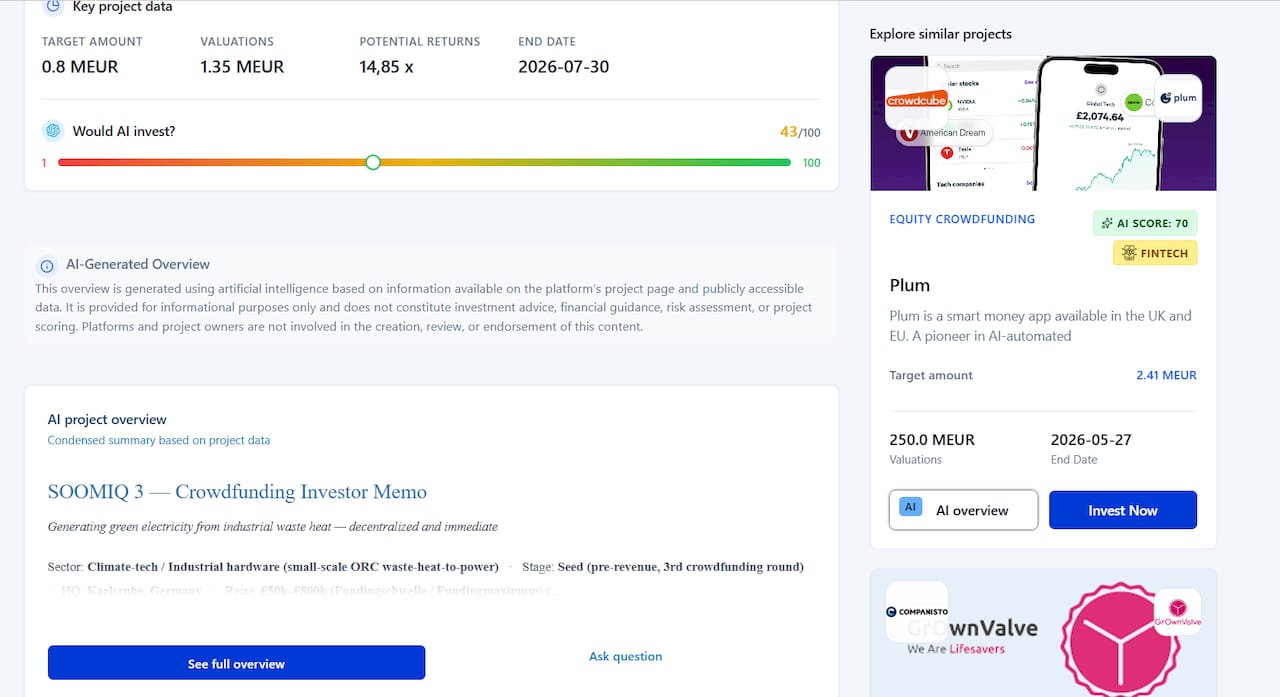
Crowdinform aggregates and reviews over 500 European crowdfunding platforms, giving investors and entrepreneurs a single, structured view of where AI-enhanced opportunities are emerging. The platform’s built-in AI copilot provides project-level reviews, helping you evaluate campaigns with the same analytical rigour that the best institutional investors apply. Whether you are assessing a reward-based campaign on Kickstarter or an equity raise on a regulated European platform, Crowdinform surfaces the data you need to decide with confidence. Start exploring investment opportunities across loans, real estate, and startups, all in one place.
FAQ
What is the role of AI in crowdfunding?
AI automates campaign creation, personalises backer communication, and improves investment forecasting accuracy. Platforms like GoFundMe and RallyUp embed AI directly into campaign workflows to reduce friction and increase funding outcomes.
Can AI predict which crowdfunding campaigns will succeed?
Yes, with measurable accuracy. A 2026 prediction tournament found that Gemini 2.5 Pro achieved a 0.74 correlation with actual outcomes across 30 live tech ventures, correctly predicting winners four out of five times.
Does combining human judgement with AI improve crowdfunding forecasts?
Not reliably. Research from the 2026 prediction tournament shows that mixing human judgement with AI forecasts frequently reduces accuracy, a phenomenon researchers call the “augmentation trap.”
What are the legal risks of using AI in crowdfunding marketing?
Regulators including the SEC and FTC are actively enforcing against AI washing, where issuers exaggerate AI capabilities in fundraising materials. Penalties include civil and criminal liability, making accurate, consistent AI disclosure a compliance priority.
How should entrepreneurs use AI in crowdfunding campaigns?
Use AI to handle structure, scheduling, and content drafts, but preserve your authentic voice in the core narrative. Research confirms that an overly machine-like tone reduces backer trust and lowers pledged amounts on platforms like Kickstarter.