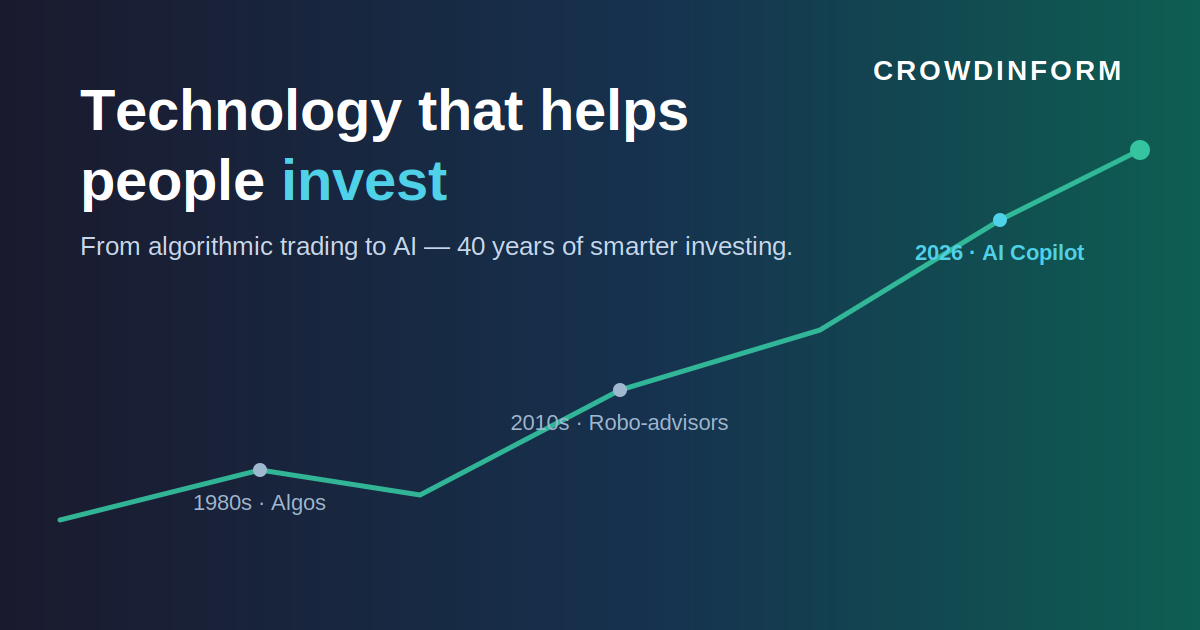
People have always looked for ways to put their money somewhere and make sure it grows. From land and livestock to government bonds, from the first joint-stock companies of the 1600s to today's index funds, the underlying question has never changed: where do I place my capital, and how do I know it's in good hands? What has changed — dramatically — is the toolkit we use to answer it.
For most of history, that toolkit was human judgment, personal networks, and paper. Then came technology. And for the last four decades, every major leap in investing has been a technology leap first.
A Short History: Technology Has Been Investing's Silent Partner for Decades
Technology in investment is not new — AI is simply the latest chapter in a long story.
The 1970s–1980s: electronic markets and program trading. NASDAQ launched in 1971 as the world's first electronic stock market. By the 1980s, institutional desks were running "program trading" — computer-executed basket trades that moved faster than any human floor broker could.
The 1990s–2000s: algorithmic and high-frequency trading. As markets went fully electronic, algorithms took over execution. Quantitative hedge funds like Renaissance Technologies proved that mathematical models could systematically beat markets — its famous Medallion Fund reportedly averaged roughly 66% gross annual returns between 1988 and 2018 using proprietary machine learning, decades before "AI" became a household word. By the 2010s, high-frequency trading accounted for the majority of equity trading volume in the US.
The 2010s: robo-advisors bring automation to retail. Betterment and Wealthfront launched in the aftermath of the 2008 financial crisis with a simple promise: automated, low-cost portfolio management for everyone. Answer a questionnaire, get a diversified ETF portfolio, let the software rebalance and harvest tax losses. Robo-advisors now manage hundreds of billions globally and made "letting an algorithm manage your money" feel completely normal.
The 2020s: the AI era. Large language models and modern machine learning changed the nature of what technology can do with an investment. Earlier tools could execute and allocate. Today's AI can read — a pitch deck, a term sheet, an annual report, ten years of news coverage — and reason about it. That is a fundamentally different capability, and it is reshaping both ends of the market.
How the Big Players Use AI Today
Institutional finance has embraced AI at a scale that is hard to overstate:
-
JPMorgan budgeted around $18 billion for technology in 2025, with roughly $2 billion earmarked specifically for AI initiatives, and its leadership has said AI now influences investment decisions across the firm's markets businesses.
-
Goldman Sachs reports AI adoption across roughly 90% of the firm, from research summarization to code generation.
-
Bridgewater Associates, the world's largest hedge fund, launched a dedicated $2 billion AI-driven fund in 2024, run substantially by machine learning rather than human macro calls.
-
BlackRock's Aladdin platform — the risk and portfolio system sitting behind tens of trillions of dollars in assets — has been layering machine learning into risk analytics for years.
-
Quant funds like Two Sigma and Man Group use natural language processing on earnings calls, news flow, and even executives' tone of voice to detect signals before the wider market prices them in. Alternative data — satellite images of parking lots, credit card transaction flows — feeds these models daily.
The pattern is consistent: institutions use AI not to replace their investment teams but to give every analyst superhuman reading speed, pattern recognition across thousands of data points, and systematic, repeatable evaluation frameworks.
What Exists for Retail Investors
The same capabilities are now trickling down — fast. A recent Investing.com survey of US retail investors (March 2026) found that 62% already use AI tools to inform investment decisions, and about 65% of those users say it has improved their results. General-purpose chatbots like ChatGPT are the most common entry point, used by more than half of respondents for investment research.
Beyond chatbots, a whole ecosystem of specialized retail tools has emerged:
-
AI stock scoring — platforms like Danelfin rate every US and European stock on a 1–10 scale with explainable AI showing why.
-
Natural-language strategy builders — Composer lets users describe a trading strategy in plain English and turns it into an executable, backtestable algorithm.
-
AI research suites — InvestingPro's WarrenAI, TrendSpider's automated technical analysis, and portfolio-connected assistants that analyze your actual holdings for concentration risk and tax efficiency.
-
Classic robo-advisors, now upgraded with machine-learning-driven personalization.
Functionality that used to require a $24,000-per-year Bloomberg Terminal is now available for the price of a streaming subscription. For public markets — stocks, ETFs, funds — the playing field between retail and professional investors has never been more level.
But notice what all of these tools have in common: they cover public markets. There is one large, fast-growing corner of investing where retail investors have been left almost entirely on their own.
The Gap: Alternative Investments
Alternative investing has opened remarkable opportunities to ordinary people over the past decade. You can back a startup at the seed stage alongside angels and VCs. You can own a fraction of a rental property — or a fraction of a collectible car. You can effectively act like a bank, lending directly to consumers and businesses through P2P and crowdlending platforms and earning the interest that used to belong to financial institutions.
These opportunities are real. But they demand a lot from the investor — far more than buying an index fund does.
Consider how the professionals handle the same asset classes. Banks and VC funds employ teams with deep, industry-specific knowledge. They know how to evaluate a biotech startup differently from a logistics SME. And crucially, they dictate the terms: they tell companies exactly what data to provide, in what format, before any money moves.
The retail investor in alternative markets has had none of that. Historically, they were alone:
-
Alone in deal discovery — hunting across dozens of platforms in different countries, each with its own inventory.
-
Alone in evaluation — without an analyst team, without sector expertise, without a repeatable framework.
-
Facing inconsistent data — every platform presents different information, in a different structure, with different levels of disclosure. Comparing a startup round on one platform with other was practically impossible.
Public-market AI tools can't help here. There is no ticker, no standardized filing, no earnings call to analyze. Until now, the information asymmetry that professionals spent decades eliminating for themselves remained fully intact for retail alternative investors.
Closing the Gap: The Crowdinform AI Copilot
This is exactly the problem Crowdinform was built to solve — and with the launch of our AI Copilot, those barriers are coming down.
Here is how it works:
-
We aggregate deals from crowdfunding and alternative investment platforms across Europe into one place, so you no longer need to search platform by platform.
-
Every deal is run through the latest AI models, applying a structured, professional-grade analysis methodology — the kind of systematic evaluation that used to require an in-house analyst team.
-
You receive a score reflecting two distinct things: how likely the business is to succeed, and how good the data the company has provided to prove it actually is. A great story backed by thin evidence looks very different from a solid business with transparent disclosure — and our scoring treats them differently.
-
You get a memo for every project in the same format, covering the key aspects: strengths, risks, terms, and what the evidence does and doesn't support. Same structure, every deal, every platform — so for the first time, opportunities become genuinely comparable.
In other words: the aggregation solves the "searching alone" problem, the AI analysis solves the "evaluating alone" problem, and the standardized memo solves the "every platform shows different data" problem.
We have launched with startup investments first. Real estate, SME loans, and loan originators will follow soon — bringing the same consistent, AI-powered analysis to every major category of alternative investing.
Explore the opportunities at Crowdinform, and let the AI Copilot do the heavy reading for you.
An Important Word of Caution
AI can make mistakes — and anyone who tells you otherwise is selling something. Models can misread documents, miss context, or be misled by incomplete company disclosures. That is true of every AI tool on the market, and it is true of ours.
That is why the Crowdinform AI Copilot is deliberately designed not to make the final decision for you. Its job is pre-selection: to filter hundreds of deals down to the handful worth your attention, to structure the information consistently, and to flag risks and strengths you should look into. The final evaluation — reading the memo critically, checking the underlying documents, deciding whether an opportunity fits your goals and risk tolerance — belongs to you, and only you.
Used that way, AI does for the retail alternative investor what it already does for the analyst at a bank or a VC fund: it doesn't replace judgment. It makes judgment scalable.
This article is for informational purposes only and does not constitute investment advice. Alternative investments carry significant risk, including the possible loss of your entire investment. Always conduct your own due diligence before investing.