
Regulated
Bonus running
Can sell early
- Risk level
- High
- Risk-return
- Medium
- Start from
- €50
Referral link · capital at risk
See 42 projects →Questions about investing? Ask the AI guide.
Hi! I'm the Crowdinform AI guide.
Sign in free to ask the AI guide about platforms, projects and your plans.
Answers come from Crowdinform's checked data. Information, not personal investment advice.
Looking it up… Something went wrong. Please try again. {n} questions left today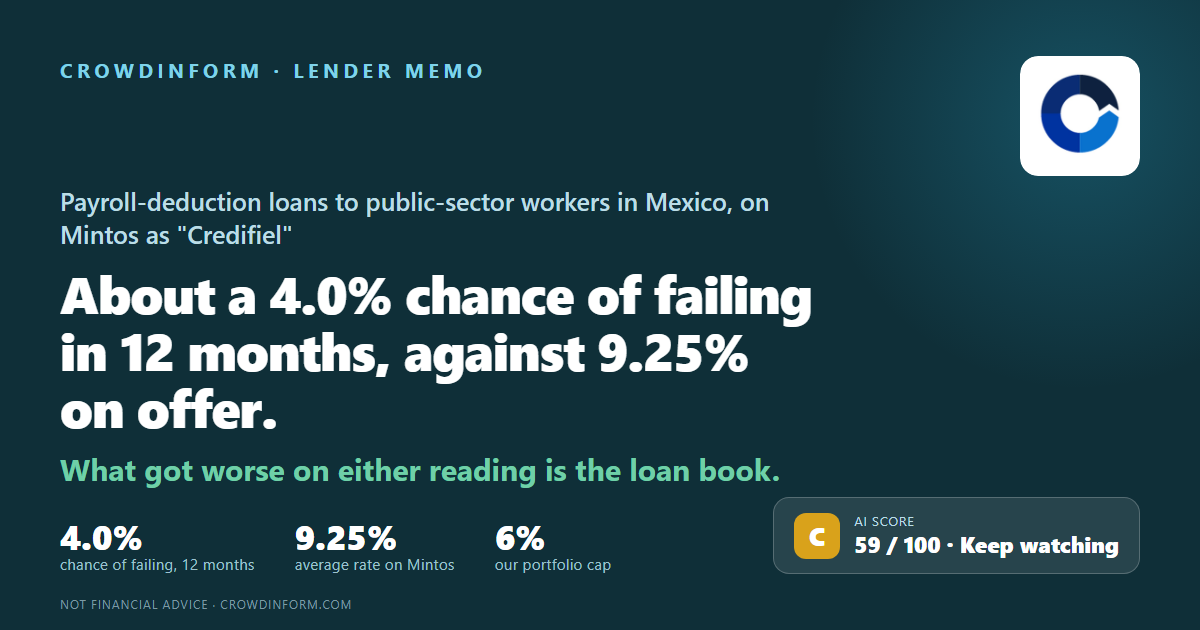
Mexico
Capital at risk. The rate is agreed, not guaranteed: if a borrower defaults you can lose some or all of your money.
Our AI gives this project 59 out of 100: Medium. How the AI score works
Information, not personal investment advice. The AI score rates the documents the platform publishes, can be wrong, and does not predict returns.
Publiseg, S.A.P.I. de C.V., SOFOM, E.N.R. — a Mexican finance company that is not a bank and takes no deposits — lends money to people and is repaid straight out of their salary before they see it. The letters E.N.R. in its legal name stand for “Entidad No Regulada” and mean it is not a regulated finance company: nobody in Mexico checks whether it is financially sound, as section 3 sets out. The company trades under the name Credifiel. Separately, investors on Mintos lend money to Publiseg. This memo asks one question: what is the chance that Publiseg fails to pay those investors back in the next 12 months, and why.
We have read its own accounts for 2021, 2022, 2023, 2024 and 2025 — five years, all audited by RSM México Bogarín with no reservations. The 2025 report was signed on 30 March 2026 and is the newest audited year we have. We have also used the reports of two credit rating agencies and Mintos’s own published record. Unaudited figures for the first quarter of 2026 exist — the Mintos prospectus of 7 August 2026 lists them — and we have not read those. That prospectus also lists unaudited figures for the first half of 2026, but those belong to the Mintos note-issuing company in Latvia, not to this Mexican lender.
Credifiel is repaid out of people’s wages before they get them, which is a safer way to lend than most — though that arrangement rests on agreements with one state government at a time rather than on any federal law, as section 2 sets out. Its owners’ money still covers 36 pesos in every 100 of everything it owns, it paid nothing out to its owners in either 2024 or 2025, and its own borrowing got markedly cheaper. Against that: it wrote off MXN 172.7m of loans in 2025 against MXN 93.0m in 2024, loans in any kind of arrears went from 7.9% of the book to 10.1%, and the money it holds against those arrears went down rather than up.
We ask six questions about every lender: does it earn enough, are its loans being repaid, does it have enough of its own money to absorb losses, how risky is its country, can we trust its numbers, and are there warning signs. Each is scored 1 to 5 and weighted. The four cards below cover all six — the first and the last each hold two of them. The weights differ a lot: earnings 30%, the loan book 20%, the cushion 20%, the country 15%, trust 10%, warning signs 5%. They are not meant to be added up; the weighted result is the about 4.0% at the top of this page. Our six scores are 3, 2, 4, 3, 3 and 2, in that order — so the B on the first card below averages an earnings score of 3 with a cushion score of 4.
The company has made money in every one of the five years we have read. Profit fell from MXN 153.3m to MXN 101.8m in 2025, and the return on the owners’ money with it, from 16.6% to 9.7%. But the owners’ money is still 36 pesos in every 100 of what the company owns, nothing has been paid out for two years, and the cost of its borrowing fell sharply. On either reading of the income line above, bad loans would have to cost about 14 pesos in every 100 of the average book, against the 7.5 actually charged, before a year’s profit disappeared. Our score for this question rests on that, not on which reading is right.
The headline figure still looks calm: loans more than 180 days late were 2.8% of the book, down from 3.1%. Every measure behind it rose. Loans 1 to 90 days late nearly doubled, and the company wrote off 7.3 pesos in every 100 of its average book during the year, against 4.7 the year before. Over 40% of its lending sits with employers in just three Mexican states, and one government agency has been paying intermittently on about MXN 112m of loans since early 2025.
No legal ceiling on what a lender of this type may charge, and no central-bank power to set one, which cuts both ways. In June 2026 Mexico’s Supreme Court told every judge in the country that they must check for usurious interest in any case where a lender sues for payment. This company earns about 47% a year on its lending.
No parent company is disclosed. The 2025 accounts give share classes and name nobody who holds them, but the Mintos prospectus of 7 August 2026 names all four shareholders: a Banco Multiva trust holds 61.49%, two individuals 14.51% and 12.00%, and a Banco Actinver trust 12.00%. A trust here is a legal arrangement that holds shares on someone else’s behalf. Who benefits from the two trusts is not disclosed anywhere. On HR Ratings’ figures to September 2025, ten employers carry 48.8% of the loan book, down from 56.3% a year earlier, while the share of borrowers who belong to one teachers’ union rose from 48.2% to 54.8% — the two biggest concentrations in this business are moving in opposite directions, and section 2 sets that out. On 15 April 2026 Mintos cut one of its scores for “changes in the security structure” and said no more than that.
Every investment carries risk, and risk is not really a letter or a mark out of ten. It is two plain questions: how likely is it that this company fails, and how much of your money would you lose if it did. Put those together and you can see whether the reward is worth it.
For Credifiel: about a 4.0% chance of failing in the next 12 months. If we assume about 30% of the money comes back in that case, the risk costs roughly 2.77% a year — so the 9.25% rate on offer is worth about 6.48% once the risk is paid for.
An advertised 9.25% is what you are promised if everything goes well. What you keep is that rate minus what failures cost you. So the rate on its own tells you very little.
Risk cost = the chance of failing × the share you do not get back. We assume 30% comes back and 70% is lost. That 30% is an assumption we apply to every lender so they can be compared with each other — it is not a measured figure, and the answer moves a lot if you choose differently.
Take two imaginary lenders. One pays 14% but has a 17% chance of failing within the year: the risk costs about 11.9% a year, leaving roughly 2%. The other pays 9% with a 2.5% chance: the risk costs about 1.8%, leaving about 7%. The bigger number on the screen can easily be the worse one.
| With our figures | |
|---|---|
| Chance of failing in a year | 4.0% |
| Loss if it fails (70%) | × 0.7 |
| Risk cost a year | 2.77% |
| Rate offered on Mintos | 9.25% |
| Left after the risk cost | about 6.48% |
One caution on that rate, before you rely on the last two rows of the table. The 9.25%, and the amount outstanding it is an average of, were read on the Mintos register on 9 November 2026, a month after the rest of this memo was written. Every other figure in this memo comes from the audited accounts or a named outside source. If the rate has moved, the about 6.48% moves with it peso for peso — the risk cost does not change.
Not a bank, and it takes no deposits. As a SOFOM E.N.R. it must hold a current registration with CONDUSEF, the authority that protects financial consumers, and the banking regulator CNBV inspects it only to check that it follows the rules against money laundering and terrorist financing. Nobody checks its capital, its cash or the money it sets aside against bad loans. Founded 2005.
Before money set aside, at the end of 2025 — about €114m. It grew just 4.7% in 2025, after 36% in 2024 and 71% the year before that. Income was MXN 1.13bn and profit after tax MXN 101.8m.
Government, health and education workers, plus retired people. On HR Ratings’ figures to September 2025, 54.8% of borrowers are members of the teachers’ union, the SNTE, spread across its state sections — up from 48.2% a year earlier. Those are the agency’s quarterly figures, not the audited year-end book. The employer takes the repayment out of the wage before the borrower is paid. Nearly nine pesos in every ten of the book is collected this way. The average loan is about MXN 22,700 and there were 106,273 of them at the end of 2025.
No parent company. The 2025 accounts set out two share classes — 34% of the shares fixed, 66% variable — and name nobody who holds them, but the Mintos prospectus of 7 August 2026 does: a trust at Banco Multiva numbered F/4894 holds 61.49%, Luis Antonio de León Cortés 14.51%, Adalberto Ruanova Sánchez 12.00%, and a trust at Banco Actinver numbered 5744 the last 12.00%. A trust is a legal arrangement that holds shares on someone else’s behalf, and who those someones are is not disclosed for either of these two. The founder, Leonel Cravioto García, is chief executive and chairman. Until February 2023 another lender, Crédito Real, held 49%.
The average rate to investors, with about €12.0m outstanding. Both were read on the Mintos register on 9 November 2026.
The full review covers the borrower or company, the security, the cash flow, the risks and a verdict. Sign in to read it.
Information, not personal investment advice. The AI score rates the documents the platform publishes, can be wrong, and does not predict returns.
Sign in to ask the AI about this project's documents.
Sign in👍 Yes · 0 👎 No · 0
Referral link · capital at risk
See 42 projects →Mintos