
Regulated
Bonus running
Can sell early
- Risk level
- High
- Risk-return
- Medium
- Start from
- €50
Referral link · capital at risk
See 42 projects →Questions about investing? Ask the AI guide.
Hi! I'm the Crowdinform AI guide.
Sign in free to ask the AI guide about platforms, projects and your plans.
Answers come from Crowdinform's checked data. Information, not personal investment advice.
Looking it up… Something went wrong. Please try again. {n} questions left today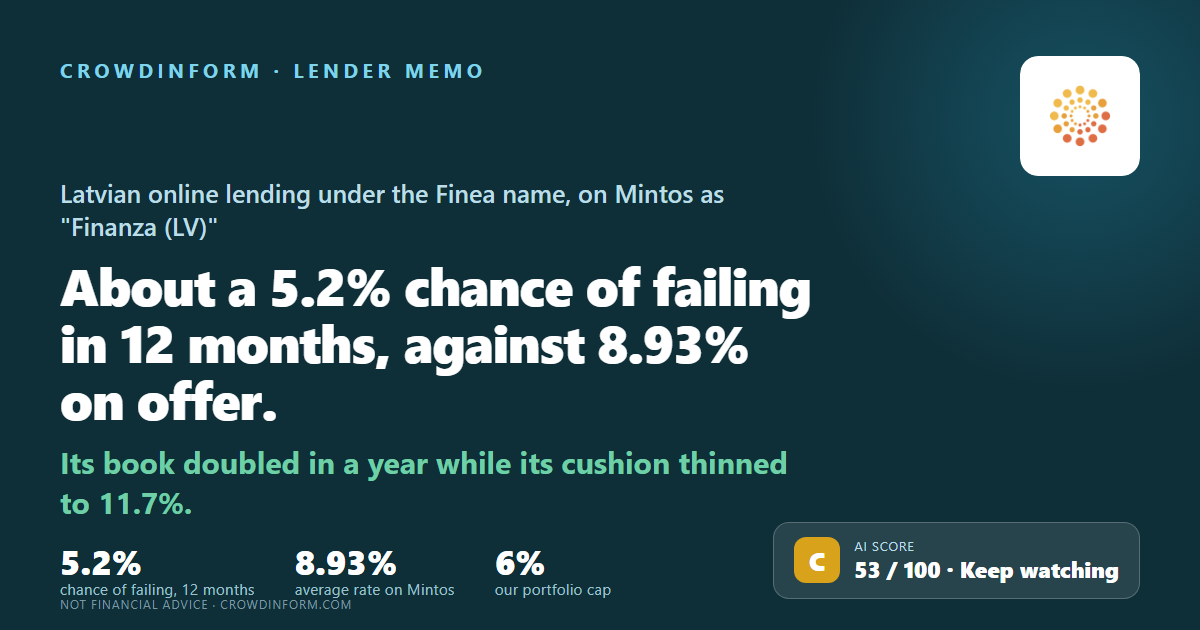
Latvia
Capital at risk. The rate is agreed, not guaranteed: if a borrower defaults you can lose some or all of your money.
Our AI gives this project 53 out of 100: Medium. How the AI score works
Information, not personal investment advice. The AI score rates the documents the platform publishes, can be wrong, and does not predict returns.
SIA Finanza lends to people in Latvia online. Two brands are associated with it, Finea and Dali Dali. It has held a consumer-credit licence in Riga since November 2016, it takes no deposits, and it belongs to the Sun Finance group. Mintos lists it as "Finanza (LV)". This memo asks one question: what is the chance it fails to pay its lenders back in the next 12 months, and why.
Finanza is growing fast and the cushion behind that growth is thinning. Its loan book doubled in a year, the owners’ money has fallen to 11.7% of what the company owns, and earnings cover its interest bill only 1.4 times. On the ordinary arithmetic of our six questions that comes out a C.
Six things would stop us scoring altogether and put the answer straight to 25% or more — for example an auditor who will not sign off cleanly, or a broken financial promise to lenders. None of the six has been established here. But one of them we could not test at all: whether Finanza has lent more than half the owners’ money to companies connected to it. The year-end figure is not published. So that test is neither passed nor failed. We have left it out of the score, because a test we cannot run is not a test the company failed — and it is not a test the company passed either. Flag 1 explains.
Each figure below shows the odds as if that part of the picture were the only risk the company faced.
It keeps €7.92 of every €100, down from €13.74. The owners’ money is 11.7% of what it owns, down from 32.3% two years ago.
Bad loans took €43 of every €100 in 2025. Nothing published shows how late its loans are — see section 2 for why the platform’s figure does not answer that.
Latvia is a B country. On our scale that puts this part of the answer in the A band — section 3 explains why.
An open test we could not close, and an audit report that exists but we could not read. Group funding and the bond guarantee are in section 4.
Every investment carries risk, and risk is not really a letter or a mark out of ten. It is two plain questions: how likely is it that this company fails, and how much of your money would you lose if it did. Put those together and you can compare one lender with another.
For Finanza: about a 5.2% chance of failing in the next 12 months. If we assume about 30% of the money comes back in that case, the risk costs about 3.7% a year against the 8.93% the loans pay. That leaves roughly 5.3%, and that margin rests entirely on our estimate of the odds being right.
An advertised 8.93% is what you are promised if everything goes well. What you keep is that rate minus what failures cost you. So the rate on its own tells you very little — and the highest rates on a platform are usually the ones being paid for a reason.
Risk cost = chance of failing × share of your money you would not get back. Nobody knows the second number in advance. How much comes back has varied widely from case to case. We use 30% back, 70% lost, as our own working assumption so that memos can be compared with each other — it is not a measured figure, and the answer moves a lot if you choose differently.
Take two imaginary lenders. One pays 14% but has a 17% chance of failing within the year: the risk costs about 11.9% a year, leaving roughly 2%. The other pays 9% with a 2.5% chance: the risk costs about 1.8%, leaving about 7%. The bigger number on the screen can easily be the worse one.
| On our numbers | |
|---|---|
| Chance of failing in a year | about 5.2% |
| Loss if it fails (70%) | × 0.7 |
| Risk cost a year | about 3.7% |
| Rate offered on Mintos | 8.93% |
| Left after the risk cost | about 5.3% |
Two things this arithmetic leaves out. Small lenders fail more often than the rated companies whose history our odds come from, so the real chance is more likely to be above 5.2% than below it. And a real failure does not arrive as a yearly cost; it arrives all at once, a yearly risk cost describes an average, not what one failure would do to one holding.
Where our number comes from: we score six questions out of five, weight them into a score out of 100, and convert that score into a chance of failure using the long-run default rates that S&P publishes for companies of each credit quality. Some findings override the score entirely and set the answer to at least 25%: lending more than half the owners’ money to people or companies connected to it, an auditor who will not sign off cleanly, an audit report carrying a material uncertainty about the business continuing, a broken financial promise to lenders — a minimum the company has to stay above — late payments to investors, or owners taking out more than the business earned two years running. A finding has to be about the company itself, not about its owner or the platform it lends through. None of them has been established here, so this memo gives a number rather than the automatic 25% minimum — though flag 1 explains one we could not test either way. It is our own estimate from public documents — not a credit rating, not a market price, and not a promise about what will happen.
Registration 40103413280, at Skanstes iela 52 in Riga. It has held consumer-credit licence NK-2016-049 since 3 November 2016, active with no restrictions. It takes no deposits.
Finea, an instalment loan. The Dali Dali pay-in-instalments brand is run from the same company on the evidence we have, but we could not establish which entity is the lender. Its licence covers consumer credit repaid to a schedule.
What it was owed at the end of 2025, after €17.9m a year earlier. The book more than doubled in twelve months.
HSFE AS holds 98%. The other 2% is held by SIA Tobago Capital, which is outside the group. Above HSFE sits AS Sun Finance Group, which carries no credit rating.
Listed there as "Finanza (LV)". Two other lenders appear on Mintos under the same Sun Finance brand: Extra Credit in Latvia, still in the group, and Luma in Sweden, which the group sold at the end of June 2026.
Mintos’s own figure, read on 9 November 2026. It was €18.1m on 13 September 2026, and our register capture a week later showed €18.2m.
Read on 9 November 2026 — Mintos’s own figure (9.01% on 13 September 2026). Platform figures read on 9 November 2026.
13 September 2026 — €67,463 across the shared pool of loans this company sits in on Mintos, one day behind on average. Loans are swapped in and out of that pool, so its figures are not a picture of Finanza’s own book — see section 2. That is 0.1% of the pool’s €47.2m, against 1.0% across every lender on the platform that day.
Mintos’s own score, not ours, read on 9 November 2026 as Mintos updated it on 9 October 2026; it was 8.5 on 13 September 2026. Its four parts: how the loans are performing 8.5, how well it runs collections 9.1, how good its promise to buy back late loans is 10.0, and how the deal is put together 6.5. Mintos raised that last part on 15 April 2026 after a pledge was registered.
The full review covers the borrower or company, the security, the cash flow, the risks and a verdict. Sign in to read it.
Information, not personal investment advice. The AI score rates the documents the platform publishes, can be wrong, and does not predict returns.
Sign in to ask the AI about this project's documents.
Sign in👍 Yes · 0 👎 No · 0
Referral link · capital at risk
See 42 projects →Mintos