
Regulated
Bonus running
Can sell early
- Risk level
- High
- Risk-return
- Medium
- Start from
- €50
Referral link · capital at risk
See 11 projects →Questions about investing? Ask the AI guide.
Hi! I'm the Crowdinform AI guide.
Sign in free to ask the AI guide about platforms, projects and your plans.
Answers come from Crowdinform's checked data. Information, not personal investment advice.
Looking it up… Something went wrong. Please try again. {n} questions left today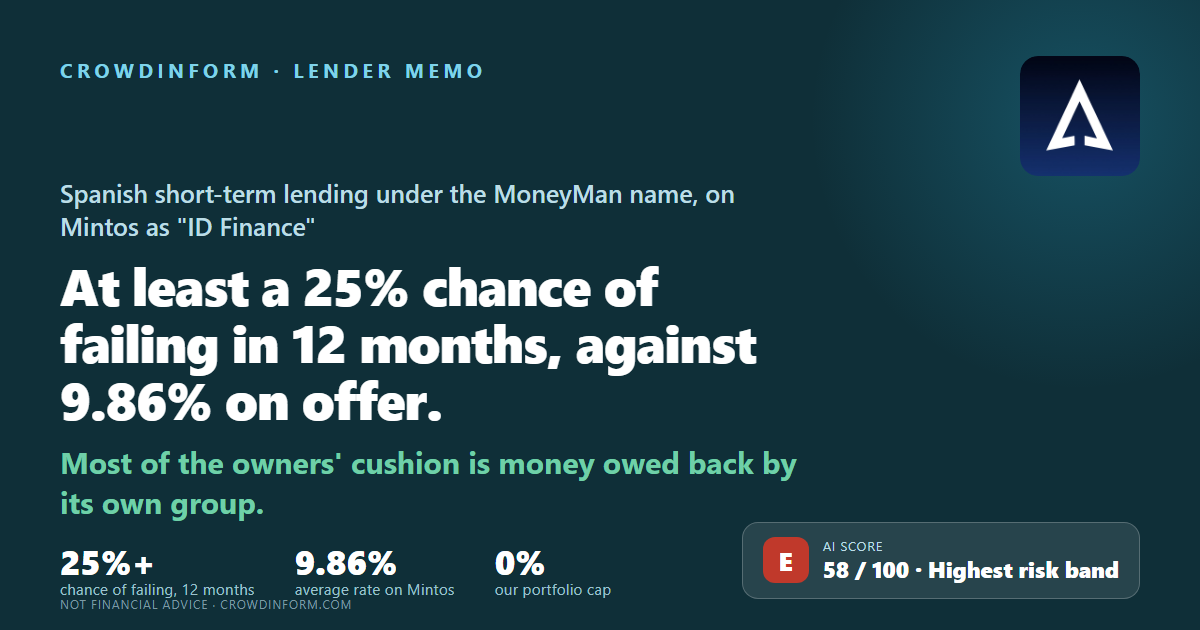
Spain
Capital at risk. The rate is agreed, not guaranteed: if a borrower defaults you can lose some or all of your money.
Our AI gives this project 58 out of 100: Medium. How the AI score works
Information, not personal investment advice. The AI score rates the documents the platform publishes, can be wrong, and does not predict returns.
IDFinance Spain, S.A.U. lends small, short-term loans to people in Spain under the MoneyMan name. It has been doing so since 2015, it takes no deposits, and Spanish law does not require it to hold a licence. Mintos lists it as "ID Finance". This memo asks one question: what is the chance it fails to pay its lenders back in the next 12 months, and why.
By the ordinary measures the business is doing well: it made a profit in every year we looked at, it kept about €10.50 of every €100 that came in, and Mintos has not suspended it. One finding stops us anyway: three years running, the money owed to it by companies in the same group was larger than half of the owners’ money in the business, and all three years come from accounts EY audited. A cushion made of claims on your own family cannot absorb your losses. The score of 58 is what our six questions give before that finding is applied; it takes the answer to at least 25%. Each figure below shows the odds as if that were the only risk the company faced.
Good earnings, thin real cushion: take out a tax saving it can only use if it keeps making profits, and everything the group owes it, and the owners’ money is about 1.5% of what is then left.
A third of everything it had lent out was more than six months late at the end of 2025, and had been at every quarter-end we can see. The price it charged covered that — but the whole business depends on being allowed to charge it.
A rich, stable euro country — but nobody licences this kind of lender, a draft law would change the price it may charge, and courts have been cancelling high-cost loans.
Its own 2025 accounts are now audited, with a clean opinion; but a €12m bond falls due in October 2026, and the yearly charge for borrower claims rose 73%.
Every investment carries risk, and risk is not really a letter or a mark out of ten. It is two plain questions: how likely is it that this company fails, and how much of your money would you lose if it did. Put those together and you can see whether the reward is worth it.
For ID Finance Spain: at least a 25% chance of failing in the next 12 months. If we assume about 30% of the money comes back in that case, the risk costs at least 17.5% a year — more than the 9.86% the loans pay. On these numbers the rate does not cover the risk it carries.
An advertised 9.86% is what you are promised if everything goes well. What you keep is that rate minus what failures cost you. So the rate on its own tells you very little — and the highest rates on a platform are usually the ones being paid for a reason.
Risk cost = chance of failing × share of your money you would not get back. Nobody knows the second number in advance. How much comes back has varied widely from case to case. We use 30% back, 70% lost, as our own working assumption so that memos can be compared with each other — it is not a measured figure, and the answer moves a lot if you choose differently.
Take two imaginary lenders. One pays 14% but has a 17% chance of failing within the year: the risk costs about 11.9% a year, leaving roughly 2%. The other pays 9% with a 2.5% chance: the risk costs about 1.8%, leaving about 7%. The bigger number on the screen can easily be the worse one.
| On our numbers | |
|---|---|
| Chance of failing in a year | at least 25% |
| Loss if it fails (70%) | × 0.7 |
| Risk cost a year | at least 17.5% |
| Rate offered on Mintos | 9.86% |
| Left after the risk cost | less than nothing |
Two things this arithmetic leaves out. Our 25% is a floor, not an estimate — once a finding of this kind appears we stop counting, so the true figure could be higher, and it could also be lower than the floor if the finding turns out to be harmless. And a real failure does not arrive as a yearly cost; it arrives all at once, which is why how much you put in one place matters as much as the rate.
Where our number comes from: we score six questions out of five, weight them into a score out of 100, and convert that score into a chance of failure using the long-run default rates that S&P publishes for companies of each credit quality. Some findings override the score entirely and set the answer to at least 25%: lending more than half the owners’ money to people or companies connected to it, an auditor who will not sign off cleanly, an audit report carrying a material uncertainty about the business continuing, a broken financial promise to lenders — a minimum the company has to stay above — late payments to investors, or owners taking out more than the business earned two years running. A finding has to be about the company itself, not about its owner or the platform it lends through. This company has one of them. It is our own estimate from public documents — not a credit rating, not a market price, and not a promise about what will happen.
Spanish law does not require a licence for this kind of lending, so no financial regulator supervises it. It takes no deposits. A draft law published in January 2026 would put lenders like it under the Bank of Spain; in September 2026 it was still a draft.
Loans of €100 to €1,600, for five days to four months, averaging about €430. Late-payment charges run to 1.32% a day. Everything is done online, with about 180 staff.
Across 939,222 loans, up from €330m across 785,548 loans in 2024 — the figure in the audited 2024 report; the 2025 accounts restate 2024 as €334m without saying why. What it still held at the end of 2025, after setting money aside for losses, was €101.5m.
ID Finance Investments, S.L. owns all of it. Registered share capital is €60,000.
Listed there as "ID Finance".
4 November 2026 — Mintos’s own figure. It was €25.2m on 20 September 2026 and €23.0m on 13 September 2026. Mintos also publishes a €31.7m "loan portfolio" figure for it, which is neither the company’s own book (€101.5m at the end of 2025) nor what investors hold, and which Mintos does not define anywhere we could find.
4 November 2026 — Mintos’s own figure.
13 September 2026 — €183,600 across its three positions, three to four days behind on average. That is 0.8% of what investors had lent it. Platform-wide the figure was 1.0% that day, but that average is pulled up by a handful of lenders in real trouble: the midpoint of the 32 lenders was 0.15%, and nine of the 32 were worse than this one. So it reads as ordinary settlement delay rather than a stoppage — though not as unusually clean. It is not one of the findings that stops us either way: those come only from a company’s own accounts, never from platform data. It does not appear on Mintos’s suspension or recovery lists, checked 21 September 2026.
Updated 9 October 2026 — Mintos’s own score, not ours. Its four parts: how the loans are performing 7.4, how well it runs collections 9.0, how good its promise to buy back late loans is 7.8, and how the deal is put together 4.0.
The full review covers the borrower or company, the security, the cash flow, the risks and a verdict. Sign in to read it.
Information, not personal investment advice. The AI score rates the documents the platform publishes, can be wrong, and does not predict returns.
Sign in to ask the AI about this project's documents.
Sign in👍 Yes · 0 👎 No · 0
Referral link · capital at risk
See 11 projects →