
Regulated
Bonus running
Can sell early
- Risk level
- High
- Risk-return
- Medium
- Start from
- €50
Referral link · capital at risk
See 42 projects →Questions about investing? Ask the AI guide.
Hi! I'm the Crowdinform AI guide.
Sign in free to ask the AI guide about platforms, projects and your plans.
Answers come from Crowdinform's checked data. Information, not personal investment advice.
Looking it up… Something went wrong. Please try again. {n} questions left today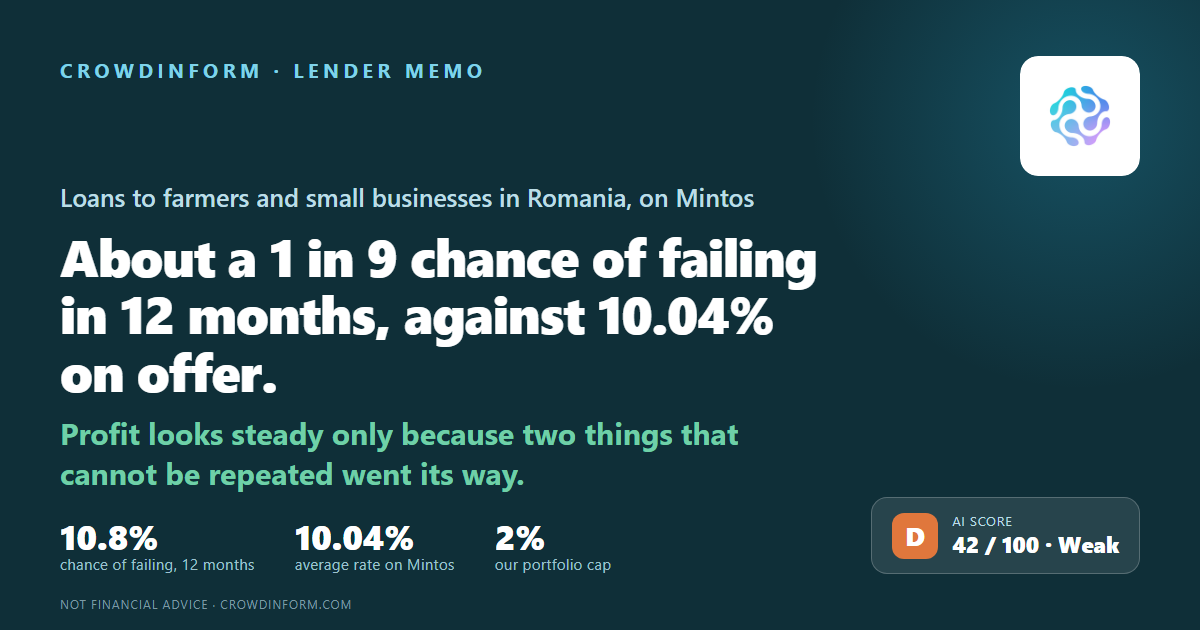
Romania
Capital at risk. The rate is agreed, not guaranteed: if a borrower defaults you can lose some or all of your money.
Our AI gives this project 42 out of 100: Low. How the AI score works
Information, not personal investment advice. The AI score rates the documents the platform publishes, can be wrong, and does not predict returns.
MK Kredit IFN S.A. is a Romanian company that lends to farmers and small businesses. The “IFN” in its name is the Romanian label for a lender that is not a bank: it lends money, but it takes no deposits. It was called Mikro Kapital IFN until July 2025. Investors on Mintos lend money to it. This memo asks one question: what is the chance that MK Kredit fails to pay those investors back in the next 12 months, and why.
We have used its own report for the first half of 2026, published on the Bucharest stock exchange at the end of September; its 2025 report to the same exchange, for which we have obtained no audit report; its 2024 accounts, audited by Baker Tilly; and its 2023 accounts, on which PricewaterhouseCoopers gave a qualified opinion — meaning the auditor signed them off but named something it thought was wrong, or could not check. Its Moldovan sister company is covered by a separate memo of ours and is not this company.
In the first half of 2026 profit after tax was almost exactly what it was a year earlier. But profit before tax fell. What was left after tax held up only because the charge for bad loans was cut sharply and the tax bill was a quarter smaller. Meanwhile the money it lost on the exchange rate — it appears to borrow in euros and it lends in lei — took RON 13.00 of every RON 100 it earned, against RON 0.21 two years ago.
We ask six questions about every lender: does it earn enough, are its loans being repaid, does it have enough of its own money to absorb losses, how risky is its country, can we trust its numbers, and are there warning signs. Each is scored 1 to 5 and weighted. The four cards below cover all six — the first and the last each hold two of them. The weights differ a lot: earnings 30%, the loan book 20%, the cushion 20%, the country 15%, trust 10%, warning signs 5%. They are not meant to be added up; the weighted result is the about 10.8% at the top of this page. Our six scores are 2, 2, 3, 2, 1 and 2, in that order.
It has made money every year, and the gap between what it charges borrowers and what it pays for its own money is widening. But profit fell a quarter in 2025, fell again before tax in the first half of 2026, and what is holding it up is not the lending. The owners’ money is about RON 19 in every RON 100 the company owns — less once you take out a promise from its parent.
Loans in serious arrears — the worst of the three groups the company sorts its loans into — improved, from 6.65% of the book at the end of 2025 to 5.79% at 30 June 2026. But in money they barely moved, and the charge that would show the improvement is real was cut to almost nothing. Nearly two thirds of the book is farm lending.
The leu is not the euro, and this company feels that directly. Romania has had no settled government since May 2026; a third candidate for prime minister was rejected by parliament on the day this memo was written. A fourth nominee, the diplomat Luca Niculescu, was named on 5 October 2026 and had not been confirmed when we last checked, on 9 October 2026.
Its owner is a Luxembourg fund with no credit rating of its own, which lends to it at up to 20% and has promised Mintos investors nothing. We have obtained no audit report for 2025. And the annual report denies paying dividends that its own audited accounts record.
Every investment carries risk, and risk is not really a letter or a mark out of ten. It is two plain questions: how likely is it that this company fails, and how much of your money would you lose if it did. Put those together and you can see whether the reward is worth it.
For MK Kredit: about a 10.8% chance of failing in the next 12 months. If we assume about 30% of the money comes back in that case, the risk costs roughly 7.55% a year — so the 10.04% rate is worth about 2.49% once the risk is paid for. That 10.04% is the rate Mintos published for this lender when we looked on 9 November 2026 (the same as on 13 September 2026), not a rate we have been able to check anywhere else.
An advertised 10.04% is what you are promised if everything goes well. What you keep is that rate minus what failures cost you. So the rate on its own tells you very little.
Risk cost = the chance of failing × the share you do not get back. We assume 30% comes back and 70% is lost. That 30% is an assumption we apply to every lender so they can be compared with each other — it is not a measured figure, and the answer moves a lot if you choose differently.
Take two imaginary lenders. One pays 14% but has a 17% chance of failing within the year: the risk costs about 11.9% a year, leaving roughly 2%. The other pays 9% with a 2.5% chance: the risk costs about 1.8%, leaving about 7%. The bigger number on the screen can easily be the worse one.
| With our figures | |
|---|---|
| Chance of failing in a year | 10.8% |
| Loss if it fails (70%) | × 0.7 |
| Risk cost a year | 7.55% |
| Rate on Mintos | 10.04% |
| Left after the risk cost | about 2.49% |
Two notes on that table. We take the risk cost from the unrounded chance of failing, 10.78%, rather than the 10.8% shown, which is why 10.8 × 0.7 gives 7.56 rather than the 7.55 we show. And there are two rates in this memo: the 10.04% above is what Mintos published to investors when we read it on 9 November 2026 (unchanged since 13 September 2026), which is the basis we use for every lender so they can be compared. Separately, the audited note to the company’s 2024 accounts shows that MK Kredit itself paid about 10.9% on its two Mintos loans, weighted by size — that is its cost, it is about 21 months old, and it is the newest breakdown by lender that exists.
Not a bank, and it takes no deposits. On the National Bank of Romania’s special register since November 2019, based in Iași, with 14 branches. It was renamed from Mikro Kapital IFN to MK Kredit IFN in July 2025.
Nearly two thirds of the book is agriculture — 62.86% at the end of 2025, and for a year earlier two documents give two answers: 62.89% in the company’s report to the exchange and 63.65% in its audited accounts. On either reading the concentration is not easing. That report also says more than 99% of the book goes to legal persons, and its own list of them is companies, sole traders (one person in business in their own name) and registered farmers. Its 2024 audited accounts separately show RON 39.7m, about a sixth of the book, as lending to individuals. In Romania a sole trader or a family farm counts in law as a private individual rather than a business, which is the likely explanation, but the two disclosures are not the same and we could not reconcile them.
That is what borrowers owed at 30 June 2026, before the money the company has set aside for loans it expects to lose. It is about €54m at the 31 December 2025 rate we use for year-end figures; at whatever rate applied in June 2026 it would be less, and the gap between the two is what section 1 is about.
ALTERNATIVE Fond de Securitizare, whose own audited accounts show €435.5m of assets against €73.9m of its own money — so the fund is itself about 83% funded by borrowing. Section 4 explains why that ownership is a risk rather than a comfort.
Listed there as “Mikro Kapital (RO)”. Its Moldovan sister is listed separately and has its own memo; do not read one for the other.
Mintos’s own figure when we read it on 9 November 2026 (it was €16.3m on 13 September 2026), which we have not been able to check anywhere else. At the end of 2024 Mintos was already this company’s largest single lender.
Mintos’s own score when we read it on 9 November 2026, as Mintos last updated it on 9 October 2026; unchanged since 13 September 2026. Platform figures read on 9 November 2026. The four parts behind it are 9.4 for how the loans perform, 7.5 for servicing, 8.1 for buyback strength and 5.2 for the structure of the arrangement — the structure is much the weakest of the four.
The full review covers the borrower or company, the security, the cash flow, the risks and a verdict. Sign in to read it.
Information, not personal investment advice. The AI score rates the documents the platform publishes, can be wrong, and does not predict returns.
Sign in to ask the AI about this project's documents.
Sign in👍 Yes · 0 👎 No · 0
Referral link · capital at risk
See 42 projects →Mintos