
Online reviews are a primary trust-building tool that help investors reduce information asymmetry by revealing real user experiences on fees, reliability, and platform responsiveness. For anyone evaluating crowdfunding or alternative investments, knowing how to use reviews for investing is no longer optional. It is a core research skill. The role of reviews in investing has grown significantly as crowd-sourced feedback now sits alongside official disclosures and analyst reports in any serious due diligence process. Crowdinform aggregates reviews from over 500 European crowdfunding platforms, making it one of the most concentrated sources of structured investor feedback on the continent.
How to use reviews for investing: sources that actually matter
Not all reviews carry equal weight. Verified user reviews from investors who have completed transactions carry far more credibility than anonymous commentary from unverified accounts. Professional commentary adds a different layer: it is structured, referenced, and less prone to emotional distortion. Anonymous opinions, by contrast, are the noisiest and least reliable signal in the mix.

Crowd-sourced research becomes significantly more reliable when it references verifiable professional intermediary analysis. That finding matters because it tells you exactly where to focus your attention: reviews that cite specific facts, compare platforms directly, or reference regulatory disclosures are worth your time. Reviews that simply express frustration or enthusiasm without context are not.
Four credibility signals separate useful reviews from noise:
- Recency. A review from three years ago tells you little about a platform's current withdrawal speed or fee structure.
- Specificity. Reviews that name exact fees, processing times, or support response rates are far more useful than vague praise or criticism.
- Comparative language. Reviews naming alternatives or previous versions anchor your evaluation against familiar benchmarks. They give you context that absolute praise cannot.
- Reviewer context. An investor who states their portfolio size, investment type, and holding period gives you a frame of reference. Anonymous one-liners do not.
Pro Tip: Prioritise 3-star reviews when assessing a platform. They combine practical pros and cons rather than extremes, giving you the most balanced picture of real user experience.
How to analyse reviews for stocks and platforms: a scoring model
Systematic review analysis uses a weighted confidence score model built on four factors: recommendation polarity, recency, repetition across sources, and contextual confirmation with market trends. A practical weighting assigns roughly 30% to polarity, 30% to recency, 20% to repetition, and 20% to contextual confirmation. That distribution reflects the reality that a recent, consistent signal confirmed by market data is far more reliable than a single glowing review from two years ago.
Polarity measures whether the overall sentiment is positive, negative, or mixed. Recency weights newer reviews more heavily because platform quality changes. Repetition checks whether the same themes appear across multiple independent sources. Contextual confirmation asks whether the review signal aligns with observable platform metrics such as liquidity, volatility, and trend regime.
| Feature category | What it measures | Typical weight |
|---|---|---|
| Recommendation polarity | Overall positive or negative sentiment | 30% |
| Recency | How current the review signal is | 30% |
| Repetition across sources | Consistency of themes across platforms | 20% |
| Contextual confirmation | Alignment with market and platform data | 20% |
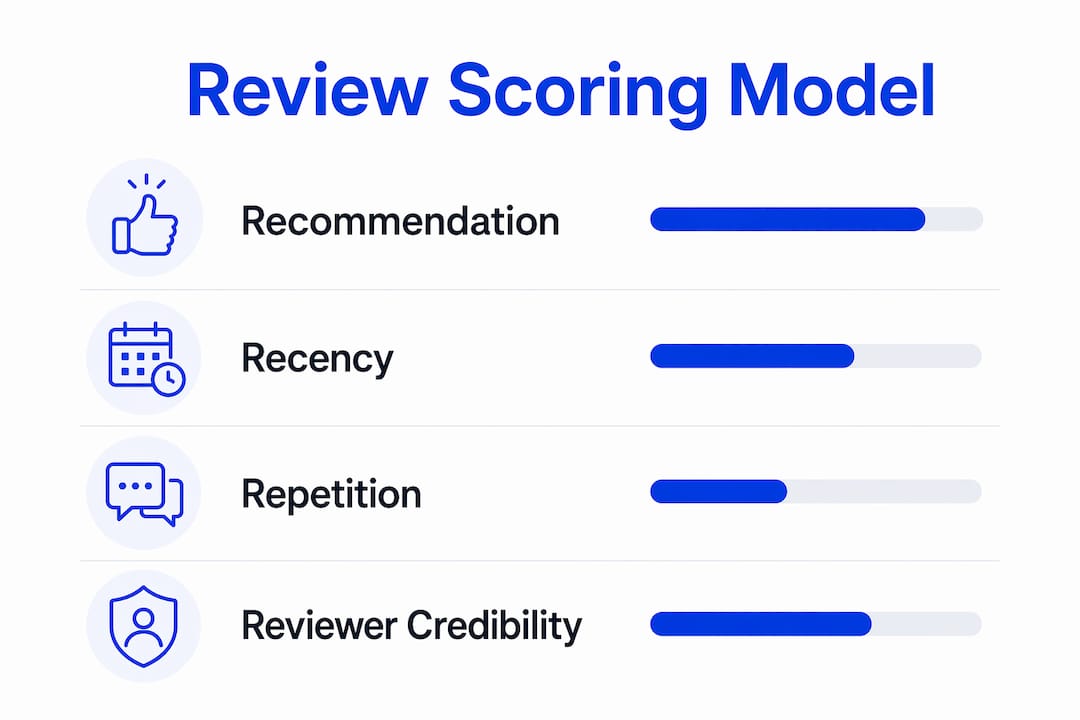
Review sentiment should not be used as a standalone signal. Reviews act as candidate generators that require further quantitative filtering before you can assign a confident investment decision. Think of them as the top of your screening funnel, not the final filter.
Pro Tip: Once you have scored a platform using the four-factor model, cross-reference your score against the platform's publicly available performance metrics such as default rates and average returns. A strong review score paired with weak fundamentals is a warning sign, not a green light.
Step-by-step guide to evaluating crowdfunding platforms with reviews
Investing using reviews effectively requires preparation before you read a single word of feedback. Three prerequisites set you up for objective analysis:
- Access multiple review sources. A single review platform creates a narrow view. Cross-referencing feedback from aggregators like Crowdinform, sector forums, and financial press gives you a fuller picture.
- Define your investment criteria first. Know your target return, risk tolerance, and preferred asset class before reading reviews. This stops you from being swayed by reviews that are irrelevant to your strategy.
- Set a minimum review volume threshold. A platform with fewer than 20 reviews does not yet have a statistically meaningful signal. Treat sparse review sets with caution.
Once you have your prerequisites in place, the collection and interpretation process follows four steps:
- Collect feedback on fees, service, withdrawal, and reliability. These four categories cover the most common investor pain points. Reviews that address all four give you a rounded operational picture of the platform.
- Triangulate with official data. Platform disclosures and regulatory filings either confirm or contradict what reviewers are saying. When they diverge, investigate further before committing capital.
- Check for trend direction. Are recent reviews improving or deteriorating compared to older ones? A platform with a declining review trend over six months is worth watching even if its historical average looks acceptable.
- Apply your confidence score model. Use the four-factor weighting from the previous section to assign a numerical score. This removes gut instinct from the equation and gives you a repeatable process.
Common mistakes to avoid when investing using reviews:
- Confirmation bias. Reading only reviews that support a decision you have already made is the most common error. Actively search for negative reviews of platforms you favour.
- Over-reliance on extremes. Five-star and one-star reviews are the least representative of typical user experience. They reflect outliers, not the median investor.
- Ignoring reviewer context. A review from a high-volume, long-term investor carries more weight than one from someone who made a single small deposit.
- Treating review volume as quality. A platform with 500 reviews is not automatically more trustworthy than one with 80. Quality of feedback matters more than quantity.
How do behavioural biases affect using online reviews for investing?
Social media review platforms amplify behavioural biases like confirmation bias and herding, leading to emotionally driven investment decisions. Traditional financial news is more structured and less prone to this distortion. That gap matters because most investors now encounter reviews through social channels before they reach structured sources.
Three biases are most damaging in review-based investment research:
- Confirmation bias. You read reviews that confirm what you already believe and skip those that challenge it. The fix is deliberate: search specifically for negative reviews of platforms you are considering.
- Herding. A platform with a large number of positive reviews can create a bandwagon effect. Popularity is not the same as quality. Check whether the positive reviews are recent and specific, or old and vague.
- Emotional reactivity. A single dramatic negative review about a withdrawal delay can trigger disproportionate alarm. Calibrate your reaction by checking whether the complaint is isolated or part of a pattern.
"Most investors use reviews to seek validation. Effective investors do the opposite. They hunt for opposing views to test their assumptions." How to read product reviews critically
The practical antidote to all three biases is structured reading. Prioritise calm, specific reviews over emotional ones. Seek out the bear case for every platform you are considering. Read the investment platform comparison guide alongside user reviews to ground your analysis in objective criteria. A tiered review structure with monthly check-ins, quarterly in-depth reviews, and annual strategic realignments also helps you avoid over-reacting to short-term review noise.
Key takeaways
Reviews are most powerful when used as a structured screening tool, not a substitute for fundamental analysis, and the four-factor confidence score model is the most reliable way to convert raw feedback into an investment signal.
| Point | Details |
|---|---|
| Prioritise credible review sources | Verified, specific, and recent reviews carry far more weight than anonymous or vague commentary. |
| Use the four-factor scoring model | Weight polarity, recency, repetition, and contextual confirmation to assign a confidence score. |
| Reviews are candidate generators | Use review signals to build a shortlist, then apply quantitative filters before committing capital. |
| Counter behavioural biases actively | Search for negative reviews of platforms you favour to avoid confirmation bias and herding. |
| Triangulate with official data | Cross-reference review findings with platform disclosures and regulatory filings for a complete picture. |
My honest view on reviews as an investment research tool
I have spent years watching investors treat online reviews as either gospel or noise. Both extremes are wrong. Reviews are a genuinely useful signal when you treat them as one layer in a multi-layer research process, not as the final word.
The most underrated insight I have encountered is that the role of reviews in investments is less about confirming good platforms and more about surfacing red flags early. A pattern of complaints about delayed withdrawals, poor customer support, or opaque fee structures in reviews will almost always precede a formal regulatory issue. Reviews are a leading indicator, not a lagging one.
What I have also found is that investors who use reviews most effectively are the ones who read them with a specific question in mind. "Does this platform handle withdrawals reliably?" is a better question to bring to a review set than "Is this platform good?" The former produces a concrete answer. The latter produces noise.
The role of trends in crowdfunding is another dimension worth watching through reviews. When a platform's review sentiment shifts over a six-month window, that shift often reflects operational changes that have not yet appeared in official data. That is the kind of early signal that gives you a genuine edge.
My advice: build a systematic habit. Read reviews on a schedule, score them using a consistent model, and always seek the opposing view. Reviews are not a shortcut. They are a discipline.
— Jevgenijs
Crowdinform: structured review intelligence for smarter investing
Crowdinform brings together reviews from over 500 European crowdfunding platforms in one place, giving you the breadth of feedback that a single-platform search cannot match.
The platform combines verified user reviews, AI-driven project analysis, and aggregated investment data across loans, real estate, and startup crowdfunding. Its built-in AI copilot lets you query specific platforms and projects directly, turning raw review data into structured investment insight. For investors who want to apply the frameworks in this guide at scale, Crowdinform is the practical starting point. Whether you are screening your first European crowdfunding platform or refining a portfolio of alternative assets, the combination of crowd intelligence and structured analytics makes the process faster and more grounded.
FAQ
What is the role of reviews in investment decisions?
Reviews reduce information asymmetry by sharing real user experiences on fees, reliability, and platform responsiveness. They act as a leading indicator of platform quality before official data reflects operational issues.
How do I analyse reviews for crowdfunding platforms?
Use a four-factor confidence score model weighting recommendation polarity (30%), recency (30%), repetition across sources (20%), and contextual confirmation (20%). Cross-reference your score with platform disclosures and performance metrics.
Which reviews are most useful for investors?
Three-star reviews are the most balanced and informative. They combine practical strengths and weaknesses rather than reflecting the emotional extremes of one-star or five-star feedback.
How do I avoid confirmation bias when reading investment reviews?
Actively search for negative reviews of platforms you are already favouring. Structured reading with a specific question, such as withdrawal reliability or fee transparency, keeps your analysis objective.
Where can I find reliable reviews of European crowdfunding platforms?
Crowdinform aggregates verified reviews from over 500 European crowdfunding platforms alongside AI-driven project analysis, making it one of the most comprehensive sources for platform due diligence in the region.


