
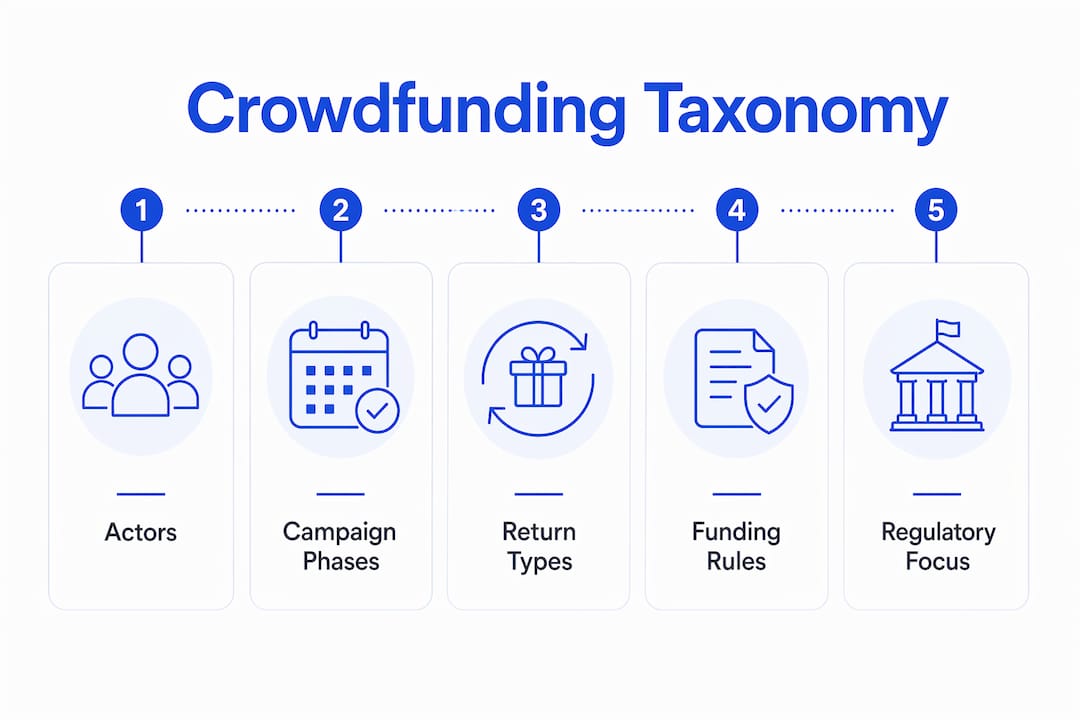
Crowdfunding taxonomy is the structured classification of crowdfunding models by actor roles, campaign phases, and economic relationships between backers and project initiators. Understanding crowdfunding classification matters because it determines how you compare platforms, assess risk, and select the model that fits your goals. The three core actors in any taxonomy are project initiators, backers, and platforms, each with distinct obligations and incentives. Whether you are an individual investor exploring loan-based returns or an organisation launching a reward campaign, taxonomy gives you the vocabulary and framework to make that choice with confidence.
What is crowdfunding taxonomy and how does it work?
Crowdfunding taxonomy is defined as a systematic framework that classifies crowdfunding by types, actor roles, campaign phases, and return structures to enable consistent comparison across diverse models. Think of it as the periodic table for crowdfunding. Each element has a defined place, and knowing where something sits tells you a great deal about how it behaves.
The taxonomy rests on three foundational actor categories. Three key actors form every crowdfunding interaction: project initiators (the founders or campaign creators), backers (the crowd providing capital), and platforms (the intermediaries facilitating the exchange). Each actor carries different rights, risks, and expectations, and taxonomy makes those differences explicit rather than leaving them buried in platform terms and conditions.

Beyond actors, taxonomy organises crowdfunding by campaign phase. The pre-funding phase covers everything from campaign creation and promotion through to the funding deadline. The post-funding phase covers fund disbursement, project delivery, and any ongoing obligations such as interest repayments or equity reporting. A 2025 systematic literature review confirms that taxonomy shapes analytical perspective in crowdfunding research, meaning the lens you apply changes what you see and measure.
The most practically useful dimension is return type. The UK Financial Conduct Authority (FCA) describes four economic relationships between backers and projects: donation, reward, equity, and debt. Each type carries a fundamentally different risk profile and set of legal obligations for all three actors.
Pro Tip: When evaluating any crowdfunding opportunity, identify the return type first. That single classification tells you whether you face credit risk (debt), business risk (equity), delivery risk (rewards), or no financial return at all (donation).
What are the main categories in crowdfunding taxonomy?
The four return-based categories are the backbone of any practical crowdfunding classification. Understanding each one precisely prevents the most common investor mistakes.
- Donation-based crowdfunding: Backers contribute capital with no expectation of financial return or tangible reward. Platforms such as GoFundMe operate primarily in this space. The backer's motivation is philanthropic or civic, and the initiator carries no repayment obligation.
- Reward-based crowdfunding: Backers receive a non-financial return, typically a product, service, or experience. Kickstarter and Indiegogo are the most widely recognised platforms in this category. The Library of Congress guide notes that peer-to-peer lending is a distinct form of crowdfunding, separate from reward models, which underlines why precise classification matters.
- Equity-based crowdfunding: Backers receive an ownership stake in the project or company. Returns depend on business performance, dividends, or an eventual exit event. This model carries the highest information asymmetry between initiator and backer, making due diligence critical.
- Debt-based crowdfunding (loan-based or peer-to-peer lending): Backers lend capital and receive repayment with interest. This is the most structured model from a financial perspective and the one most closely regulated by bodies such as the FCA. You can explore debt crowdfunding in depth to understand how loan terms, interest rates, and borrower credit profiles interact.
Beyond return type, taxonomy also classifies campaigns by funding rule. The two dominant rules are all-or-nothing (AON) and keep-it-all (KIA). Under AON, funds are returned to backers if the campaign target is not met. Under KIA, the initiator retains whatever is raised regardless of target achievement. These rules directly affect backer incentives, platform fee timing, and campaign design strategy.
How do crowdfunding types compare in structure and returns?
The table below compares the four primary crowdfunding types across the dimensions most relevant to investors and project founders.
| Type | Backer return | Typical funding rule | Primary risk for backer | Regulatory scrutiny |
|---|---|---|---|---|
| Donation | None | Keep-it-all | No financial return | Low |
| Reward | Product or perk | All-or-nothing | Non-delivery of reward | Low to moderate |
| Equity | Ownership stake | All-or-nothing | Business failure or dilution | High |
| Debt (loan) | Interest repayment | All-or-nothing | Borrower default | High |
The FCA confirms that platforms charge fees as a percentage of funds raised, typically triggered only when funding targets are met under an all-or-nothing structure. This means the platform's commercial incentive aligns with campaign success, which is a structural feature worth noting when you assess platform neutrality.
Equity and debt crowdfunding attract the most regulatory attention because they involve financial instruments. The FCA and equivalent European regulators treat these as investment products, applying disclosure requirements, investor categorisation rules, and platform authorisation standards. Donation and reward models sit outside most financial regulation, which lowers the compliance burden for initiators but also reduces formal backer protections.
Return type also drives operational obligations for initiators. Ownership, repayment, perks, or donation each create different post-campaign responsibilities. An equity initiator must maintain shareholder communications and potentially file accounts. A debt initiator must service loan repayments on schedule. A reward initiator must manufacture and ship a product. Taxonomy makes these obligations visible before you commit.
Pro Tip: If you are comparing platforms across Europe, check whether they hold a European Crowdfunding Service Provider (ECSP) licence. Licensed platforms are authorised to offer equity and debt products under a harmonised regulatory framework, which is a meaningful quality signal. See regulated crowdfunding platforms for a current overview.
How to choose a crowdfunding model using taxonomy
Taxonomy is only useful if it translates into a decision. Here is a practical sequence for selecting the right crowdfunding model based on classification criteria.
- Define your return expectation. Are you seeking financial return (equity or debt), a tangible product (reward), or contributing to a cause without expectation of return (donation)? This single question eliminates at least two of the four categories immediately.
- Assess your risk tolerance. Debt crowdfunding carries credit risk. Equity carries business risk. Rewards carry delivery risk. Donation carries no financial risk but also no financial upside. The FCA taxonomy maps these risk types explicitly, and experienced investors use them to calibrate portfolio exposure.
- Evaluate the funding rule. For backers, all-or-nothing structures offer downside protection: if the campaign fails to reach its target, your capital is returned. Keep-it-all structures offer no such protection. For initiators, KIA provides certainty of receiving some funds, but may damage credibility if the project cannot be delivered on a reduced budget.
- Examine platform fees and legal instruments. Platforms typically charge between 3% and 8% of funds raised, though fee structures vary significantly. Equity platforms may also charge ongoing administration fees for shareholder management. Debt platforms may charge origination fees to borrowers. Understanding platform fee structures before committing prevents unpleasant surprises.
- Conduct type-specific due diligence. Investor due diligence varies by crowdfunding type: credit risk applies to loan-based models, business risk to equity, and delivery risk to rewards. This taxonomy-driven approach to due diligence by type is what separates informed participation from speculative guesswork.
How academic research and regulation have shaped crowdfunding taxonomy
Academic frameworks and regulatory guidance have both contributed to the taxonomy we use today, and understanding their influence helps you apply it more accurately.
Scholarly research has consistently organised crowdfunding studies around actor-based and phase-based categories. A 2025 systematic literature review demonstrates that taxonomy shapes motivation analysis by determining whether a study focuses on donor behaviour, founder strategy, platform design, or campaign outcomes. This is not an academic abstraction. It means that when you read a report claiming "crowdfunding success rates are X%", the figure is only meaningful if you know which actor category and which crowdfunding type the study examined.
Regulators have adopted taxonomy for a different but equally practical purpose. The FCA uses crowdfunding classification to map types of investor participation and their inherent risks, guiding investor protection measures. This regulatory use of taxonomy has produced concrete outcomes: equity and debt platforms must be authorised, must provide standardised risk warnings, and must categorise investors before allowing participation. Donation and reward platforms face none of these requirements.
The European Union's ECSP regulation, which came into full effect in 2023, represents the most ambitious attempt to harmonise crowdfunding taxonomy at a regulatory level. It defines investment-based and lending-based crowdfunding as distinct categories, each with specific disclosure and governance requirements. Platforms operating across multiple European markets now use this taxonomy as their compliance architecture.
- Taxonomy clarifies which regulatory regime applies to a given platform or campaign.
- It determines what disclosures initiators must make to backers.
- It shapes the due diligence checklist investors should apply.
- It provides a consistent language for comparing platforms across jurisdictions, which is particularly valuable in Europe's fragmented market.
For a practical look at how scholarly frameworks apply to renewable energy projects, Crowdinform's guide on researching energy crowdfunding illustrates how actor and phase classifications translate into project evaluation criteria.
Key takeaways
Crowdfunding taxonomy is the single most effective framework for comparing crowdfunding models, assessing risk, and selecting platforms aligned with your financial goals.
| Point | Details |
|---|---|
| Four return types define taxonomy | Donation, reward, equity, and debt each carry distinct risks, obligations, and regulatory treatment. |
| Three actors structure every model | Project initiators, backers, and platforms each hold different rights and responsibilities within the taxonomy. |
| Funding rules affect backer protection | All-or-nothing structures return capital if targets are missed; keep-it-all structures do not. |
| Due diligence varies by type | Credit risk applies to debt, business risk to equity, and delivery risk to rewards. |
| Regulation follows taxonomy | Equity and debt models attract FCA and ECSP oversight; donation and reward models largely do not. |
Why taxonomy is the most underused tool in crowdfunding
Most investors I speak with treat crowdfunding as a single category. They ask "is crowdfunding safe?" as if Kickstarter and a peer-to-peer property lending platform are the same thing. They are not. They share a name and a crowd mechanic, and almost nothing else.
The taxonomy framework changes that conversation entirely. When you know you are evaluating a debt instrument with a fixed interest rate, a defined borrower, and a specific loan-to-value ratio, you stop asking vague questions and start asking precise ones: What is the borrower's credit history? What is the platform's default rate? What recovery mechanisms exist? Those are the right questions, and taxonomy is what gets you there.
The misconception I encounter most often is that taxonomy is an academic exercise with no practical application. The opposite is true. Regulators built the ECSP framework on it. The FCA's investor protection rules are structured around it. The most experienced European crowdfunding investors I have observed use it instinctively, tagging every opportunity by return type, funding rule, and legal instrument before they read a single line of the campaign description.
My honest recommendation: before you evaluate any crowdfunding opportunity, spend thirty seconds placing it in the taxonomy. What is the return type? What is the funding rule? Who are the three actors and what are their obligations? Those three questions will save you from the majority of poor decisions in this market.
— Jevgenijs
Explore crowdfunding smarter with Crowdinform
Understanding taxonomy is the foundation. Applying it across hundreds of platforms and thousands of live projects is where Crowdinform comes in.

Crowdinform aggregates and reviews over 500 European crowdfunding platforms, covering loan, real estate, and startup investments with clear classifications aligned to the taxonomy framework described in this article. The platform's AI copilot analyses live projects and delivers structured reviews that map directly to return type, funding rule, and risk category, so you can compare opportunities without starting from scratch each time. Whether you are a cautious investor exploring safer crowdfunding options or an experienced backer tracking European deal flow, Crowdinform gives you the structured intelligence to act with confidence.
FAQ
What is crowdfunding taxonomy?
Crowdfunding taxonomy is a structured classification system that organises crowdfunding models by actor roles (initiators, backers, platforms), campaign phases (pre- and post-funding), and economic return types (donation, reward, equity, debt). It enables consistent comparison across diverse crowdfunding approaches.
What are the four main types of crowdfunding?
The four main types are donation-based, reward-based, equity-based, and debt-based crowdfunding. Each type defines a different economic relationship between the backer and the project, with distinct risks and regulatory treatment.
What is the difference between all-or-nothing and keep-it-all crowdfunding?
All-or-nothing campaigns return funds to backers if the target is not met, protecting backer capital. Keep-it-all campaigns allow initiators to retain whatever is raised regardless of whether the target is reached, which shifts risk to the backer.
How do regulators use crowdfunding taxonomy?
Regulators such as the FCA and the EU use crowdfunding taxonomy to map investor participation types and their inherent risks, applying authorisation requirements and disclosure obligations specifically to equity and debt models while leaving donation and reward models largely outside financial regulation.
Why does due diligence differ by crowdfunding type?
Because each type carries a different primary risk: credit risk for debt crowdfunding, business risk for equity, and delivery risk for rewards. Taxonomy identifies the correct risk lens before you begin evaluating a specific campaign or platform.