
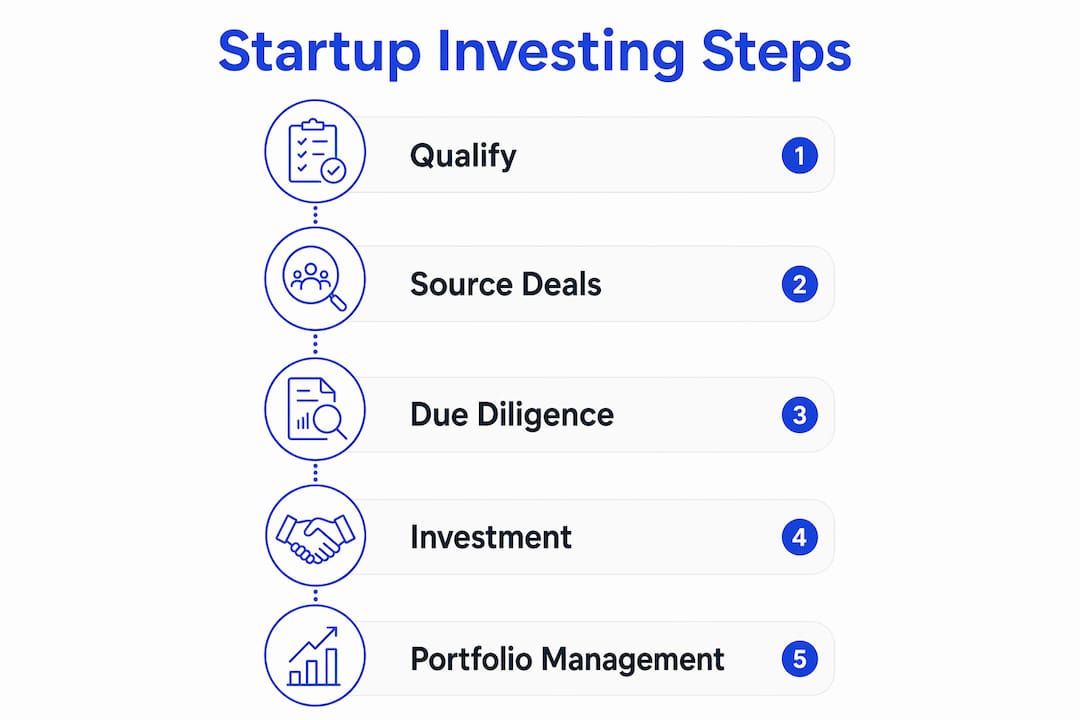
Step-by-step startup investing is a disciplined process of qualifying yourself, sourcing deals, performing due diligence, and managing a portfolio to capitalise on high-growth early-stage ventures. Most first-time investors underestimate how structured this journey needs to be. A typical angel investment plan spans roughly 15 weeks from qualification to your first cheque, with portfolio building stretching across years. Platforms like AngelList, instruments like SAFEs and convertible notes, and frameworks like systematic due diligence are the building blocks of every successful startup investor. Follow this guide and you will have a clear, repeatable blueprint.
What prerequisites and tools do you need for startup investing?
Before you source a single deal, you need to confirm your eligibility and assemble the right toolkit. In most European jurisdictions, investing in early-stage companies through equity crowdfunding or angel networks requires you to meet certain financial thresholds or self-certify as a sophisticated investor. In the UK, for example, the Financial Conduct Authority distinguishes between high-net-worth individuals and self-certified sophisticated investors, each with different annual income or net asset requirements.

Beyond legal eligibility, you need sufficient capital and the right mindset about diversification. Startup investing is a long-horizon asset class. Expecting returns in two or three years is unrealistic. Plan to deploy capital across multiple investments over two to three years, not in a single large bet.
Here is what you need in place before you begin:
- Investor status: Confirm accredited, high-net-worth, or sophisticated investor status under your local regulations.
- Dedicated budget: Allocate only capital you can afford to lock away for 7 to 10 years. Never use emergency funds or borrowed money.
- Instrument literacy: Understand the three main deal structures: SAFEs (Simple Agreements for Future Equity), convertible notes, and priced equity rounds. Each carries different risk and dilution implications.
- Deal flow access: Register on platforms such as AngelList or explore European-focused networks. Join a local angel group or syndicate for curated opportunities.
- Professional advisers: Engage a tax adviser familiar with EIS or SEIS relief (in the UK) and a solicitor who can review term sheets without charging you a fortune.
Pro Tip: Start with a syndicate rather than investing directly. Syndicates pool capital under a lead angel who performs diligence on your behalf, reducing your time commitment and legal costs significantly for your first few deals.
How do you research and source startups to invest in?
Deal sourcing is where most beginners struggle. The best opportunities rarely appear on public listings. They circulate through warm networks, accelerator cohorts, and curated syndicates long before they reach a general audience. Your sourcing strategy directly determines the quality of your deal flow, so treat it as seriously as the investment decision itself.
Follow this step by step investment research process to build a reliable pipeline:
- Attend accelerator demo days. Y Combinator, Techstars, and Seedcamp each run cohort demo days where you can evaluate 20 to 30 startups in a single session. These events compress your learning curve dramatically.
- Join angel networks and syndicates. Groups such as the UK Business Angels Association or European Business Angel Network give you access to vetted deals and co-investors who share diligence costs.
- Leverage warm introductions. A referral from a trusted founder or fellow investor carries far more signal than a cold inbound pitch. Invest in your professional network actively.
- Use curated platforms. Crowdfunding and angel platforms aggregate deals with standardised information packs, making initial screening faster. Crowdinform, for instance, aggregates data from over 500 European platforms and uses an AI copilot to help you evaluate projects quickly.
- Track sectors you understand. Investing in industries where you have professional experience gives you a genuine edge in spotting strong teams and realistic market claims.
- Diversify across vintages. Spread investments across different years to avoid concentration in a single economic cycle.
Pro Tip: Write a one-page investment thesis before you start sourcing. Define your preferred sectors, cheque size, and stage. This filter saves you hours of evaluating deals that were never right for you.
New investors consistently improve outcomes by gaining exposure to many pitches and practising due diligence through mentorship rather than theory alone. Shadow an experienced angel for a few months before committing your own capital.
What are the key steps to perform due diligence on a startup?
Due diligence is the stage that separates disciplined investors from those who rely on excitement. Because early-stage startups have limited financial history, diligence focuses on team, market, traction, and terms rather than audited accounts. This is actually an advantage for well-prepared investors: qualitative judgement matters as much as spreadsheet analysis.
Here is a practical framework:
- Founder assessment: Conduct reference calls with former colleagues, customers, and co-founders. Verify track record claims independently. A founder who has shipped products before is meaningfully less risky than a first-timer.
- Market validation: Analyse total addressable market size, timing, and competitive moat. Talk directly to potential customers to verify demand. Customer interviews and unit economics tests reduce gut-based decisions.
- Traction review: Look for paying customers, pilot agreements, or strong engagement metrics. Revenue is the clearest signal, but even a waitlist with strong conversion data tells a story.
- Cap table and terms: Review the capitalisation table for cleanliness. Understand liquidation preferences, pro-rata rights, and anti-dilution clauses. Valuation cap and entry price influence your returns as powerfully as the company's eventual outcome.
- Legal review: Budget between £1,500 and £4,000 per deal for legal costs. Incomplete legal and financial diligence accounts for a significant share of angel investment losses, making this a non-negotiable step.
| Diligence area | What to look for |
|---|---|
| Founder credibility | Reference calls, prior exits, domain expertise |
| Market opportunity | TAM size, timing, and defensible positioning |
| Traction | Revenue, pilots, engagement, or waitlist data |
| Investment terms | Valuation cap, discount rate, pro-rata rights |
| Legal and cap table | Clean structure, no hidden obligations or side letters |
Pro Tip: Spend 10 to 20 hours per deal on diligence if you are investing directly. If that feels excessive, join a syndicate where the lead angel absorbs most of this work and you review their memo instead.
How do you execute your first investment and manage deal closing?
Once your diligence is complete and you have decided to invest, the closing process begins. This phase is more administrative than analytical, but delays here are common and frustrating. Preparation prevents most of them.
Follow these steps to close your first deal cleanly:
- Confirm your commitment in writing. Notify the founder or platform of your intended cheque size. This locks your allocation before the round fills.
- Review and sign legal documents. Whether it is a SAFE, convertible note, or subscription agreement, read every clause before signing. Use DocuSign or a similar electronic signature tool to speed up the process.
- Wire funds promptly. Follow the wiring instructions precisely. Errors in bank details are the single most common cause of closing delays. Closing requires coordination among multiple parties, including founders, legal teams, and sometimes escrow agents.
- Confirm receipt and documentation. Request written confirmation that your funds have been received and your shares or instrument have been issued. Store all documents in a dedicated folder.
- Document your investment thesis. Write a brief memo explaining why you invested, what success looks like, and what would change your view. This becomes invaluable when you review the investment 18 months later.
The full journey from qualification to first investment typically spans about 15 weeks. Weeks two to four involve 20 to 30 hours of structured learning. Week six covers platform onboarding. Weeks seven to fourteen focus on observing deal flow and writing practice memos. Week fifteen is your first investment. This timeline is realistic and worth respecting.
Pro Tip: Never wire funds without a signed legal document in hand. Verbal commitments and email confirmations are not sufficient protection. Signed paperwork first, funds second, always.
How do you build and manage a startup portfolio over time?
A single startup investment is a lottery ticket. A portfolio of 15 to 20 investments, built systematically over two to three years, is a genuine asset class. Diversification and follow-on capital reservation significantly reduce downside risk and maximise upside potential. This is the most important structural insight in startup investing.
Here is how to build and manage your portfolio with discipline:
- Target 15 to 20 investments. Angel investing success hinges on diversification; holding at least 20 to 25 investments over three to five years balances return optimisation with your capacity to perform diligence on each one.
- Reserve 30 to 50% of capital for follow-on rounds. Your best performers will raise again. If you cannot participate, you will be diluted precisely when the company is most valuable.
- Track everything in a portfolio spreadsheet. Maintaining a detailed record with company name, investment date, amount, instrument terms, and quarterly updates keeps you informed and ready for follow-on decisions.
- Engage with founders regularly. Offer introductions, customer referrals, or hiring help. Founders remember supportive investors when allocating follow-on rounds.
- Set realistic return timelines. Expect a 7 to 10 year holding period before meaningful liquidity. Startups that exit in three years are the exception, not the rule.
| Portfolio metric | Recommended target |
|---|---|
| Number of investments | 15 to 20 minimum |
| Capital reserved for follow-on | 30 to 50% of total budget |
| Investment horizon | 7 to 10 years |
| Portfolio review frequency | Quarterly |
| Sectors covered | At least 3 to 4 distinct verticals |
Pro Tip: Use a simple Google Sheets tracker from day one. Include columns for valuation cap, ownership percentage, and estimated dilution at each follow-on round. Reviewing this quarterly keeps your thesis honest and your decisions data-driven.
Key takeaways
Successful step by step startup investing requires structured preparation, disciplined diligence, and a diversified portfolio built patiently over years rather than months.
| Point | Details |
|---|---|
| Qualify before you invest | Confirm investor status, allocate a dedicated budget, and learn core instruments like SAFEs and convertible notes. |
| Source deals through networks | Use accelerator demo days, angel syndicates, and curated platforms to access quality deal flow. |
| Diligence is non-negotiable | Assess founder, market, traction, and terms systematically; budget time and legal costs for every deal. |
| Close with documentation | Sign legal documents before wiring funds and record your investment thesis immediately after closing. |
| Build a diversified portfolio | Target 15 to 20 investments over two to three years and reserve capital for follow-on rounds in top performers. |
Why patience and process matter more than picking winners
I have seen many first-time investors make the same mistake: they find one exciting startup, put a large cheque in, and wait. When it fails (and statistically, most early-stage companies do), they conclude that startup investing does not work. The problem was never the asset class. It was the absence of a system.
What actually works is treating startup investing like a practice rather than a one-off decision. Write investment memos even for deals you pass on. Review your thesis every quarter. Join a syndicate for your first three or four investments so you can observe how experienced angels think before you lead your own diligence. The observation phase of 7 to 14 weeks before your first investment is not wasted time. It is the most valuable education you will get.
The investors I respect most are not the ones who found the next unicorn. They are the ones who built a repeatable process, stayed curious, and kept learning after every investment. If you are exploring startup investment advantages for European investors, the opportunity is genuinely exciting right now. But excitement without process is just expensive speculation.
— Jevgenijs
Start your investment journey with Crowdinform
Ready to put this framework into practice? Crowdinform makes it straightforward to explore startup and alternative investment opportunities across Europe without the noise.

Crowdinform aggregates data from over 500 European crowdfunding platforms, covering startup crowdfunding, P2P loans, real estate, and more. The built-in AI copilot reviews individual projects and surfaces the details that matter most to you, from yield estimates to risk indicators. Whether you are beginning your step by step alternative investing journey or expanding into step by step loan investing alongside equity, Crowdinform gives you the research tools to decide with confidence. Explore the platform and find your first opportunity today.
FAQ
What is the minimum budget for startup investing?
There is no universal minimum, but most angel networks and syndicates accept cheques from £1,000 to £5,000 per deal. A realistic starting budget for a diversified portfolio of 15 to 20 investments is between £25,000 and £100,000 deployed over two to three years.
How long does it take to see returns from startup investing?
Expect a 7 to 10 year holding period before meaningful liquidity. Early-stage startups rarely exit quickly, and the most valuable companies often take a decade to reach IPO or acquisition.
Do I need to be an accredited investor to invest in startups?
In most European jurisdictions, you need to self-certify as a sophisticated or high-net-worth investor. Requirements vary by country, so confirm your eligibility with a financial adviser before committing capital.
What is the difference between a SAFE and a convertible note?
A SAFE (Simple Agreement for Future Equity) converts to equity at a future funding round without accruing interest, while a convertible note is a debt instrument that accrues interest and converts at a set trigger. SAFEs are simpler and more founder-friendly; convertible notes offer investors slightly more downside protection.
How many startup investments should a beginner make?
Target at least 15 to 20 investments to achieve meaningful diversification. Concentrating capital in fewer than 10 deals significantly increases the risk that a single failure wipes out your returns.


