
Not long ago, getting into early-stage startup investing meant knowing the right people, sitting on a venture capital committee, or writing cheques with several zeros. That gatekeeping is dissolving fast. European crowdfunding platforms have made it genuinely possible for individual investors to back high-potential startups with modest amounts, building diversified portfolios once reserved for institutional players. This article walks you through the real mechanics, honest risks, and smart strategies behind startup investing, so you can decide whether it deserves a place in your portfolio. 🚀
Key Takeaways
| Point | Details |
|---|---|
| Startups offer high growth potential | Startup investments can outperform traditional assets but require patience and a diversified approach. |
| Crowdfunding opens access | Regulated European platforms let individual investors easily participate in promising startups. |
| Risk and illiquidity are significant | Expect long holding periods, possible total loss, and limited ability to sell your investments. |
| Diversification is crucial | Investing in a range of startups and other assets helps manage risk and smooth outcomes. |
| Education aids smarter investing | Learning platform rules and understanding venture risks improves your startup investing experience. |
What makes startup investing different?
Startup investing is a distinct asset class. It sits in a different universe from buying shares in FTSE 100 companies or holding government bonds. The upside can be extraordinary. So can the downside. Understanding that dynamic is the first step toward investing responsibly.
When you buy shares on a public exchange, you can check the price every minute, sell in seconds, and measure performance daily. Startups offer none of that. You’re backing a company at its earliest, most uncertain stage, and your capital is locked in for years. Returns are not realised through price fluctuations but through exits: acquisitions, IPOs, or secondary sales. These events can take five to ten years, sometimes longer.
The advantages of startup investing are real, but context matters enormously. Institutional venture capital data, including fund-level benchmarks such as the Cambridge Associates horizon pooled IRR, is calculated across entire portfolios over long holding periods, not on individual deal outcomes. One startup might return 20x your investment. Another might return zero. That variance is the nature of the asset class.
“Many outcomes depend on holding periods and portfolio approach. No single investment tells the whole story of venture-style returns.”
Here is how startup investing compares with more familiar options:
| Feature | Startups (crowdfunding) | Equities (public shares) | Bonds |
|---|---|---|---|
| Liquidity | Very low | High | Medium |
| Typical holding period | 5 to 10+ years | Flexible | Fixed term |
| Return potential | Very high (or total loss) | Moderate to high | Low to moderate |
| Entry barrier | Low via crowdfunding | Low | Low to medium |
| Regulatory protection | Growing in Europe | Strong | Strong |
| Diversification ease | Requires effort | Easy | Easy |
Key characteristics to keep in mind:
-
Illiquidity is a feature, not a bug. Patient capital is what allows startups to grow without short-term market pressure.
-
Most gains come from a small number of winners. Portfolio construction matters more than any individual pick.
-
Valuations at early stages are speculative. There is no audited earnings record to anchor your analysis.
-
Dilution is normal. Future funding rounds will likely reduce your ownership percentage.
Pro Tip: Diversify across a minimum of ten to fifteen startups across different sectors and stages. One outsized winner can compensate for several losses, but only if you’ve built sufficient breadth into your portfolio.
The benefits of investing in startups via crowdfunding
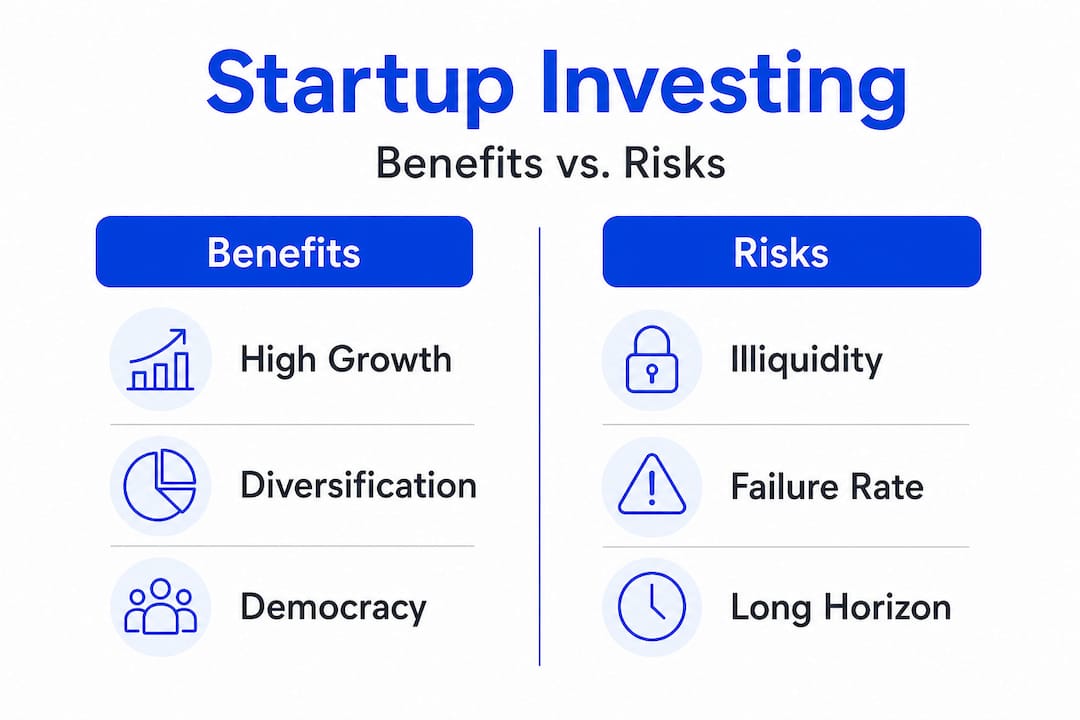
Crowdfunding has genuinely changed the landscape. Platforms regulated under the European Crowdfunding Service Providers (ECSP) Regulation now offer retail investors access to equity rounds, convertible notes, and revenue-based financing in startups across the continent. The fractional ownership benefits are clear: you can invest as little as €100 or €500 in a company that, a decade ago, would have required a €250,000 minimum cheque via a traditional VC fund.

European crowdfunding participation has expanded rapidly, with the ECSP framework pushing platforms toward standardised disclosures, investor categorisation, and risk warnings. This regulatory backdrop makes the ecosystem more transparent, though it is critical to understand the important nuance: regulatory compliance improves disclosure, not outcomes. Equity crowdfunding gives retail investors venture-style access, but they must treat it as venture risk, including illiquidity, dilution, and a meaningful probability of total loss.
Here are the core benefits that make startup investing via crowdfunding worth serious consideration:
-
Access to high-growth opportunities. You can invest alongside professional investors in sectors like climate tech, fintech, health tech, and deep tech, which were previously inaccessible without significant wealth.
-
Portfolio diversification. Adding uncorrelated assets, those that don’t move in lockstep with public markets, can smooth overall portfolio volatility over time. Startups, by definition, are uncorrelated with the FTSE or the DAX on any given trading day.
-
Direct impact investing. Many European crowdfunding platforms feature mission-driven startups in renewable energy, sustainable agriculture, and social impact. You can align capital with values, not just returns. 🌱
-
Learning and engagement. Crowdfunding platforms offer pitch decks, founder interviews, financial projections, and community Q&A. The educational value of simply reading through a dozen investment opportunities is significant for any investor.
-
Low entry thresholds. Unlike private equity funds with six-figure minimums, crowdfunding investments are genuinely accessible. This democratisation is real, even if its limits must be acknowledged.
-
Potential for outsized returns. While most startups fail, those that succeed can generate returns that no bond or savings account will ever match. Even a small allocation to a successful exit can meaningfully move your portfolio.
The key phrase to hold onto is “venture risk.” Excitement about access is legitimate. But the investor who treats a €500 crowdfunding round like a savings product is setting themselves up for disappointment. The platform does not protect you from a startup going bust. That responsibility sits with you and your due diligence.
Risks and realities: What every investor should know
Let’s be direct. Startup investing is not for everyone, and even for those it suits, the risks are significant. Responsible investing means looking at both sides of the ledger, and the risk column in startup investing is long.
Some commentators argue that crowdfunding business models can be fragile when transaction volumes or deal quality deteriorates, suggesting that investor experience may depend on platform economics and market cycle effects, not purely on investor protection rules. That is a sobering but important observation. When markets tighten and fewer deals close, platforms face revenue pressure, and that can affect their operational stability.
Here are the key risk factors to weigh up carefully:
| Risk factor | What it means | Severity |
|---|---|---|
| Illiquidity | Your capital is locked until an exit event | High |
| Dilution | Future fundraising rounds reduce your stake | Medium to high |
| Platform risk | The platform itself could close or fail | Medium |
| Business failure | The startup fails entirely, and you lose your investment | Very high |
| Cycle risk | Economic downturns reduce exit opportunities and valuations | High |
| Information asymmetry | Founders know far more than investors about the business | Medium |
Mistakes that trip up new startup investors:
-
Over-concentrating in one startup or one sector. Putting €5,000 into a single company is speculation, not investing.
-
Ignoring the Key Investment Information Sheet (KIIS). Every ECSP-regulated platform must provide this document. Read it. All of it.
-
Expecting rapid exits. Startup investing is a decade-long game at minimum. Do not rely on this capital for anything planned within five years.
-
Chasing hype. A compelling video pitch is not a business model. Look for revenue traction, credible founding teams, and clear use of funds.
-
Misreading regulatory protection. Regulation governs disclosure and conduct. It does not underwrite your returns or protect you from loss.
Understanding crowdlending considerations and how they differ from equity crowdfunding is also valuable here. Debt-based crowdfunding carries different risk profiles from equity. Similarly, real estate crowdfunding operates on its own distinct set of risk dynamics, asset collateral, and liquidity expectations.
Pro Tip: Only commit amounts you can afford to have locked away for five to ten years with a realistic possibility of losing entirely. A good rule of thumb is to keep your total startup allocation below 10 to 15% of your investable assets.
How to start investing in startups: A practical roadmap
Knowing the theory is useful. Having a clear process is better. Here is a practical, step-by-step roadmap for European individual investors looking to enter the startup investing space responsibly. 🎯
-
Educate yourself first. Spend time reading investor guides, platform FAQs, and case studies before committing any capital. Understanding the asset class builds better decisions. Remember, regulatory compliance improves disclosure, not outcomes, so your own knowledge is your first line of defence.
-
Select regulated platforms carefully. Look for platforms operating under the ECSP Regulation, authorised by national regulators such as the FCA (UK), AMF (France), or BaFin (Germany). Check their track record, the types of startups they feature, and their fee structures. Use aggregator tools like Crowdinform to compare hundreds of European platforms side by side with user reviews and AI-powered project insights.
-
Start with small test investments. Before committing meaningful capital, make two or three small investments to understand the process: how updates arrive, how documents are structured, and how platforms communicate. This is your learning phase.
-
Conduct proper due diligence on each opportunity. Read the KIIS document, review the startup’s financials or revenue projections, research the founding team’s background, and assess the competitive landscape. Ask yourself: what problem does this solve, and why is this team best placed to solve it?
-
Build a diversified portfolio deliberately. Aim for ten to twenty investments spread across sectors (climate tech, health, software, fintech), geographies (UK, Germany, France, Nordics), and funding stages. Spread investments over time rather than deploying all capital at once. This is called dollar-cost averaging into venture, and it reduces timing risk.
-
Monitor without obsessing. Check in quarterly rather than daily. Startup progress is measured in product milestones, customer growth, and fundraising rounds, not share prices. Most platforms send regular founder updates. Read them.
-
Plan for the long term. Set a mental horizon of seven to ten years. Be prepared for some investments to fail within the first two years and for others to take longer than expected to exit. Patience is the most powerful tool in startup investing.
Pro Tip: Spread your investment capital across several rounds and multiple platforms rather than deploying it all at once. This approach reduces the impact of any single platform’s risk profile and improves the diversity of your exposure.
Watch for red flags: vague use-of-funds statements, founders with no relevant experience, unusually high promised returns with no credible model, and platforms with poor communication records.
A fresh perspective on startup investing for individual investors
Most articles about startup crowdfunding celebrate access. And yes, access is genuinely exciting. But we think the conversation is missing something more important: the mindset shift that startup investing actually demands.
Here is what we observe consistently. Investors who are new to the space come in energised by the idea of finding the next big thing. They want to back a unicorn. They invest in three or four startups within a month, then grow frustrated when nothing has moved after eighteen months. They confuse silence with failure. They expected the stock market’s feedback loop and got venture capital’s silence instead.
The startup investing lessons that matter most are not about platform selection or due diligence checklists, though those matter. They are about developing the patience to think in years, not quarters, and the discipline to maintain a portfolio approach even when individual bets look shaky.
“Startups challenge you to think in years, not months. True wealth in this asset class is built with time, portfolio thinking, and the courage to stay the course.”
Crowdfunding’s genuinely transformative contribution is not just democratising access to venture capital. It is inviting ordinary investors to develop the same long-term ownership mindset that institutional funds have practised for decades. That is a shift worth making.
But it comes with real responsibility. You are not buying a lottery ticket when you back a startup. You are becoming a part-owner of an early business. That means tolerating uncertainty, supporting founders through updates and community engagement, and accepting that most investments will not return what you hoped. The ones that do, often more than make up for the ones that don’t. That asymmetry is what makes the asset class worth the patience.
The investors who will succeed over the next decade are not necessarily those who pick the best individual startups. They are those who build the most thoughtful, diversified portfolios, stay invested across full cycles, and resist the temptation to abandon the strategy when early signs are mixed.
Ready to diversify? Start your journey with Crowdinform
Startup investing is no longer a privilege. It is an opportunity within reach of any informed, patient European investor. But navigating hundreds of platforms, comparing investment opportunities, and assessing risks is a significant task to take on alone.
That is where Crowdinform comes in. Think of it as the TripAdvisor of European crowdfunding: a platform aggregating reviews and data from over 500 platforms across the continent, so you can compare, evaluate, and choose with confidence. With built-in AI tools that analyse individual investment projects and a growing library of investor guides, Crowdinform puts institutional-quality insight in your hands before your first investment. Whether you are just starting out or expanding an existing portfolio, investing in startups with Crowdinform gives you a smarter, more informed starting point. 🚀
Frequently asked questions
How risky is startup investing compared to shares or bonds?
Startup investing is considerably riskier than public equities or bonds, with a genuine possibility of losing your entire investment. VC benchmarks are measured at the fund level over long holding periods, reflecting how rarely individual deals perform predictably.
Can I sell my startup shares easily if I change my mind?
Most startup investments via crowdfunding are highly illiquid, and selling before an exit event is rarely straightforward. As the Eurazeo guide notes, equity crowdfunding carries illiquidity, dilution, and failure probability, and should never be treated as a liquid income alternative.
Does regulation mean my investment is safe?
No. European regulation increases transparency and improves platform conduct, but as the Eurazeo framework confirms, regulatory compliance improves disclosure, not the outcomes of your investment. Business failure remains a real and common risk.
How much should I invest in startups for a balanced portfolio?
Most experienced investors suggest keeping your startup allocation between 5% and 15% of your overall investable assets. Given the fragility of some crowdfunding models during economic downturns, only commit what you can genuinely afford to lock away for a decade or lose entirely.


