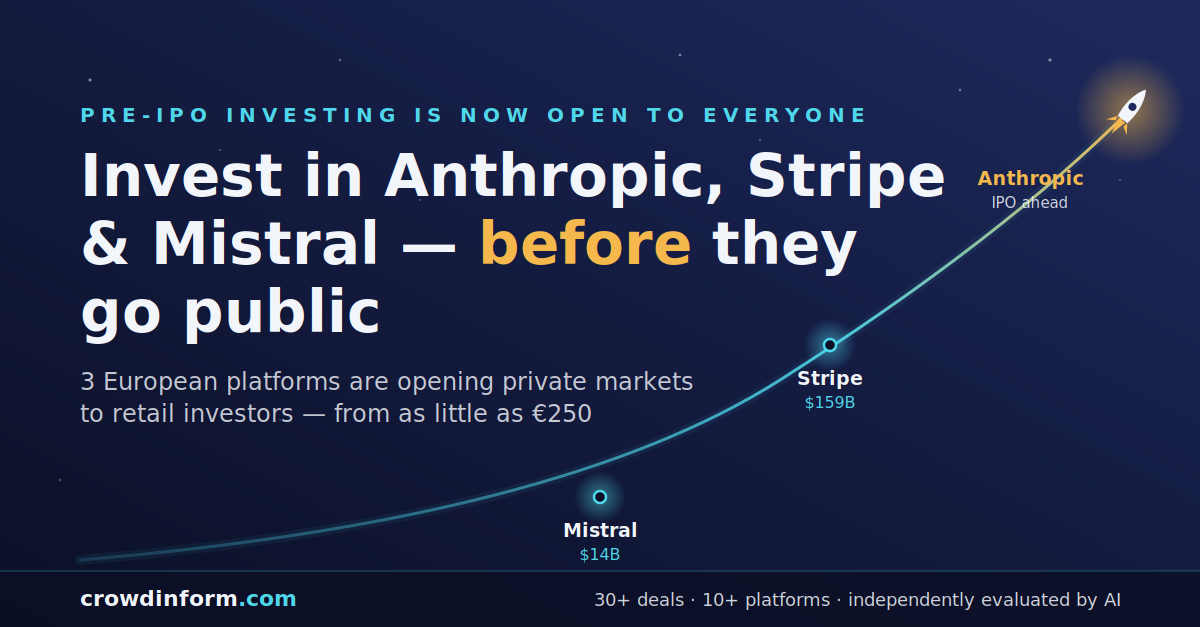
Imagine being able to invest in SpaceX before its record-breaking stock market debut. Or in Stripe, the payments giant valued at $159 billion. Or in Mistral and Perplexity, two of the hottest AI companies in the world.
Until very recently, that was impossible for regular people. These opportunities were reserved for venture capital funds, billionaires and Silicon Valley insiders. By the time a company finally arrived on the stock exchange, most of the spectacular growth had already happened — and someone else had pocketed it.
Now that is changing. Three European platforms — Crowdcube, Invesdor and Republic Europe — have found ways for everyday investors to buy into world-famous private companies, sometimes starting from as little as €250, £20 or even £10.
In this article, we'll explain exactly how each platform does it, what it costs, what could go right, and — just as importantly — what could go wrong.
Why "pre-IPO" investing matters
First, a quick translation of the jargon.
IPO stands for Initial Public Offering — the moment a private company "goes public" and its shares start trading on a stock exchange, where anyone can buy them. Pre-IPO investing simply means getting in before that moment, while the company is still private.
Why would you want to? Because companies today stay private much longer than they used to — and most of their explosive growth happens during those private years.
A few examples show what's at stake:
- Airbnb was valued at around $31 billion on the private market in 2017. Shortly after its IPO, it was worth over $100 billion. Early private investors more than tripled their money before the public even got a chance.
- Revolut raised money from ordinary people on Crowdcube back in 2016, when the whole company was valued at just £42 million. Today Revolut is Europe's most valuable fintech — early backers are sitting on gains of several hundred times their investment.
- Freetrade investors on Crowdcube saw returns of up to 47x when a share sale allowed them to cash out in 2021.
- SpaceX completed the largest IPO in history in June 2026. Investors who had bought "mirror" exposure through Republic just months earlier, when SpaceX was valued at $400 billion, saw the implied value roughly double before the listing even happened.
Of course, for every success story there are companies that stumble — and we'll talk honestly about that below. But the core point stands: the biggest wealth creation of our era is happening in private markets, and the door is finally opening for regular investors.
From startups to giants: the next chapter of equity crowdfunding
For more than a decade, equity crowdfunding has let ordinary people invest small amounts in startups with unicorn potential — buying tiny stakes in young companies in exchange for a share of their future success. Some of those bets paid off spectacularly (Revolut and Monzo both started as crowdfunding campaigns).
But there was always a catch: you had to pick winners very early, when most startups still fail.
Now three European platforms have flipped the script. Instead of only offering young startups, they let you invest in companies that are already worth billions — and could become worth tens or hundreds of billions. Companies like SpaceX, Stripe, Anthropic, Mistral, Perplexity and Revolut.
Each platform does it differently. Let's look at them one by one.
Crowdcube: buy real shares from early investors
What it is: Crowdcube (UK, regulated by the FCA) is Europe's original equity crowdfunding platform. Its newest focus is "secondaries" — a simple idea with a fancy name. Instead of buying new shares from the company, you buy existing shares from early investors, employees or founders who want to cash out some of their gains.
Why it's special: Of the three platforms, Crowdcube is the only one where you end up owning actual shares in the company (held safely on your behalf by Crowdcube's nominee service, which handles all the paperwork).
Who you can invest in: Over the past year, Crowdcube has offered shares in Mistral (the French AI champion, valued at $14 billion), Perplexity (the AI search company, $21 billion), Atom Bank and BOLT ahead of its expected IPO. Its investor community already holds shares in Revolut, Monzo, Moneybox, Chip, Nothing and Qonto.
What it costs: A one-off investment fee of 2.49% (minimum £5), rising to up to 5% for some deals. No ongoing fees.
The big risks, in plain terms:
- You're buying at a high price. These companies are already valued in the billions. There's less room for the 100x fairy-tale returns of early-stage investing — and if the valuation was too optimistic, you can lose money even if the company does fine.
- Your money is locked up. There's no guarantee you can sell until the company IPOs, gets acquired, or runs another share sale. That could take years.
- Even "exits" can disappoint. Freetrade — once a 47x success story — was eventually sold at a discounted valuation. A famous name is not a guarantee.
Invesdor: a bond that follows a company's value
What it is: Invesdor (Germany/Austria/Finland/Netherlands) offers pre-IPO investing through a structured bond. Here's the simple version: your money, together with other investors' money, goes into a special company that buys a stake in the target business. You hold a bond — an IOU — whose value rises or falls with the target company's valuation. When the company IPOs or gets sold, you get paid out based on how much its value has grown.
Who you can invest in: The current campaign gives exposure to Stripe, the payments powerhouse last valued at $159 billion. Invesdor's partner behind these deals, COMETUM, has also structured access to SpaceX and Anthropic. And Invesdor has real pedigree here: it was the first European crowdfunding platform ever to deliver an IPO exit, when Finnish company Heeros went public within 12 months of its campaign.
What it costs: Minimum investment is €250, with a transaction fee of around 1.5%. Important: there are additional costs inside the investment structure itself — always check the Key Information Document (a standardised fact sheet every EU investor receives) before investing.
The big risks, in plain terms:
- No exit, no payday. Unlike a normal bond, there's no interest. Your entire return depends on the company eventually IPOing or being sold at a higher valuation. If that never happens, your money can stay locked up for 5+ years — possibly indefinitely.
- You're at the back of the queue. Big professional investors in these companies often have special rights that mean they get paid first if things go badly. In a bad scenario, there may be little or nothing left for you.
- Total loss is possible. Invesdor says this itself, clearly: if the company fails or is sold cheaply, you can lose everything you invested.
Republic Europe: "Mirror Notes" that track a company's performance
What it is: Republic Europe (formerly Seedrs, UK) has launched the most innovative — and most unusual — product of the three: Mirror Notes. Think of it as a financial mirror. You don't own shares in the company, and no shares are held for you. Instead, you buy a note whose payout mirrors what would have happened if you had owned the shares. If the company's value goes up between when you invest and when it IPOs or gets sold, you profit. If it goes down, you lose.
Who you can invest in: The first Mirror Note, rSPAX, tracked SpaceX — and it has already been put to the test. SpaceX listed on NASDAQ in June 2026 in the biggest IPO of all time, triggering a payout event for note holders. On Republic's US platform, the same concept is being extended to names like Databricks and ByteDance, with Anthropic and Epic Games mentioned as potential future offerings.
What it costs: The minimum is around £20. But here's the catch: the main cost is invisible. It's built into the "Reference Price" — the starting valuation you're measured against — which includes a premium over what the shares actually trade for privately. In simple terms: you start the race a few steps behind, and the company's value has to grow enough to cover that gap before you make anything.
The big risks, in plain terms:
- You're trusting the issuer, not just the company. This is the crucial one. Mirror Notes are an unsecured promise from a Republic group company. Even if SpaceX soars, if the note issuer runs into financial trouble, your investment could become worthless. And these notes are not covered by the UK's investor compensation scheme (FSCS).
- Ten years is a long time. If no IPO or sale happens, you wait until the note matures — up to 10 years — with no way to sell in between except in limited circumstances.
- The starting price isn't verified. There's no audited, official valuation of a private company like SpaceX. You're relying on the platform's estimate of what the shares are worth today.
The honest bottom line
Let's be clear about the pattern here, because it's the single most useful thing to understand:
The more famous the company, the less you actually own. On Crowdcube you own real shares. On Invesdor you own a bond linked to shares. On Republic Europe you own a promise that mirrors shares. Each step gives you access to bigger names — but adds another layer between you and the actual company.
None of this makes these bad products. It makes them products you need to understand. The golden rules apply to all three:
- Only invest money you can afford to lose completely. Every one of these platforms says this, and they mean it.
- Diversify. One pre-IPO bet is a lottery ticket. Ten different investments is a strategy.
- Read before you invest. The fees, the exit conditions, and who gets paid first — it's all in the documents.
An awesome opportunity — if you do your homework
Make no mistake: this is a genuinely historic shift. For the first time, people like you and me can participate in the growth of the world's most exciting private companies — the SpaceXs, Stripes and Mistrals of this era — with pocket-money amounts. Ten years ago, this was unthinkable.
But opportunity without information is just gambling. The winners in this new world will be the investors who compare deals, ask the hard questions, and understand what they're actually buying.
That's exactly why we built Crowdinform.
At Crowdinform, we've aggregated 30+ live investment projects from 10+ European platforms — startups and growth companies across the continent — and put every single one through our AI Copilot for an independent evaluation. For each project, you get:
- The current valuation — and whether it's fair;
- An AI Score — indicating how ready the company is to reach a successful exit;
- Potential returns — what you could realistically earn in different scenarios;
- The key questions you should ask before investing, and the risks that deserve your attention.
No hype, no cherry-picking — just independent, structured analysis so you can decide with your eyes open.
The doors to private markets are opening. Walk through them informed.
Explore independently evaluated deals on Crowdinform →
This article is for informational purposes only and does not constitute investment advice. Investing in private companies involves significant risks, including the loss of your entire investment. Always read the official offering documents and consider seeking independent financial advice.