
Investor community insights are defined as the collective knowledge, judgement, and experience shared among groups of investors to improve individual and group decision-making. The role of investor community insights has never been more consequential: 57% of investors use AI for research, yet only 7% credit AI as the most influential factor in their last major decision. Human judgement, peer validation, and qualitative context still drive the final call. Whether you invest in crowdfunding, real estate, startups, or alternative assets, community feedback fills the gaps that algorithms cannot. Crowdinform aggregates reviews and data from over 500 European crowdfunding platforms, giving you a structured entry point into that collective intelligence.
What is the role of investor community insights in reducing uncertainty?
Digital investor communities do one thing exceptionally well: they convert private experience into shared knowledge. A study of 125 retail investors found that community participation aids collective learning and reduces decision uncertainty. That finding matters because uncertainty is the primary reason investors hesitate or make costly errors.
The mechanism is straightforward. When one investor has already evaluated a Portuguese real estate crowdfunding platform, their experience becomes a reference point for everyone else in the group. Collective learning compounds quickly across sectors:
- Crowdfunding: Community members flag platform fee structures, default rates, and secondary market liquidity that prospectuses rarely highlight clearly.
- Real estate: Peer reviews surface local planning risks, developer track records, and rental yield realities that headline figures obscure.
- Startups: Group analysis of founding teams, product traction, and cap table dynamics gives early-stage investors context that pitch decks omit.
- Alternative investments: Community dialogue on asset-backed lending, green bonds, and P2P loans helps investors evaluate loan originators with the rigour of a credit analyst.
The value of community feedback compounds when members actively share post-investment updates, not just pre-investment opinions. A member who reports a delayed repayment on a P2P platform in month six provides more useful data than any marketing brochure.
Pro Tip: Before acting on any community insight, check whether the contributor has a disclosed position in the asset they are discussing. Undisclosed conflicts of interest are the most common source of misinformation in investor forums.

What behavioural risks emerge from community participation?
Community participation amplifies two well-documented behavioural risks: herding and overconfidence. The 2026 retail investor study confirms that the same communities that enable learning also increase these risks. Herding occurs when investors follow the crowd rather than their own analysis. Overconfidence grows when positive reinforcement from peers inflates conviction beyond what the evidence supports.
Understanding these risks is the first step to managing them. The table below maps each risk to a practical management technique.
| Behavioural risk | How it appears | Management technique |
|---|---|---|
| Herding | Buying because "everyone in the group is buying" | Require your own written thesis before acting |
| Overconfidence | Increasing position size after peer praise | Set fixed position-size rules independent of sentiment |
| Confirmation bias | Seeking only posts that support your view | Actively read bearish arguments on every position |
| Groupthink | Avoiding dissent to maintain social harmony | Seek out the most critical voice in the community |
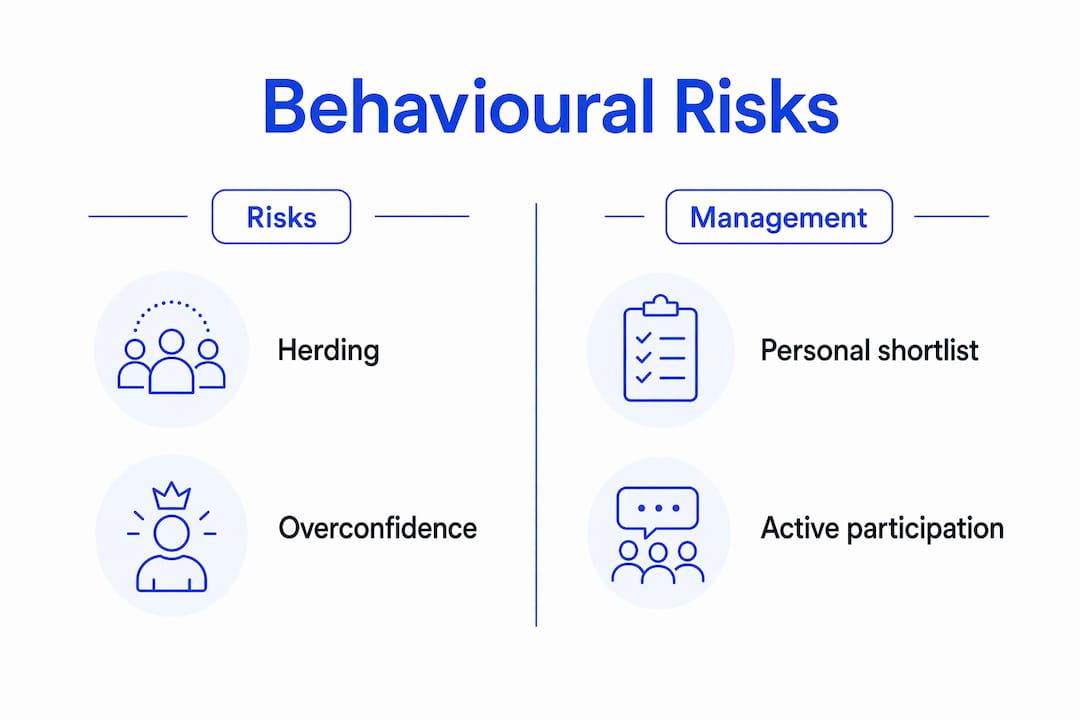
Active engagement, rather than passive scrolling, is the most effective counter to these biases. Investors who write investment memos and defend them publicly within a community are forced to confront logical flaws before committing capital. Passive content consumption yields low value and leaves biases unchallenged.
Practical steps for disciplined community engagement:
- Weight contributions by track record, not by follower count or posting frequency.
- Use bot detection and trusted contributor weighting to filter raw community data before acting on it.
- Separate the signal from the noise by tracking which contributors have been right before and under what conditions.
Pro Tip: Create a personal "trusted contributor" shortlist of five to ten community members whose reasoning you have verified over time. Prioritise their posts and discount the rest until new contributors earn their place on your list.
Understanding the role of digital trading communities in shaping investor behaviour helps you engage with them on your own terms rather than being swept along by group dynamics.
Why does qualitative information from communities drive outperformance?
Harvard Law School research establishes that the primary investment advantage from communities lies in qualitative, "soft" information that is difficult to digitise. Raw financial data is available to everyone. The nuanced judgement about whether a founding team executes under pressure, or whether a real estate developer delivers on time, is not.
"The most valuable thing I get from my investor community is not deal flow. It is accountability. When I have to defend my thesis to people who will remember if I was wrong, I think more carefully before I invest." — Angel investor Brian Nichols, as cited in community research on first-time angel investors.
Peer accountability disciplines investment thinking in ways that solo analysis cannot replicate. Angel investor insights consistently identify accountability as the community's greatest value, ranking it above deal flow and market intelligence. That accountability creates a feedback loop: investors who know they will be questioned sharpen their reasoning before they act.
Qualitative community insights deliver specific advantages across asset classes:
- Crowdfunding: Members share platform reliability scores, withdrawal experience, and customer service quality that aggregate ratings miss.
- Real estate: Experienced investors provide context on local market cycles, tenant quality, and renovation cost overruns from lived experience.
- Startups: Community members with sector expertise spot product-market fit signals and founder red flags that financial models cannot capture.
- Alternative investments: Peer dialogue on startup investing advantages and risk profiles helps investors calibrate exposure with greater confidence.
Trust is the foundation that makes qualitative insight credible. 93% of institutional investors would not invest without trust in management, and 85% have sold shares due to lost trust. That dynamic applies equally to community relationships: you act on insights from people you trust, and you build that trust through consistent, honest participation over time.
Pro Tip: Use community feedback as a stress test for your investment thesis, not as a replacement for it. Present your reasoning, invite the sharpest criticism, and update your view only when the argument is stronger than your original case.
How to maximise value from community insights across investment types
Getting the most from investor communities requires active participation tailored to the asset class you are targeting. Passive membership produces passive results. The most effective investors treat their community as a working tool, not a news feed.
A practical framework for each investment sector
Crowdfunding investors should prioritise communities that include experienced platform reviewers. Post your own platform assessments after each investment cycle. Ask specifically about secondary market liquidity and what happens when a platform faces regulatory scrutiny. Crowdinform's AI copilot helps you cross-reference community reviews with aggregated platform data from across Europe, giving your analysis a structured foundation.
Real estate investors benefit most from geographically specific communities. A community discussing pan-European real estate crowdfunding is less useful than one focused on Polish or Spanish markets, where local planning law, tax treatment, and developer reputation vary significantly. Seek out members who have completed full investment cycles, from entry to exit, in your target market.
Startup investors need communities with sector depth. A generalist angel network provides social capital but limited technical insight. Communities organised around specific verticals, such as climate tech, fintech, or health tech, produce sharper due diligence and more relevant peer accountability. Analysing investment platforms through a community lens adds a layer of qualitative validation that platform metrics alone cannot provide.
Alternative investment participants gain most from communities that include practitioners with direct experience in asset-backed lending, invoice finance, or green bonds. These are niche asset classes where regulatory nuance and counterparty quality matter enormously.
Steps for integrating community insights into your investment workflow
- Join before you need to. Build relationships and credibility in a community before you have a live investment decision. Cold requests for advice from strangers produce shallow answers.
- Write a public investment memo. Before committing capital, post a structured thesis to the community. Invite criticism. The process of writing forces clarity, and the feedback surfaces blind spots.
- Attend live events and calls. Text-based communities miss tone, hesitation, and nuance. Live interaction reveals the quality of thinking behind the posts.
- Practise reciprocal mentorship. Effective mentorship in communities works both ways. Contribute your unique skills, whether that is financial modelling, legal knowledge, or sector expertise, rather than only seeking answers.
- Review your community sources quarterly. Track which contributors have added genuine value to your decisions. Promote them on your trusted shortlist and remove those who have not.
- Filter before you act. Experienced investors avoid aggregate community data and prefer curated, verified insights from contributors with demonstrated track records.
Key takeaways
Investor community insights deliver their greatest value when combined with disciplined, active participation and rigorous filtering of qualitative information across all investment types.
| Point | Details |
|---|---|
| Human judgement leads final decisions | Only 7% of investors credit AI for their last major decision; communities fill the gap. |
| Collective learning reduces uncertainty | A study of 125 retail investors confirms community participation lowers decision uncertainty. |
| Behavioural risks require active management | Herding and overconfidence grow in communities; written investment memos and trusted contributor lists counter them. |
| Soft information drives outperformance | Harvard Law School research confirms qualitative community insights outperform raw data reliance. |
| Reciprocal participation builds social capital | Contributing your own expertise strengthens community value and improves the quality of insights you receive. |
Why active participation is the only strategy that works
I have watched investors treat online communities the way they treat financial news: something to consume in the background while making decisions in isolation. That approach produces the worst of both worlds. You absorb the noise and the biases without gaining the accountability and qualitative depth that make communities genuinely useful.
The investors I have seen perform consistently well in crowdfunding and startup investing share one habit. They show up, they contribute, and they defend their positions publicly before they invest. That discipline is uncomfortable. It means being wrong in front of people who remember. But that discomfort is precisely what sharpens thinking.
The behavioural risks are real. I have seen herding destroy returns in P2P lending communities where one enthusiastic voice convinced a dozen investors to pile into a platform that subsequently froze withdrawals. The antidote is not to avoid communities. It is to engage with them critically, weight contributors by track record, and never substitute community consensus for your own written analysis.
AI tools, including Crowdinform's AI copilot, are genuinely useful for aggregating platform data and surfacing patterns across hundreds of projects. But the role of AI in crowdfunding is to inform, not to decide. The best outcomes I have observed come from investors who combine AI-generated data with community-validated qualitative insight and then apply their own disciplined judgement. Communities are not a shortcut. They are a sharpening tool. Use them that way.
— Jevgenijs
Crowdinform: your gateway to trusted investor communities
Crowdinform connects you with aggregated, AI-assisted insights from over 500 European crowdfunding platforms, giving your community-driven decisions a solid data foundation.
Whether you are evaluating a real estate project in Spain, a startup raise in Estonia, or a P2P lending platform in Latvia, Crowdinform's platform reviews and AI copilot help you cross-reference community feedback with verified platform data. You can explore crowdfunding platforms and projects across Europe, read structured investor reviews, and use the built-in AI tool to interrogate any project before you commit capital. The result is a more grounded, community-informed investment process that goes well beyond gut feel or headline returns.
FAQ
What is the role of investor community insights?
Investor community insights provide qualitative, peer-validated knowledge that fills the gaps left by raw financial data and AI tools. They reduce decision uncertainty, surface soft information, and create peer accountability that sharpens investment thinking.
How do investor communities reduce behavioural risks like herding?
Active participation, including writing public investment memos and weighting contributors by track record, counters herding and overconfidence. A study of 125 retail investors confirms that disciplined engagement, rather than passive consumption, is the key differentiator.
Why is qualitative information from communities more valuable than raw data?
Harvard Law School research shows that nuanced, qualitative insights from peer interactions drive portfolio outperformance because they capture context, management quality, and execution risk that financial models cannot quantify.
How do I know which community members to trust?
Build a personal shortlist of five to ten contributors whose reasoning you have verified over multiple investment cycles. Experienced practitioners recommend weighting by track record and using bot detection to filter unreliable sources from aggregate community data.
What is an investor community and how do I join one?
An investor community is a structured or informal group of investors who share knowledge, review opportunities, and hold each other accountable. You join by contributing actively, not just by signing up.


