
Minimum investment is defined as the smallest sum an investor must commit to participate in a crowdfunding project or alternative investment opportunity. Across European platforms, this figure varies from as little as €100 on real estate portals to several hundred euros on more institutionally oriented services, shaped by platform policy, asset class, and the EU regulatory framework known as ECSPR. For anyone exploring real estate, startup, or alternative investments in Europe, understanding where these thresholds sit and why they exist is the starting point for building a credible portfolio.
What is minimum investment in real estate crowdfunding?
Real estate crowdfunding platforms in Europe set their own entry thresholds, and the range is wider than most new investors expect. Profitus requires €100 per project. Letsinvest, which operates under an ECSP licence and focuses on larger-scale development projects, sets its minimum at €500. That fivefold difference between two regulated platforms illustrates a core truth: there is no universal minimum across European real estate crowdfunding.
Several factors drive these differences. Project scale matters considerably. A development requiring €2 million in crowd capital can afford to accept smaller tickets because the total investor pool is large. A smaller project with tighter operational margins may set a higher floor to limit administrative overhead per investor. Mortgage security, loan-to-value ratios, and the platform’s own risk appetite all feed into the decision. The ECSPR fundraising cap of €5 million per project over 12 months does not directly dictate investor minimums, but it does shape the scale of projects that platforms can list, which in turn influences ticket sizing.

For context, average European crowdfunding deals raise between €100,000 and €1 million, well below the €5 million ceiling. This means most projects are genuinely accessible at the lower end of the minimum spectrum. You can explore the mechanics of entry points and project selection in this step-by-step real estate guide from Crowdinform.
Key variables that influence real estate crowdfunding minimums:
-
Project size and capital target: Larger projects can absorb more investors at lower ticket sizes.
-
Platform licensing model: ECSP-licensed platforms may apply stricter onboarding, which can push minimums upward.
-
Loan structure: Mortgage-backed projects often carry lower minimums because security reduces per-investor risk.
-
Operational cost per investor: Platforms with high compliance costs may prefer fewer, larger commitments.
Pro Tip: When comparing platforms, check whether the minimum applies per project or per campaign tranche. Some platforms allow you to spread a small starting amount across multiple projects from day one, which accelerates diversification without requiring a large initial commitment.
How do startup crowdfunding platforms set minimum investment amounts?
Startup and equity crowdfunding operates on a different logic from real estate. Startup crowdfunding platforms in Europe do not enforce a standard minimum; ticket sizes depend entirely on the platform and the individual campaign. Republic Europe, for instance, structures its investor terms around campaign-specific conditions rather than a blanket floor. This flexibility reflects the early-stage nature of startup investing, where founders and platforms negotiate terms that suit the funding round.
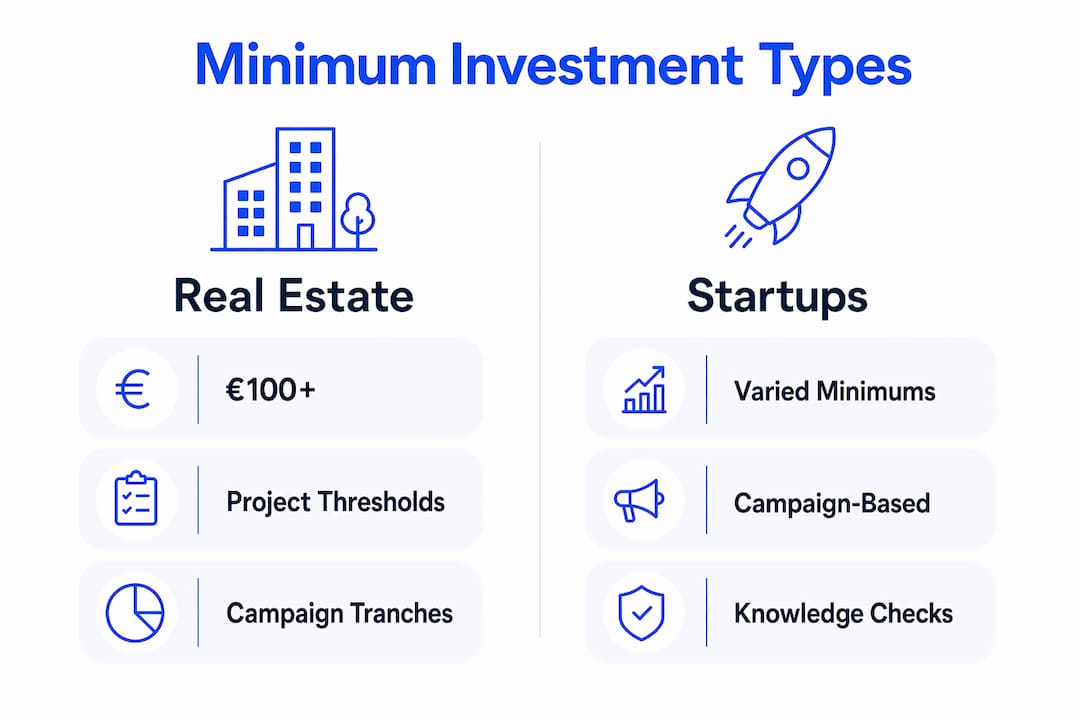
The absence of a regulatory minimum does not mean anything goes. ECSPR’s investor protection framework places significant weight on disclosure and suitability rather than on setting a floor. Platforms must present clear risk warnings, and non-sophisticated investors face additional safeguards that can limit how much they invest rather than how little. This is a subtle but important distinction: the regulation is more concerned with capping exposure for inexperienced investors than with establishing a minimum entry point.
Here is how startup crowdfunding minimums typically take shape in practice:
-
Campaign-level negotiation: Founders and platforms agree on a minimum ticket that reflects the round size and investor relations capacity.
-
Risk disclosure requirements: Platforms must communicate that startup investing carries a high probability of total loss, which influences how they frame minimum commitments.
-
Investor onboarding checks: Appropriateness assessments determine whether a non-sophisticated investor should proceed at all, regardless of the stated minimum.
-
Platform commercial model: Some platforms earn fees per investor, incentivising lower minimums to attract volume. Others prefer fewer, larger investors to reduce administrative burden.
-
Campaign momentum: Campaigns with strong early traction sometimes lower minimums mid-round to broaden participation and generate social proof.
For a thorough breakdown of how startup equity rounds work across EU platforms, Crowdinform’s startup investment guide covers the full picture.
Pro Tip: Before committing to a startup campaign, complete the platform’s knowledge assessment honestly. If the platform flags that the investment may not be appropriate for your profile, treat that as genuinely useful information rather than a formality to bypass.
How does ECSPR shape investment thresholds and investor protections?
The EU Crowdfunding Service Providers Regulation (ECSPR) is the primary legal framework governing crowdfunding across EU member states. It does not prescribe a minimum investment amount for individual investors, but it creates a structured environment in which platforms must operate, and that structure has a direct bearing on how minimums are set and enforced.
The regulation’s most consequential investor-facing rule concerns non-sophisticated investors. Additional protections are triggered when an investment exceeds €1,000 or 5% of the investor’s net worth, whichever is lower. At that point, platforms must issue explicit risk warnings and may require the investor to confirm they understand the implications. This threshold does not prevent investment below €1,000, but it creates a natural psychological and procedural checkpoint.
| ECSPR protection mechanism | What it means for investors |
|---|---|
| €5 million fundraising cap per project | Limits project scale; most deals remain accessible at low ticket sizes |
| Appropriateness and knowledge assessment | Non-sophisticated investors must demonstrate basic understanding before proceeding |
| €1,000 or 5% net worth trigger | Additional warnings and confirmation steps apply above this level |
| Cooling-off period | Non-sophisticated investors can withdraw commitments within a defined reflection window |
| Business continuity requirements | Platforms must have wind-down plans, protecting investor funds if the platform closes |
“ECSPR harmonises investor protection across the EU but deliberately leaves minimum investment amounts to market forces, trusting platforms to set thresholds that reflect their project types and investor base.” — ESMA crowdfunding regulation overview
The practical implication is that minimum investment ticket size is often less decisive than the onboarding checks that determine how much a non-sophisticated investor can commit after that initial entry. Investor safeguards align investment amounts with knowledge and net worth to limit exposure risk. You can read more about how these mechanisms work across licensed platforms in Crowdinform’s regulated crowdfunding guide.
What are minimum investment levels for alternative and structured investments?
Beyond crowdfunding, the investment universe includes private placements, structured products, and vehicles designed for accredited or professional investors. These carry substantially higher entry points. In the United States, Regulation D private placements frequently require minimums of at least $200,000, used partly as a proxy to verify accredited investor status. The logic is that a high minimum filters for investors with sufficient wealth to absorb potential losses without regulatory intervention.
European equivalents exist in the form of professional investor categories under MiFID II and AIFMD, where minimum commitments for alternative investment funds often start at €100,000. These are not crowdfunding products. They are institutional or semi-institutional structures with correspondingly higher barriers.
The contrast with crowdfunding minimums is stark and worth holding in mind:
-
Crowdfunding entry points (€100 to €500 on platforms like Profitus and Letsinvest) are designed for retail participation.
-
Private placement minimums ($200,000 and above) function as eligibility filters, not just capital requirements.
-
Alternative investment funds in Europe typically require €100,000 or more, placing them beyond the reach of most retail investors.
-
Structured notes and derivatives may carry lower nominal minimums but embed complexity that effectively restricts them to sophisticated buyers.
For investors who want exposure to real assets or growth companies without institutional-scale capital, European crowdfunding under ECSPR remains the most accessible regulated route. The low starting investment amount is a genuine structural advantage, not a marketing claim.
How to build a diversified portfolio using minimum investment strategies
Knowing the minimum is only the first step. Using it well requires a deliberate approach to diversification, regulatory awareness, and realistic expectations about returns and risk.
-
Map your starting capital against platform minimums. If you have €1,000 to deploy, Crowdestate’s €100 minimum allows ten separate project positions. Letsinvest’s €500 minimum gives you two. The choice between breadth and depth depends on your risk tolerance and the quality of available projects.
-
Respect the €1,000 or 5% net worth threshold. Staying below this level on any single platform keeps your onboarding experience straightforward and avoids the additional confirmation steps that ECSPR triggers above it.
-
Combine asset classes where minimums allow. Mixing real estate crowdfunding with startup equity positions creates genuine diversification. The correlation between a Portuguese development loan and a Berlin-based SaaS startup is low, which is exactly what a diversified portfolio needs.
-
Use platform investor information actively. ECSPR requires platforms to publish key investment information sheets (KIIS) for every project. Reading these before committing, even at a low minimum, is the single most effective due diligence habit you can build.
Pro Tip: Low minimums can create a false sense of security. Spreading €100 across ten projects does not eliminate risk if all ten projects are in the same sector or geography. Genuine diversification requires variety in asset type, country, and loan structure, not just in the number of positions.
Key takeaways
The minimum investment in European crowdfunding is a platform-set figure, not a regulatory mandate, and understanding the difference between entry thresholds and investor protection caps is what separates informed investors from those who simply chase the lowest ticket size.
| Point | Details |
|---|---|
| Minimum investment defined | The smallest sum required to participate in a crowdfunding project, set by each platform independently. |
| Real estate platform range | Crowdestate starts at €100; Letsinvest requires €500, reflecting project scale and licensing model. |
| ECSPR protection trigger | Investments above €1,000 or 5% of net worth activate additional warnings and checks for non-sophisticated investors. |
| Alternative investment contrast | Private placements and alternative funds require €100,000 to $200,000+, far above crowdfunding entry points. |
| Diversification principle | Low minimums enable broad diversification, but variety in asset type and geography matters more than number of positions. |
Why minimum investment thresholds matter more than they appear
I have spent considerable time reviewing crowdfunding platforms across Europe, and the question I hear most often from new investors is not “what returns can I expect?” It is “how much do I need to start?” That question is understandable, but it is also slightly the wrong one.
The minimum investment is the door. What happens after you walk through it is what actually determines your outcome. I have seen investors treat a €100 minimum as an invitation to scatter small amounts across dozens of projects without reading a single key investment information sheet. That is not diversification. That is noise.
What I find genuinely encouraging about the current European crowdfunding environment is that ECSPR has shifted the conversation. The regulation does not tell you how little you can invest. It asks whether you understand what you are investing in. The appropriateness checks, the cooling-off periods, the risk warnings above €1,000: these are not bureaucratic obstacles. They are the framework that makes retail participation in real assets credible and sustainable.
My honest view is that the most productive minimum investment strategy is not about finding the lowest possible entry point. It is about finding the lowest entry point that still allows you to invest with genuine conviction in a project you have actually evaluated. Start with feasible amounts, use the regulatory protections as a guide rather than a hurdle, and build from there. The platforms are better regulated than they were five years ago, and the opportunities are genuinely expanding.
— Jevgenijs
Explore crowdfunding opportunities with Crowdinform
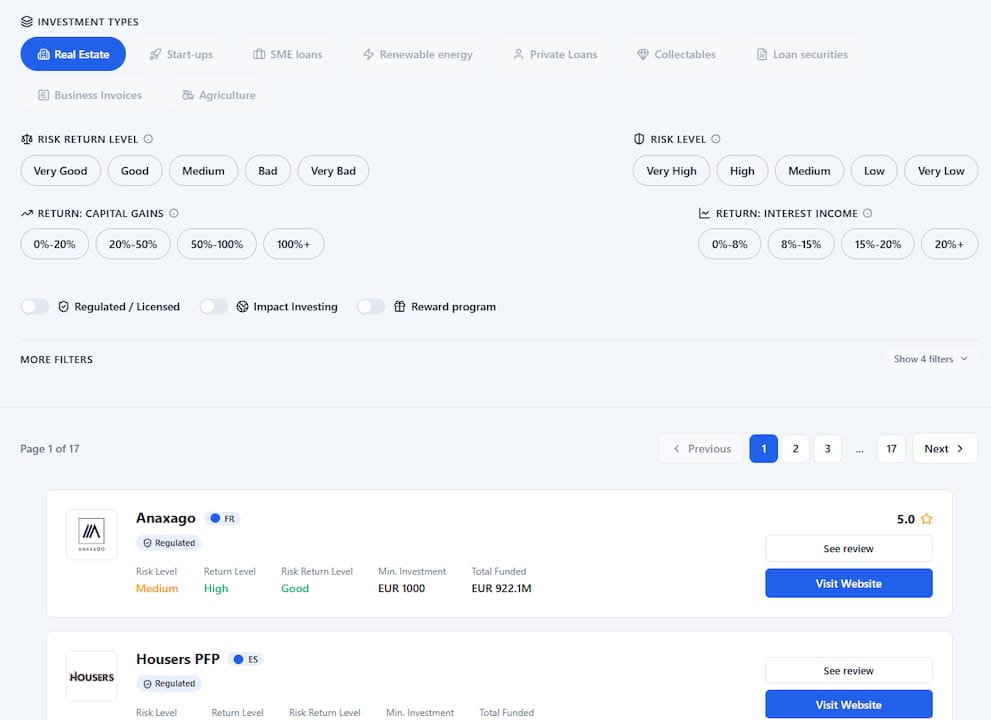
Crowdinform aggregates and reviews over 500 European crowdfunding platforms, covering P2P loans, real estate, and startup equity investments. Whether you are assessing your starting investment amount or comparing platforms with different minimum thresholds, Crowdinform’s AI copilot analyses individual projects and surfaces the data you need to make informed decisions. The platform brings together verified reviews, live project data, and regulatory context in one place, so you spend less time searching and more time investing. Visit Crowdinform to explore current opportunities across all three asset classes and find the entry point that fits your profile.
FAQ
What is the minimum investment on European crowdfunding platforms?
Minimum investment requirements vary by platform. Crowdestate accepts commitments from €100 per project, while Letsinvest requires €500 per project. There is no single EU-wide minimum.
Does ECSPR set a minimum investment amount for investors?
ECSPR does not set a minimum investment floor. It sets a €5 million fundraising cap per project and triggers additional investor protections when a single investment exceeds €1,000 or 5% of net worth.
How much do I need to start investing in European startups?
Startup crowdfunding platforms in Europe set their own minimums on a campaign-by-campaign basis. No standard minimum exists across EU startup platforms, so entry points depend on the specific campaign and platform terms.
Are minimum investments higher for alternative investments than for crowdfunding?
Yes. Private placements and alternative investment funds typically require minimums of $200,000 or more in accredited investor frameworks, compared to €100 to €500 on regulated crowdfunding platforms.
Can I diversify with a small starting investment amount?
A €100 minimum on platforms like Crowdestate allows you to spread capital across multiple projects. Genuine diversification requires variety in asset type, geography, and loan structure, not just a high number of positions.