
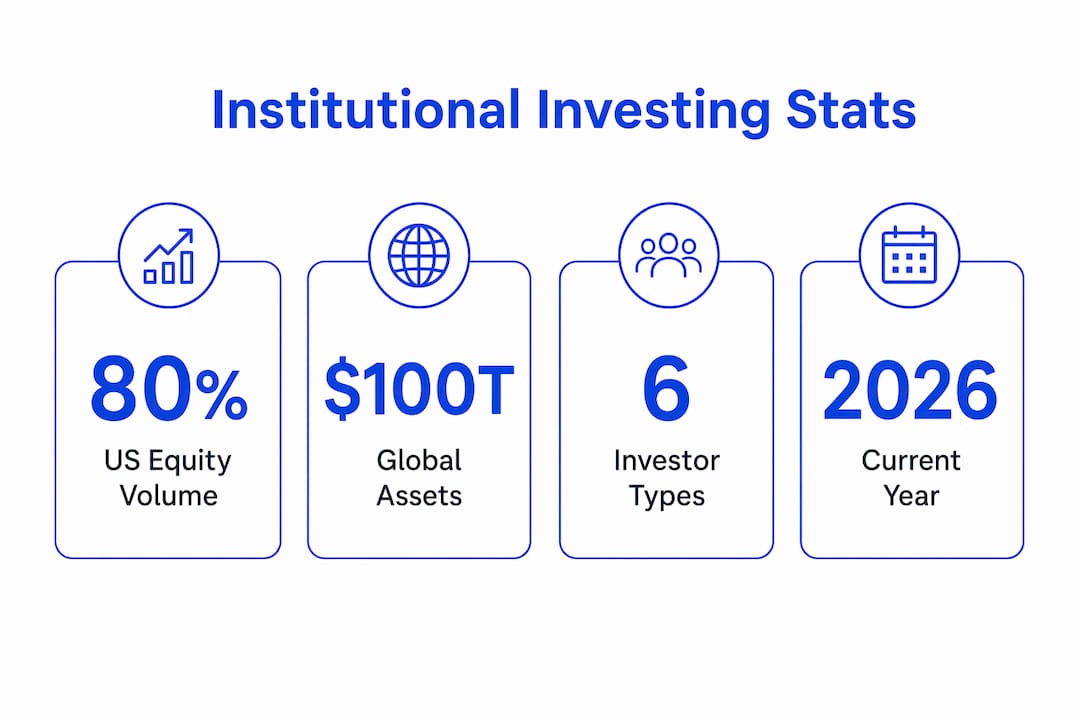
Institutional investing is defined as the professional management of large capital pools on behalf of beneficiaries, governed by fiduciary duty and executed at a scale that shapes entire financial markets. Pension funds, sovereign wealth funds, insurance companies, mutual funds, endowments, and family offices all qualify as institutional investors. Institutional investors control approximately 80% of US equity trading volume, making them the dominant force in global markets. Their defining characteristic is not simply size. It is the legal obligation to act exclusively in the interests of those whose money they manage, a standard that separates them sharply from retail investors managing personal savings.
What is institutional investing and who qualifies?
Institutional investing refers to the deployment of pooled capital by organisations acting on behalf of clients or beneficiaries, rather than for personal gain. The scale involved is the first distinguishing feature. FINRA Rule 4512(c) sets the regulatory threshold at $50 million in assets for an entity to qualify as an institutional account, exempting it from the retail suitability rules that protect individual investors. That exemption reflects an assumption of financial sophistication, not a regulatory loophole.
The main types of institutional investors each carry distinct mandates:
- Pension funds manage retirement savings for employees, with long investment horizons and a strong focus on capital preservation alongside growth.
- Sovereign wealth funds are state-owned vehicles investing national reserves, often with geopolitical as well as financial objectives.
- Insurance companies invest premium income to meet future claims, prioritising stable, predictable returns.
- Mutual funds pool retail and institutional capital into diversified portfolios, offering broad market access.
- Endowments manage permanent capital for universities or charities, balancing current spending needs with long-term growth.
- Family offices manage wealth for ultra-high-net-worth families, often with highly customised mandates.
| Type | Typical scale | Common investments | Primary mandate |
|---|---|---|---|
| Pension fund | Hundreds of billions | Equities, bonds, real assets | Retirement income security |
| Sovereign wealth fund | Trillions | Global equities, infrastructure | National wealth preservation |
| Insurance company | Tens of billions | Fixed income, property | Liability matching |
| Mutual fund | Billions | Diversified public markets | Client return generation |
| Endowment | Billions | Alternatives, equities | Perpetual capital growth |
| Family office | Hundreds of millions | Private equity, real assets | Bespoke wealth management |
Investment style varies significantly across these types. Some institutions favour active management, where portfolio managers select individual securities to beat a benchmark. Others use index strategies, tracking broad market indices at lower cost. The choice depends on mandate, cost tolerance, and the institution's view on market efficiency.
How do institutional investors operate and move markets?

Institutional investors pool capital from many beneficiaries and deploy it through professional management teams with access to research, trading infrastructure, and asset classes unavailable to most individuals. This pooling creates the scale that defines institutional behaviour. A single pension fund may allocate billions across equities, bonds, private equity, infrastructure, and commodities simultaneously.
Trading at institutional scale creates direct market consequences. Block trades involve the purchase or sale of large security volumes in a single transaction, and they can cause immediate price movements by creating supply and demand imbalances. A fund selling a £500 million equity position cannot do so quietly. Market participants observe the pressure and prices adjust, sometimes sharply. This is why institutions use specialist trading desks, dark pools, and algorithmic execution to minimise market impact.
The core operating principles of institutional investing include:
- Fiduciary responsibility: Every decision must serve the beneficiary's interests. Fiduciary duty is the legal and ethical backbone of institutional management, distinguishing it from retail investing driven by personal preference.
- Diversification: Institutions spread capital across asset classes, geographies, and sectors to reduce concentration risk.
- Hedging: Sophisticated instruments including derivatives, currency forwards, and options protect portfolios against downside scenarios.
- Access to private markets: Institutions invest in private equity, venture capital, and direct infrastructure deals that are simply not available to retail investors.
Pro Tip: If you notice a sudden, unexplained price movement in a large-cap stock, a block trade from an institutional investor is often the cause. Watching institutional 13F filings in the US gives you a quarterly window into where the largest funds are positioning.
Institutional liquidity provision is a critical and often underappreciated market function. Without the constant buying and selling activity of large funds, bid-ask spreads would widen and markets would become harder to trade for everyone. Retail investors benefit from institutional activity even when they never interact with it directly.
What are the benefits and challenges of institutional investing?
Institutional investing delivers measurable benefits to the broader financial system, but it also carries risks that regulators and market observers monitor closely.
Benefits for the financial ecosystem:
- Price discovery: Institutional research teams analyse companies in depth, and their trading activity pushes prices toward fair value. This makes markets more efficient for all participants.
- Corporate governance: Large shareholders vote at annual general meetings, engage with boards, and push for management accountability. This oversight benefits all shareholders, including retail investors.
- Market liquidity: Sophisticated hedging strategies and constant trading activity keep markets liquid, reducing transaction costs across the board.
- Access to alternatives: Institutions channel capital into infrastructure, renewable energy, and private credit, funding projects that public markets alone would not support. Readers interested in sustainable investment opportunities will find that much of the green finance growth is driven by institutional capital.
- Beneficiary protection: Fiduciary standards enforced by regulators mean that pension savers and insurance policyholders have legal recourse if their funds are mismanaged.
Challenges and risks:
The concentration of market power in a small number of large institutions creates systemic risks. When major funds rebalance simultaneously, the resulting sell-off can amplify market volatility rather than dampen it. The 2008 financial crisis demonstrated how interconnected institutional positions can transmit stress across the global system rapidly.
Sustainability considerations have become a growing pressure point. Organisations such as the Principles for Responsible Investment (PRI) and the OECD have pushed institutions to account for environmental, social, and governance (ESG) factors in their decision-making. Institutional investor engagement and stewardship is now a formal discipline, with dedicated stewardship codes in the UK, EU, and Japan. The shift is real, but critics argue that ESG commitments sometimes reflect reputational management rather than genuine capital reallocation.
How do investor profiles shape strategy and market impact?
Not all institutional investors behave the same way, even when managing similar sums. The OECD identifies distinct archetypes that explain why two funds of equal size can have opposite effects on market stability and corporate behaviour.
State-aligned investors, such as sovereign wealth funds, often carry geopolitical objectives alongside financial ones. Norway's Government Pension Fund Global manages $1.5 trillion in assets and owns approximately 1.5% of all globally listed companies. Its mandate includes ethical exclusion lists and active voting on governance issues worldwide. That is a level of market influence no private fund can match.
Entrepreneurial investors, such as certain endowments and family offices, take concentrated positions in private markets and accept illiquidity in exchange for higher expected returns. Yale University's endowment model, developed by David Swensen, popularised heavy allocations to alternatives and influenced institutional investing globally.
Retail-focused institutions, such as large mutual fund managers, prioritise broad diversification and cost efficiency. Their investment decisions are shaped by the need to serve millions of individual clients with varying risk tolerances.
The liability profile of an institution predicts its strategy more reliably than its size alone. Liability-driven investment means a pension fund with obligations maturing in 10 years will hold very different assets than one with a 30-year horizon, even if both manage the same total capital. Understanding this distinction helps you read institutional behaviour in the market rather than being surprised by it.
Pro Tip: When a large pension fund announces a shift toward long-duration bonds, it is almost certainly responding to changes in its liability profile, not making a macro call on interest rates. Recognising the difference helps you interpret institutional moves accurately.
The diversity of institutional archetypes also matters for real asset investing, where state-aligned and liability-driven investors tend to be the most active and longest-term holders. Their presence in infrastructure and property markets provides pricing stability that shorter-horizon investors cannot offer. The growing fragility of institutional trust in 2026 adds another layer of complexity, as public scrutiny of large fund behaviour intensifies.
Key takeaways
Institutional investing is the dominant force in global financial markets, defined by fiduciary duty, pooled capital, and a scale that shapes prices, liquidity, and corporate governance for all market participants.
| Point | Details |
|---|---|
| Scale and regulatory threshold | FINRA sets the institutional account threshold at $50 million, granting exemption from retail suitability rules. |
| Fiduciary duty is the core distinction | Institutional investors are legally bound to act in beneficiaries' interests, unlike retail investors managing personal goals. |
| Market impact is structural | Institutional block trades and rebalancing activity directly move prices and determine liquidity conditions. |
| Liability profile drives strategy | A fund's obligations, such as pension payouts, shape asset allocation more than size or market trends alone. |
| Sustainability is now a formal discipline | Bodies like the PRI and OECD have made ESG stewardship a standard expectation for institutional investors globally. |
Why institutional investing matters more than most people realise
I have spent years watching retail investors treat institutional activity as background noise, something happening in a different financial universe. That view is a costly mistake. The 80% of US equity trading volume controlled by institutions means that every price you see on a screen is, in large part, a reflection of institutional positioning. You are not trading against other retail investors. You are trading in a market shaped almost entirely by professional capital.
What strikes me most in 2026 is how the sophistication gap between institutional and retail investors is widening, not narrowing. Institutions now use machine learning for portfolio construction, access private credit markets at scale, and engage directly with company boards on governance. The tools available to large funds have expanded dramatically, while the average retail investor still relies on public market access and basic diversification.
The practical implication is not that retail investors should try to replicate institutional strategies. Most cannot, and should not. The real lesson is to understand institutional behaviour well enough to avoid being on the wrong side of it. When you analyse investment platforms and read market signals, knowing whether a price move is driven by institutional rebalancing or genuine fundamental change is genuinely valuable.
The most underrated aspect of institutional investing is the fiduciary standard. It creates accountability that personal investing simply does not have. Watching how the best-run pension funds and endowments approach risk, diversification, and long-term thinking offers a practical framework that any investor can learn from, regardless of portfolio size.
— Jevgenijs
Crowdinform: your starting point for smarter investment research
Understanding institutional investing is the foundation. Applying those insights to real investment decisions requires the right tools and information.
Crowdinform aggregates data from over 500 European crowdfunding platforms, providing AI-powered project reviews and a searchable catalogue of active investment opportunities. Whether you are exploring property investment models or researching how platforms manage risk, Crowdinform's AI copilot gives you institutional-grade analysis at an accessible level. Visit Crowdinform to explore top-rated projects, read verified platform reviews, and use the built-in tools to make more informed investment decisions today.
FAQ
What is the definition of institutional investing?
Institutional investing is the professional management of large pooled capital on behalf of beneficiaries, governed by fiduciary duty. Entities managing $50 million or more in assets qualify as institutional investors under FINRA Rule 4512(c).
What are the main types of institutional investors?
The main types are pension funds, sovereign wealth funds, insurance companies, mutual funds, endowments, and family offices. Each carries a distinct mandate, risk tolerance, and investment horizon shaped by its underlying liabilities.
How do institutional investors differ from retail investors?
Institutional investors manage capital on behalf of others and carry a legal fiduciary duty, while retail investors manage personal funds for personal goals. Institutions also access private markets, use sophisticated hedging, and trade at volumes that directly influence market prices.
What impact do institutional investors have on financial markets?
Institutional investors control approximately 80% of US equity trading volume, making them the primary drivers of price discovery, liquidity, and corporate governance standards. Their block trades can cause immediate price movements across entire sectors.
Why does an institution's liability profile matter for its investment strategy?
A fund's liabilities, such as pension obligations due in a specific timeframe, determine which assets it can hold and for how long. Liability-driven investment means two funds of identical size can hold entirely different portfolios based on when they need to pay out capital.


