
Monitoring investment trends is defined as the regular assessment of market movements, portfolio shifts, and thematic signals to make informed decisions that improve returns and reduce risk. For investors managing loans, real estate, or equities, understanding why monitor investment trends is the difference between reacting to losses and positioning ahead of them. Trend monitoring draws on techniques from total return accounting, trend-following strategies, and thematic analysis to give you a complete, forward-looking picture of your portfolio. Crowdinform aggregates data from over 500 European crowdfunding platforms, making it a practical starting point for investors who want structured visibility into where capital is moving.
Why monitor investment trends: the core case
Tracking investment trends is not optional for serious investors. It is the mechanism that separates disciplined portfolio management from guesswork dressed up as strategy.

The most compelling evidence comes from trend-following strategies, which have generated positive returns during major equity market downturns, a phenomenon known as "crisis alpha." Approximately £350 billion in assets are committed to these strategies globally. That scale reflects institutional conviction, not a passing fad.
Key benefits of monitoring investment trends include:
- Risk reduction: Trend monitoring reveals allocation drift and concentration risks before they compound into losses.
- Opportunity capture: Structural themes such as AI spending, renewables, electrification, medical advances, defence spending, and demographic shifts are expected to drive growth over the next 20–30 years. Investors who track these themes early gain entry at lower valuations.
- Crisis positioning: Trend-following strategies exhibit positive convexity, meaning they are designed to profit during market crashes by shorting declining assets. This delivers gains precisely when traditional portfolios suffer.
- Informed rebalancing: Regular monitoring tells you when a position has grown beyond its intended weight, prompting timely rebalancing rather than emotional reaction.
The importance of tracking investments goes beyond watching prices. It means understanding the forces that drive prices, so you can act on evidence rather than sentiment.
How often and by what methods should you monitor trends?
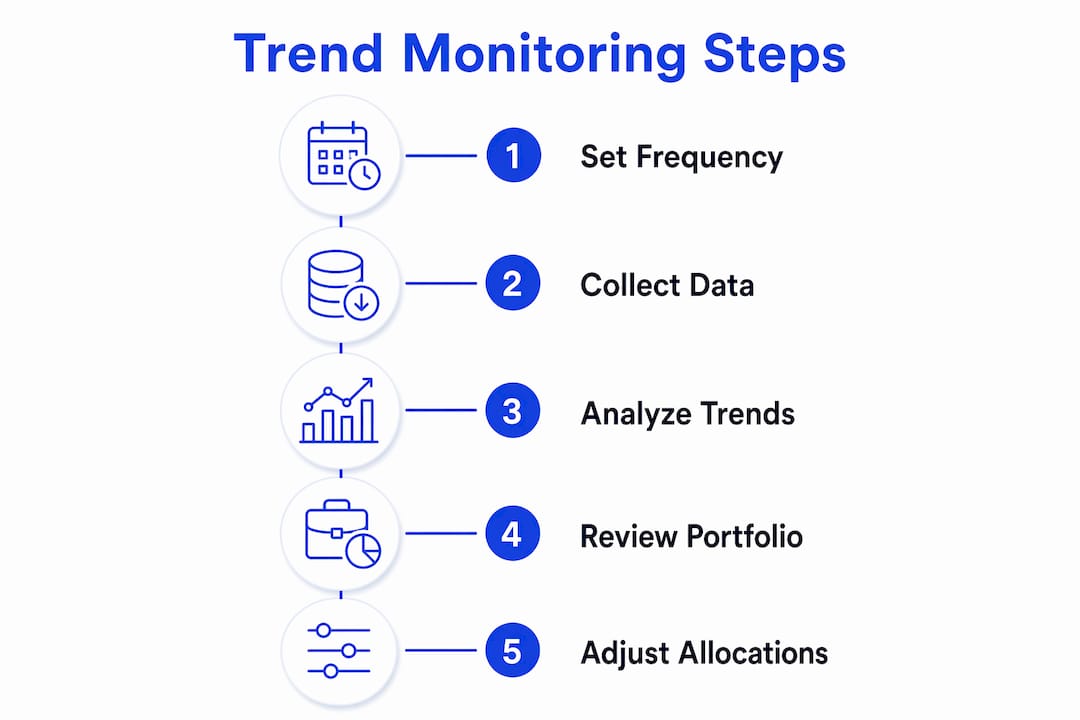
Frequency matters as much as the act of monitoring itself. Daily price watching creates anxiety and degrades decision quality. Monthly or quarterly reviews are more effective for long-term wealth building. That cadence keeps you focused on strategy rather than noise.
The method you use shapes what you see. Follow this structured approach:
- Measure total return, not just price. Dividends historically account for up to 40% of total returns on major indices. Ignoring dividends can underestimate your actual performance by nearly half. Always include fees in your calculation.
- Benchmark against a relevant index. Comparing your portfolio to a benchmark reveals whether your active decisions add value or simply track the market at higher cost.
- Use a consolidated dashboard. Spreadsheets, dedicated portfolio trackers, or investment platforms that aggregate data give you a single view of allocation, performance, and risk. Scattered accounts hide the full picture.
- Review thematic signals quarterly. Check whether the macro tailwinds behind your thematic positions, such as electrification or AI infrastructure, are strengthening or fading. Adjust allocation accordingly.
- Log your decisions. Recording why you made each change creates an audit trail that reduces emotional repetition of past mistakes.
Pro Tip: Set a recurring calendar reminder for your quarterly review. Treat it like a board meeting for your portfolio. Investors who schedule reviews in advance are far less likely to make reactive trades during volatile periods.
Knowing how to analyse investment platforms is a natural extension of this process. The platform you use shapes the quality of data you receive, which directly affects the quality of your decisions.
What pitfalls do investors face when monitoring trends?
Monitoring trends without discipline creates its own risks. The most common trap is overconcentration in crowded themes.
"The greatest risk in tracking mega-trends is overconcentration. Successful investors combine thematic investing with diversified, long-term strategies, focusing on supporting industries rather than betting everything on a single narrative."
When a theme becomes consensus, valuations already reflect the expected growth. Chasing a crowded trade at peak enthusiasm is one of the fastest ways to destroy the returns that early monitoring would have delivered. Protecting against this requires portfolio diversification as a counterweight to thematic conviction.
A second pitfall is overreliance on lagging indicators. Revenue growth, earnings per share, and profit margins all confirm what has already happened. Micro-signals appear years before they show up in financial statements. Talent migrations, patent filings, and early adoption rates in adjacent sectors are the signals that matter most. Investors who wait for financial confirmation consistently pay a premium for what early movers already own.
The third pitfall is emotional decision-making caused by poor visibility. Without clear allocation data, investors often make reactive trades, overlook ETF overlap, and miss allocation drift. Scattered accounts across multiple platforms compound this problem significantly.
How can you apply trend monitoring to improve portfolio outcomes?
Practical application is where monitoring converts from theory into returns. The starting point is consolidation.
Scattered investments across multiple platforms create "hidden wealth" crises. Consolidating your view enables accurate tax-loss harvesting, clearer allocation decisions, and faster identification of overlapping positions. The cost of not consolidating is measurable: unclaimed investments due to poor tracking run into billions globally.
Once you have a consolidated view, apply a three-layer analysis framework:
| Layer | What to track | Why it matters |
|---|---|---|
| Macro tailwinds | Interest rates, policy shifts, demographic trends | Sets the direction of capital flows across sectors |
| Sector shifts | Profit pool migration, regulatory changes, competitive dynamics | Identifies which industries capture macro growth |
| Micro-adoption signals | Talent movement, patent activity, early customer adoption | Confirms a trend is real before it reaches financial statements |
This framework mirrors the approach used by the best trend analysts, who do not predict the future but interpret present signals more accurately than the consensus.
For thematic investing specifically, the six structural themes identified for 2026 and beyond, including AI spending, renewables, and the demographic "grey wave," reward investors who spot top investment projects early and hold through volatility rather than chasing momentum at the top.
Balancing thematic conviction with diversification is the final discipline. Allocate a defined percentage of your portfolio to thematic positions, say 20–30%, and keep the remainder in diversified, lower-correlation assets. Rebalance annually or when any single theme exceeds its target weight by a meaningful margin.
Pro Tip: When a thematic position doubles, consider trimming back to your original allocation. Locking in partial gains while maintaining exposure is a disciplined way to benefit from trends without becoming dangerously concentrated.
Trend-following strategies during downturns, such as those that buy into falling markets with a systematic approach, demonstrate that discipline and process outperform reactive decision-making in volatile conditions.
Key takeaways
Monitoring investment trends is the single most effective habit for protecting and growing a portfolio over the long term, combining risk awareness, thematic positioning, and disciplined rebalancing into one continuous process.
| Point | Details |
|---|---|
| Monitor at the right frequency | Monthly or quarterly reviews outperform daily tracking for long-term decision quality. |
| Measure total return | Always include dividends and fees; dividends account for up to 40% of index returns. |
| Avoid trend crowding | Combine thematic positions with diversified allocation to prevent overconcentration. |
| Use a three-layer framework | Track macro tailwinds, sector shifts, and micro-adoption signals to stay ahead of consensus. |
| Consolidate your accounts | A single portfolio view enables tax-loss harvesting and removes emotional blind spots. |
My honest view on trend monitoring after years in the field
Most investors I speak with confuse activity with discipline. They check prices every morning, react to headlines, and call it "monitoring." That is not monitoring. That is anxiety with a brokerage account.
The investors who consistently outperform are the ones who do less, but do it deliberately. They run quarterly reviews, they measure total return properly, and they use a framework to distinguish genuine structural shifts from noise. The three-layer approach, macro, sector, and micro-adoption, is not complicated. It is simply more rigorous than what most people bother to do.
The part that surprises people most is how much consolidation matters. I have seen portfolios where the investor genuinely did not know they held the same underlying assets in three different wrappers. That kind of overlap destroys the diversification you think you have. Fixing it is not exciting work, but it is the foundation everything else rests on.
Thematic investing excites me because the structural trends of 2026, electrification, AI infrastructure, and the grey wave, are genuinely predictable in direction even if not in timing. The discipline is in not overpaying for that predictability. Monitor early, size sensibly, and rebalance without sentiment.
— Jevgenijs
Crowdinform: your starting point for trend-informed investing
Applying trend monitoring insights requires access to quality data and a broad view of where capital is moving across asset classes.
Crowdinform aggregates reviews and performance data from over 500 European crowdfunding platforms, covering loans, real estate, and startup investments. Its AI copilot analyses individual projects and surfaces signals that would take hours to gather manually. Whether you are building a thematic position in renewables or assessing a P2P lending platform's track record, Crowdinform's investment tools give you the consolidated, data-driven view that disciplined trend monitoring requires. Explore the platform and put your monitoring practice to work with real European investment opportunities.
FAQ
What is investment trend monitoring?
Investment trend monitoring is the regular assessment of market movements, portfolio allocation, and thematic signals to guide investment decisions. It combines total return tracking, macro analysis, and sector-level observation into a structured review process.
How often should investors review their portfolios?
Monthly or quarterly reviews are more effective than daily price tracking for long-term wealth building. Structured reviews reduce emotional decision-making and keep focus on strategy rather than short-term market noise.
What is crisis alpha in trend-following strategies?
Crisis alpha refers to the positive returns that trend-following strategies generate during major equity market downturns. These strategies exhibit positive convexity, profiting from declining assets when traditional portfolios suffer losses.
Why does consolidating investment accounts matter?
Consolidating accounts gives you a complete view of allocation, performance, and risk across all positions. Without it, investors miss ETF overlap, allocation drift, and tax-loss harvesting opportunities that can meaningfully improve net returns.
What are the biggest risks when monitoring investment trends?
The three main risks are overconcentration in crowded themes, overreliance on lagging indicators such as earnings reports, and emotional decision-making caused by poor portfolio visibility. A structured monitoring framework addresses all three directly.


