
An alternative assets investment workflow is a defined, systematic process that guides investors through evaluating, acquiring, managing, and exiting alternative investments to maximise returns and control risk. Unlike public equities, alternatives such as real estate, renewable energy, private equity, and infrastructure demand a disciplined, multi-stage approach. Without a clear workflow, even experienced investors face avoidable losses from liquidity mismatches, insufficient due diligence, and operational errors. This guide covers every critical stage of the alternative assets investment workflow, from prerequisites and due diligence through to portfolio construction, automation, and common pitfalls to avoid.
What prerequisites and tools are essential before starting the alternative assets investment workflow?
The right team structure is the foundation of any effective alternative investments process. A functioning investment committee, supported by legal counsel and a risk management function, provides the governance layer that keeps decisions disciplined. Without these roles clearly defined, even well-sourced opportunities can stall or proceed without adequate scrutiny.
Documentation requirements are equally non-negotiable. Before evaluating any opportunity, you need access to offering documents, audited track records, operational reports, and fund manager disclosures. Investors targeting meaningful diversification across five or more asset classes typically scale their portfolios from £1,000–£5,000 at entry to £25,000 or more. That range reflects the capital commitment required to spread risk across real estate, renewable energy, private credit, and infrastructure simultaneously.

Digital tools are the operational backbone of a modern workflow. The table below maps common tool categories to their workflow functions:
| Tool category | Primary workflow function |
|---|---|
| Document management platforms | Centralise offering documents, legal agreements, and reports |
| Portfolio tracking software | Monitor NAV, capital calls, and distributions in real time |
| Collaboration and task tools | Coordinate investment committee reviews and approvals |
| Data aggregation platforms | Consolidate manager data from multiple underlying assets |
| AI-assisted review tools | Flag anomalies and surface key risks across large data sets |
Pro Tip: Before committing capital, build a standardised data room template. Requiring every manager to populate the same fields eliminates the inconsistency that slows down initial screening.
For investors new to alternatives, publicly traded REITs and interval funds offer a lower-barrier entry point. REIT ETFs start from as little as $50, while interval funds typically require $1,000–$10,000, with quarterly or semi-annual liquidity. These vehicles let you practise the workflow at lower stakes before committing to illiquid private structures.
How to conduct comprehensive due diligence within the investment workflow?
Due diligence is the central pillar of the alternative investment workflow, and for institutional-grade investments it spans 6–12 months with multi-stakeholder teams. That timeline reflects the genuine complexity of evaluating private structures where public information is limited. Rushing this phase is the single most common cause of poor outcomes in alternative asset management.
The process follows four distinct phases:
- Initial screening. Assess the fund's strategy, target returns, and market opportunity against your portfolio objectives. Eliminate opportunities that fail basic fit criteria before investing deeper resources.
- Comprehensive assessment. Evaluate manager experience, historical performance, risk controls, and the coherence of the investment thesis. 94% of institutional investors consider this phase critical, which reflects how much weight professional allocators place on manager quality.
- Operational review. Examine back-office infrastructure, compliance frameworks, third-party service providers, and reporting quality. Weak operations are a leading indicator of future problems, regardless of strategy strength.
- Legal validation. Review fund documents, fee structures, side letters, and redemption terms with qualified legal counsel. Pay particular attention to gate provisions and lock-up periods.
A thorough due diligence checklist covers:
- Manager track record across full market cycles, not just bull markets
- Clarity and consistency of the investment strategy
- Quality and independence of the fund administrator and auditor
- Fee structure, including management fees, performance fees, and hurdle rates
- Governance and reporting standards
- Alignment of interests, specifically whether the General Partner has substantial personal capital invested alongside limited partners
That last point deserves emphasis. A GP with meaningful personal capital at risk shares your downside. It is one of the most reliable commitment signals available to any investor.
Pro Tip: Watch for the "black box" problem. If a manager cannot clearly explain their competitive edge in plain language, treat it as a red flag regardless of past performance. Complexity is not the same as sophistication.
Due diligence is not a single event. It continues throughout the life of the investment, with ongoing monitoring of governance, controls, and reporting to sustain conviction through market cycles.
What are the key stages in executing the alternative assets investment workflow?
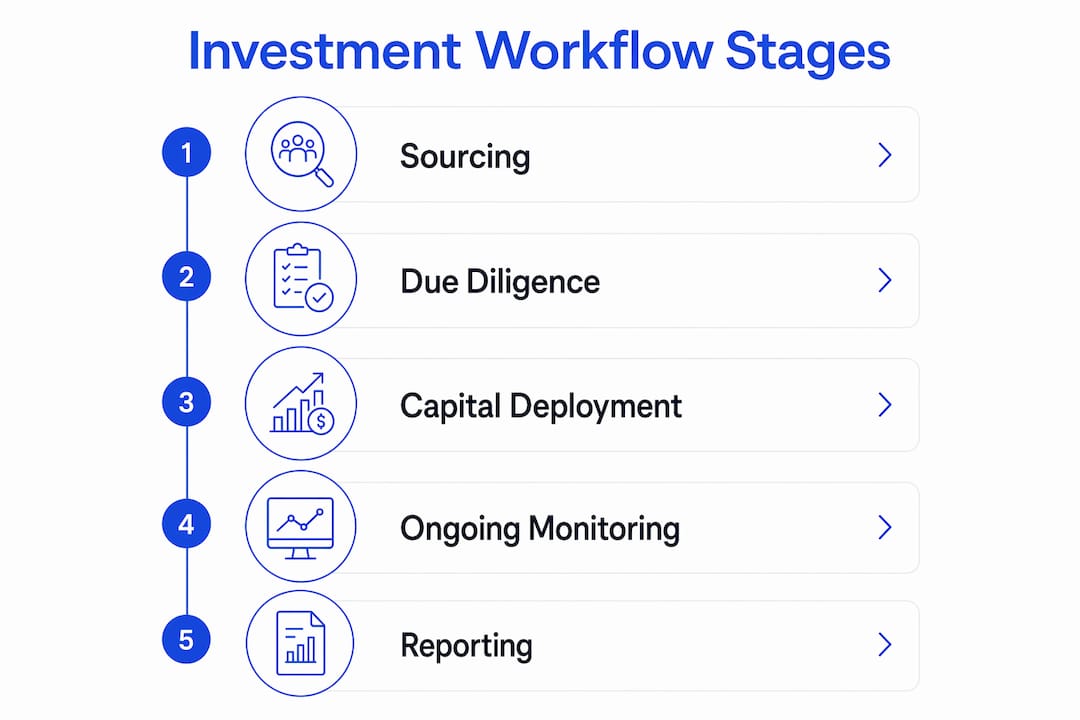
Execution transforms research into portfolio positions. The workflow moves through five sequential stages, each with its own decision gates:
- Sourcing. Identify opportunities through proprietary networks, placement agents, and platforms that aggregate manager data. Quality sourcing filters for strategy fit before any detailed analysis begins.
- Screening and underwriting. Apply quantitative screens (target IRR, vintage year, sector exposure) followed by qualitative assessment of the manager and market thesis. The investment committee reviews underwriting outputs before any term sheet is signed.
- Investment decision. The committee votes based on a formal investment memorandum. Dissenting views are documented. This governance step protects against groupthink and creates an audit trail.
- Capital deployment and call management. Capital calls require investors to transfer cash on short notice. Failing to prepare for this creates liquidity crises. Maintain a dedicated cash reserve specifically for capital call obligations.
- Exit planning. Define exit criteria at the point of entry, not at the end of the holding period. For venture capital and private equity buyouts, plan for 7–10 year horizons or longer. Secondary markets are improving liquidity options, but they come at a discount.
Portfolio construction guidelines sit across all five stages. Diversify by asset class, geography, vintage year, and manager to avoid concentration risk. Pacing matters too. Committing capital across multiple vintages smooths the J-curve effect and reduces the impact of any single entry point.
For a broader view of how these stages fit within a European investment context, the investment platform workflow guide on Crowdinform covers the structural components in detail.
How can investors optimise and automate their alternative asset investment workflows?
Manual spreadsheet workflows are the biggest operational liability in alternative asset management. Managers and investors are shifting to AI-powered systems that autonomously gather data and detect anomalies, moving humans into exception-handling and review roles. This shift is not optional for anyone managing a portfolio of meaningful scale.
Document fragmentation is the core operational challenge. Multiple underlying companies generate reports in different formats, at different frequencies, and with inconsistent data fields. Automation platforms that extract and normalise this data reduce portfolio errors and free up analyst time for higher-value work.
Practical steps for workflow optimisation include:
- Replace ad hoc email chains with a structured document management system that logs every version and approval
- Set automated alerts for capital call notices, distribution announcements, and reporting deadlines
- Use AI-assisted tools to flag performance deviations against benchmarks before they become material issues
- Standardise quarterly reporting templates across all managers to enable like-for-like comparison
- Build a governance calendar that schedules investment committee reviews, compliance checks, and portfolio rebalancing at fixed intervals
Pro Tip: Treat your workflow documentation as a living asset. Review and update your process after every capital deployment. The gaps you find after closing a deal are the ones that cost you on the next one.
Ongoing monitoring is not a passive activity. Governance controls, reporting reviews, and manager meetings are continuous workflow elements that sustain the investment thesis between entry and exit. Platforms like Crowdinform, which aggregate data across hundreds of European crowdfunding and alternative investment platforms, support this monitoring function by surfacing project updates and manager performance data in one place.
What common challenges and mistakes should investors avoid in managing alternative assets workflows?
Liquidity mismatches are the most frequent and most damaging mistake in alternative asset portfolios. Investors who allocate too much capital to illiquid structures without maintaining adequate reserves face forced sales at discounts or missed capital calls.
Capital call unpredictability is a structural feature of private markets, not an exception. Seasoned investors always budget for short-notice cash transfer requirements and treat their cash reserve as a non-negotiable portfolio allocation.
Red flags to monitor throughout the investment lifecycle:
- Managers who resist operational due diligence or limit access to back-office information
- Fee structures that misalign incentives, such as high management fees with no performance hurdle
- Inconsistent or delayed reporting that obscures portfolio performance
- Lack of GP co-investment, indicating limited personal commitment to the fund's success
- Strategies that cannot be explained clearly, which signals either poor communication or genuine opacity
Insufficient operational diligence is a close second to liquidity mismanagement as a source of portfolio losses. Investors who focus exclusively on the investment thesis and skip the operational review regularly discover governance failures, compliance gaps, or inadequate service providers after capital is committed.
Pro Tip: Maintain a cash reserve equal to at least 10–15% of your total alternative asset commitment specifically for capital calls. This figure is not publicly standardised, but experienced allocators consistently cite this range as a practical buffer against short-notice demands.
Clear communication with managers is a workflow discipline, not a courtesy. Establish reporting expectations, escalation protocols, and meeting cadences at the point of commitment. Managers who agree to these terms upfront are demonstrably more transparent throughout the holding period. For guidance on analysing investment platforms and their governance standards, Crowdinform's resources provide a practical starting point.
Key takeaways
A disciplined alternative assets investment workflow, built on structured due diligence, clear execution stages, and continuous monitoring, is the most reliable path to consistent risk-adjusted returns in private markets.
| Point | Details |
|---|---|
| Build the team first | Define investment committee, legal, and risk roles before sourcing any opportunity. |
| Due diligence is ongoing | Treat evaluation as a continuous process, not a one-time pre-investment event. |
| Prepare for capital calls | Maintain a dedicated cash reserve to meet short-notice capital transfer demands. |
| Automate document management | Replace manual spreadsheets with AI-assisted tools to reduce errors and free analyst time. |
| Watch for red flags | Opacity, misaligned fees, and absent GP co-investment are reliable warning signs. |
Why workflow discipline defines long-term performance in alternative assets
Most investors I speak with underestimate how much of their eventual return is determined before they sign a subscription document. The sourcing quality, the rigour of the operational review, the governance structure of the fund itself — these factors compound over a 7–10 year holding period in ways that no amount of post-investment monitoring can fully correct.
What I have observed over years of tracking European alternative investment platforms is that the investors who outperform consistently are not necessarily the ones with the best deal flow. They are the ones with the most disciplined process. They ask the same questions every time. They document dissenting views. They maintain liquidity reserves even when it feels conservative.
The shift toward AI-assisted workflows is genuinely exciting. Agentic AI models are beginning to handle routine data gathering and anomaly detection at a speed no human team can match. That frees experienced investors to focus on the judgement calls that actually require human insight: assessing manager character, evaluating market timing, and deciding when a thesis has run its course.
My honest view is that the investors who will struggle most in the next decade are those who treat workflow as administrative overhead rather than a core competency. The complexity of alternative assets is not decreasing. The managers who survive market cycles are the ones with operational infrastructure to match their investment ambitions. Build the workflow first. The returns follow.
— Jevgenijs
Crowdinform: your resource for alternative investment research
Crowdinform aggregates data from over 500 European crowdfunding and alternative investment platforms, giving you a single place to compare projects, read verified reviews, and access AI-powered project analysis.
Whether you are refining your due diligence process or building your first alternative asset portfolio, Crowdinform's AI copilot surfaces the project data and manager insights you need to make informed decisions. The platform covers real estate, renewable energy, private credit, and more, with curated guides on understanding alternative investments to support every stage of your workflow. Visit Crowdinform to explore current projects and start building a more disciplined investment process today.
FAQ
What is an alternative assets investment workflow?
An alternative assets investment workflow is a structured, repeatable process covering sourcing, due diligence, capital deployment, monitoring, and exit planning for non-traditional asset classes such as real estate, private equity, and renewable energy.
How long does due diligence take for alternative investments?
Institutional-grade due diligence for alternative investments typically spans 6–12 months, involving investment committees, legal teams, and risk management functions to evaluate manager quality, strategy, and operational infrastructure.
What is the minimum capital needed to invest in alternative assets?
Entry points vary significantly. REIT ETFs start from as little as $50, interval funds from $1,000–$10,000, while meaningful diversification across five or more alternative asset classes typically requires £25,000 or more.
How do capital calls work in alternative asset portfolios?
Capital calls require investors to transfer committed cash to a fund on short notice, often within 10–14 business days. Maintaining a dedicated liquidity reserve is the standard practice among experienced allocators to avoid missing these obligations.
What is the biggest red flag in alternative investment due diligence?
The "black box" problem is the most consistent red flag: a manager who cannot clearly explain their competitive edge or investment strategy in plain language, regardless of their historical performance record.


