
Spotting top investment projects is defined as the ability to recognise opportunities with strong market fit, measurable product depth, and sound financial efficiency before the wider market catches on. Frameworks from AquaFunded, NUVC, and Aption confirm that the investors who consistently outperform are those who apply structured criteria rather than gut instinct. This guide walks you through the exact signals, sector-specific tactics, and practical tools you need to identify high-potential investments across startups, real estate, and renewable energy in 2026.
What are the essential criteria to evaluate an investment project?
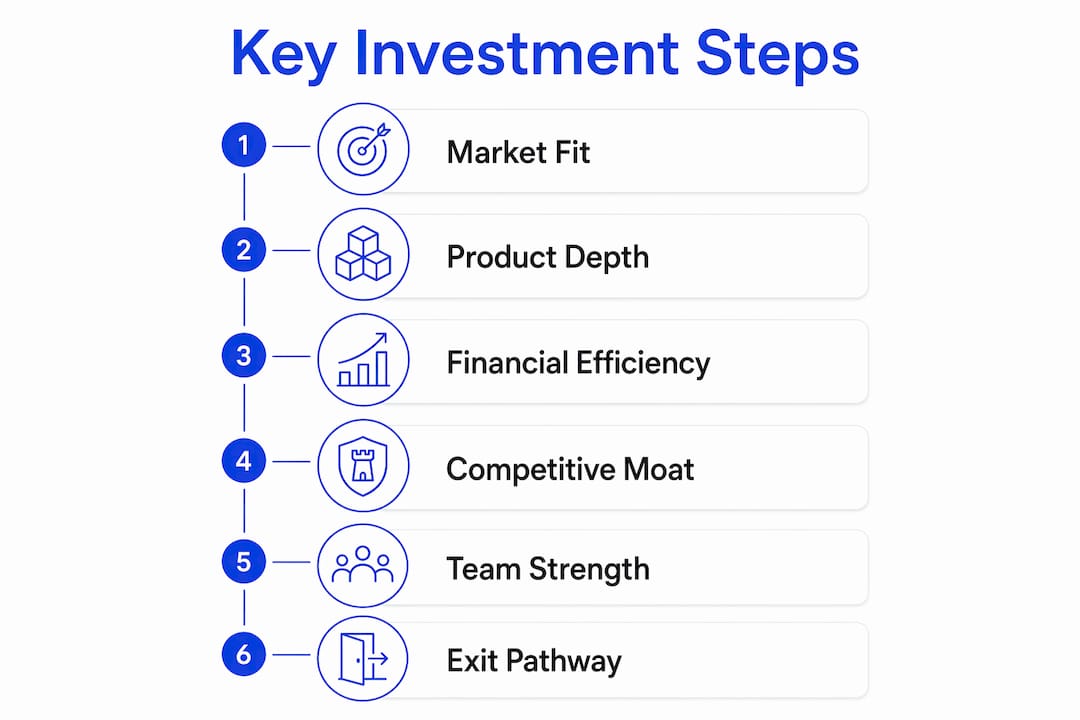
The single most reliable way to evaluate investment opportunities is to assess market fit first, product depth second, and financial efficiency third. 75% of investors rank market fit as the most critical factor above optimistic financial forecasts. This tells you something important: a project solving a real, validated problem in a large addressable market will always outperform a technically impressive product with no clear demand.
Product depth is the next non-negotiable. NUVC's analysis of 298 pitch decks found that successful startups score 6.76 on product depth versus 5.30 for unfunded companies. That gap is not accidental. It reflects whether a product has genuine defensibility, a clear use case, and a roadmap that extends beyond the initial release.
Financial efficiency separates disciplined operators from optimistic storytellers. According to Aption's researcher framework, top-decile startups maintain an ARR-to-equity ratio above 1 dollar per dollar raised. Any ratio below 0.25 is a red flag signalling capital mismanagement or premature scaling. This metric cuts through vanity revenue figures and shows you how efficiently a team converts investment into real output.
Beyond these three pillars, experienced investors also assess competitive moat, team strength, and exit pathway. A good exit thesis is often more critical than operational plans in illiquid investments, because without a testable exit path, even a promising project becomes a liquidity trap. The table below summarises the core criteria with practical benchmarks.
| Criterion | Benchmark to look for |
|---|---|
| Market fit | Validated demand, paying customers, or strong waitlist evidence |
| Product depth | Score above 6.5 on a 10-point depth framework (NUVC standard) |
| Capital efficiency | ARR-to-equity ratio above 1.0; below 0.25 is a red flag |
| Team quality | Founder with bottom-up financial reasoning and prior execution track record |
| Exit pathway | Explicit, testable exit route (acquisition, IPO, or secondary market) |
Pro Tip: When reviewing financial projections, do not judge the numbers themselves. Judge the quality of the reasoning behind them. A founder who builds a bottom-up model with clear assumptions signals far more discipline than one who presents a polished spreadsheet with no logic trail.
How to analyse investment opportunities across sectors
Sector context changes which criteria carry the most weight, and understanding these nuances is what separates a generalist investor from one who consistently finds lucrative investment projects.
Startups: traction, founders, and unit economics
For startups, traction velocity matters more than absolute revenue. A company growing monthly recurring revenue at 15% month-on-month from a small base is a stronger signal than one with flat £500k ARR. Alongside traction, founder quality is decisive. TDK Ventures' investment scorecard confirms that experienced investors prefer a mediocre idea with a top-tier execution team over a brilliant idea with an unproven one. The "jockey over horse" principle holds because markets shift, but great operators adapt. For a deeper look at startup investment fundamentals for European investors, Crowdinform's dedicated guide is worth your time.

Real estate: location signals and demand trends
Real estate evaluation centres on three factors: proximity to infrastructure development, rental demand trends, and supply constraints. A property near a confirmed transport hub or regeneration zone in cities like Warsaw, Lisbon, or Tallinn carries a structural tailwind that pure yield calculations miss. Look for locations where rental vacancy rates are below 5% and where planning restrictions limit new supply. These conditions create durable income and capital appreciation simultaneously.
Renewable energy: regulation, scalability, and dual revenue
Renewable energy projects offer a compelling combination of regulatory support and dual revenue streams (energy sales plus carbon credits or government subsidies). When researching renewable energy projects, prioritise those with confirmed grid connection agreements and offtake contracts already in place. Scalability matters too: a solar farm with a modular design that can expand capacity without proportional cost increases is structurally superior to a fixed-output asset.
| Sector | Primary evaluation focus | Key risk to stress-test |
|---|---|---|
| Startups | Traction velocity and unit economics | Founder execution and burn rate |
| Real estate | Location fundamentals and rental demand | Interest rate sensitivity and vacancy |
| Renewable energy | Regulatory tailwinds and offtake contracts | Policy change and grid access delays |
Pro Tip: Diversification across sectors is not just a risk management tactic. It also gives you comparative data. When you evaluate a solar project alongside a startup and a real estate deal simultaneously, your benchmarking improves dramatically because you are calibrating relative value, not just absolute merit.
What tools and methods help you spot top projects efficiently?
Systematic screening tools transform how to spot top investment projects from an art into a repeatable process. The most reliable quantitative metrics are Net Present Value (NPV), Internal Rate of Return (IRR), and payback period. These remain the backbone of project finance, but they have limits: they depend entirely on the quality of the assumptions fed into them, which is why stress-testing is non-negotiable.
Stress-testing against worst-case scenarios is what separates professional investors from speculators. A project with a 50% chance of a 20% return and a 50% chance of a 20% loss has an expected return of zero, yet many investors chase it based on the upside alone. Running downside scenarios forces you to price risk honestly.
NUVC's AI-driven scoring system and Aption's researcher framework both demonstrate that structured scorecards outperform intuition at scale. NUVC's research also identifies "rough diamonds": projects with moderate overall scores but exceptional performance in one critical category that matches the right investment archetype. These are the deals most investors overlook because they fail a simple average-score filter.
Syndication and co-investment signals are underused validation tools. When a credible lead investor commits capital and others follow, it provides independent due diligence at no cost to you. Here is a practical screening checklist:
- NPV and IRR modelling using conservative, base, and worst-case assumptions
- Scorecard frameworks such as NUVC's AI signal detection or TDK Ventures' open-source investment scorecard
- Capital efficiency ratio (ARR divided by total equity raised) for startups
- Comparable transaction analysis for real estate and infrastructure projects
- Co-investment signals from lead investors with verifiable track records
- Platform-level aggregation tools such as Crowdinform's AI copilot for cross-platform project comparison
For a structured approach to analysing investment platforms before committing capital, Crowdinform's platform analysis guide provides a practical framework.
Pro Tip: Set a minimum composite score threshold before you begin evaluating any project. Decide in advance that you will not proceed unless a project scores above, say, 70% on your chosen framework. This removes emotional bias from the final decision and keeps your process consistent across sectors.
Common mistakes investors make when identifying top projects
The most costly mistake in identifying high-potential investments is over-reliance on optimistic financial projections. Polished pitch decks with hockey-stick revenue curves are not evidence of quality. Financial reasoning quality is a far better proxy for founder discipline than the projections themselves. Ask how the numbers were built, not what they show.
A second common error is treating team biographies as a proxy for execution ability. A founder with a prestigious university degree or a well-known previous employer is not automatically a strong operator. What matters is whether they have navigated adversity, managed capital responsibly, and built something from scratch before.
Chasing large market size without examining scalability or exit strategy is another trap. A £10 billion addressable market means nothing if the project cannot scale unit economics or if there is no realistic path to liquidity. Investments without explicit exit pathways should be discounted for illiquidity risk regardless of how attractive the growth story sounds.
Watch out for these additional pitfalls:
- Confirmation bias: seeking data that supports a pre-formed view rather than actively looking for disconfirming evidence
- Single-sector concentration: failing to compare opportunities across sectors reduces your ability to judge relative value
- Ignoring regulatory risk: particularly relevant in renewable energy and real estate, where policy shifts can alter returns materially
- Skipping comparative evaluation: reviewing projects in isolation rather than against a benchmark set of similar opportunities
Key takeaways
Spotting top investment projects requires combining market fit validation, product depth scoring, and capital efficiency analysis into a repeatable, sector-aware framework.
| Point | Details |
|---|---|
| Market fit comes first | 75% of investors rank market fit above financial forecasts as the primary evaluation criterion. |
| Product depth predicts success | Funded startups average a product depth score of 6.76 versus 5.30 for unfunded ones. |
| Capital efficiency is the financial test | An ARR-to-equity ratio above 1.0 signals a top-decile startup; below 0.25 is a red flag. |
| Sector context shapes your criteria | Startups need traction velocity; real estate needs location fundamentals; renewables need offtake contracts. |
| Stress-test every scenario | Running worst-case models separates disciplined investors from those chasing upside alone. |
The discipline behind great investment decisions
I have spent years reviewing investment projects across crowdfunding platforms, startups, and infrastructure deals, and the pattern that consistently separates winning investments from disappointing ones is not the quality of the opportunity itself. It is the quality of the evaluation process the investor brings to it.
Most investors I observe make the same mistake: they fall in love with a narrative before they have tested the numbers. A compelling founder story or an exciting sector trend triggers a positive emotional response, and from that point the due diligence becomes a search for confirmation rather than a genuine stress test. The frameworks from NUVC and Aption exist precisely to counter this tendency, but they only work if you commit to using them before you form an opinion, not after.
The rise of AI-assisted deal flow screening is genuinely exciting for disciplined investors. Tools that score pitch decks against historical funding patterns, or that flag "rough diamond" opportunities with exceptional single-category performance, give individual investors access to the kind of systematic analysis that was previously available only to institutional funds. The key is treating these tools as a starting point for deeper investigation, not as a substitute for it.
My honest advice: build your own minimum score threshold and stick to it. The deals you pass on because they fall just below your threshold will occasionally turn out to be winners. That is fine. The discipline of maintaining consistent criteria will protect you from far more losses than it costs you in missed gains. Patient, structured evaluation is the only edge that compounds over time.
— Jevgenijs
Explore top investment projects with Crowdinform

Crowdinform aggregates data from over 500 European crowdfunding platforms, giving you a single place to compare, review, and evaluate investment projects across loans, real estate, and startups. The platform's built-in AI copilot analyses individual projects and delivers structured reviews so you can apply the criteria in this guide without spending hours on manual research. Whether you are diversifying across sectors or focusing on a specific asset class, Crowdinform's curated project data and community reviews help you make decisions grounded in evidence. Start exploring top crowdfunding investment projects and put your evaluation framework to work today.
FAQ
What is the most important factor when evaluating investment projects?
Market fit is the most critical factor. 75% of investors rank it above financial projections because a project solving a validated problem in a real market is far more likely to succeed regardless of early-stage revenue figures.
How do I assess investment risks in a startup?
Stress-test the project against worst-case financial scenarios and assess the founder's reasoning quality rather than the projections themselves. Capital efficiency, measured as ARR per dollar of equity raised, is the most reliable single metric for gauging operational discipline.
What makes renewable energy projects worth investing in?
Renewable energy projects with confirmed offtake contracts, grid connection agreements, and dual revenue streams (energy sales plus subsidies or carbon credits) offer the strongest risk-adjusted returns. Regulatory tailwinds across the EU make this sector particularly attractive in 2026.
How do I compare investment opportunities across different sectors?
Use a structured scorecard that weights criteria by sector: traction velocity for startups, location fundamentals for real estate, and regulatory security for renewables. Comparing projects across sectors simultaneously sharpens your benchmarking and reduces single-sector concentration risk.
What is a "rough diamond" investment opportunity?
A rough diamond is a project with a moderate overall score but exceptional performance in one critical category that aligns with the right investment archetype. NUVC's AI research identifies these as high-potential deals that most investors overlook because they fail simple average-score filters.


