
Real estate crowdfunding has quietly shifted from a niche concept into one of the most exciting access points for individual investors. The idea is straightforward: instead of purchasing a property outright, you pool capital with other investors through an online platform to participate in real estate deals that were once exclusive to the wealthy. What is real estate crowdfunding, really? It is a method of fractional investing in property assets, offering exposure to residential, commercial, and development projects with far less capital than traditional routes demand. This guide covers the mechanisms, types, benefits, and risks you need to know before committing a single euro or pound.
Key takeaways
| Point | Details |
|---|---|
| Accessible entry points | Minimum investments range from as little as € 10 to € 10,000 depending on the platform and deal type. |
| Two core structures | Equity and debt crowdfunding offer distinct risk profiles, return expectations, and liquidity horizons. |
| Platform risk is real | A platform’s failure can affect your capital even when the underlying property performs well. |
| Fee stacking matters | Multiple fee layers compound quietly, reducing your net returns more than most investors expect. |
| Due diligence is non-negotiable | Evaluating sponsors, deal structures, and platform track records is the foundation of safe participation. |
How real estate crowdfunding works
At its core, real estate crowdfunding uses online platforms as intermediaries connecting property developers and sponsors with individual investors. A developer lists a project — a residential development in Manchester, a commercial office block in Warsaw, or a buy-to-let portfolio in Lisbon. Investors browse these listings, review the deal terms, and commit capital starting from very modest sums.
The platform pools those contributions, transfers the aggregated capital to the project sponsor, and manages the ongoing relationship: distributing income payments, sending project updates, and handling exit proceeds when the deal concludes. You never deal with tenants, solicitors, or planning permissions. Your role is purely that of an investor.
Here is what the typical process looks like:
-
A sponsor submits a project to the platform for vetting and listing
-
The platform performs due diligence on the deal structure and the sponsor’s track record
-
Investors review project details, projected returns, and risk disclosures
-
Capital is committed and pooled until the fundraising target is met
-
Returns are distributed periodically (rental income, interest payments) or at exit (property sale or loan repayment)
-
The platform manages communications and compliance throughout
Investment minimums vary considerably, from as low as € 10 on beginner-friendly platforms to € 10,000 on institutional-grade commercial deals. This range is precisely what makes crowdfunding and real estate such a compelling combination for new investors.
Pro Tip: Before committing capital to any project, read the full information memorandum, not just the headline yield figure. The detail on exit strategy and debt structure tells you far more about actual risk than the projected return percentage.
Types of real estate crowdfunding investments
Understanding real estate crowdfunding types is where many investors get stuck. The terminology sounds technical, but the underlying logic is straightforward once you see the comparison clearly.
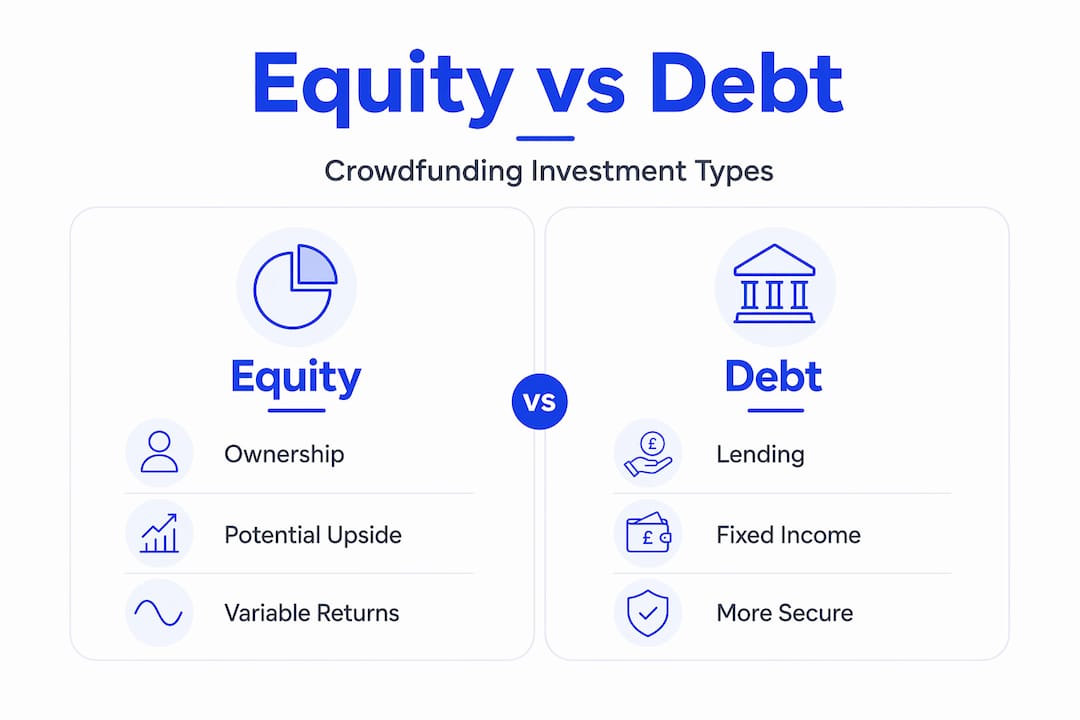
Equity vs debt: the fundamental split
| Feature | Equity crowdfunding | Debt crowdfunding |
|---|---|---|
| What you hold | Ownership share in the asset | A loan to the developer |
| Return type | Variable: rental income and capital appreciation | Fixed: interest payments |
| Position in capital stack | Last to be repaid | First priority over equity |
| Typical horizon | 5 to 10 years lock-up | 1 to 3 years |
| Risk level | Higher, tied to property performance | Lower, but capped returns |
| Suited to | Growth-focused investors | Income-focused, lower risk tolerance |
Equity investments offer ownership and the potential for higher returns through rental income and property appreciation. The trade-off is patience: your capital is typically locked up for five to ten years, and returns are not guaranteed. If the property underperforms or the market shifts, your returns follow suit.

Debt investments function more like lending. You receive fixed interest payments and sit higher in the capital stack, meaning you are repaid before equity investors if things go wrong. Returns are capped but more predictable, making debt a popular choice for investors prioritising income over growth.
Pooled funds versus single deals
Beyond equity and debt, you will encounter two structural approaches. Pooled funds, sometimes called eREITs, spread your capital across multiple properties. Some platforms offer diversified funds specifically for non-accredited investors, which smooths individual property risk but introduces a layer of platform dependency. Single-deal investing lets you choose specific projects, concentrating your risk but giving you full visibility of where your money sits.
Pro Tip: For your first investment, a diversified pooled fund is almost always the smarter starting point. You get broad exposure while you learn how platforms operate, before committing larger sums to individual deals.
Benefits and risks of real estate crowdfunding
The benefits of real estate crowdfunding are genuinely compelling, particularly for investors who want property exposure without the management burden.
-
Access to institutional-grade assets. Properties you could never afford alone — multi-unit residential blocks, logistics warehouses, commercial developments — become accessible with a few hundred pounds of capital.
-
Passive income potential. Depending on the deal structure, you receive quarterly or annual distributions without any active management on your part.
-
Portfolio diversification. Real estate crowdfunding adds a non-correlated asset class to a portfolio otherwise dominated by equities or cash, and you can read more about diversifying your holdings across asset types.
-
Lower barriers to entry. You do not need large capital, a mortgage, or specialist knowledge to get started.
-
Geographic diversification. Platforms operating across Europe allow you to spread exposure across different property markets and regulatory environments.
The risks, however, deserve equal attention.
“Liquidity is not guaranteed; redemption windows can be paused at platform discretion when many investors want to exit simultaneously.”
This is one of the most frequently underestimated risks in the sector. Investors assume that because a platform offers a secondary market or redemption programme, they can exit when they choose. In stressed markets, that assumption evaporates quickly.
Platform risk is separate from real estate risk. If the platform that holds your investment structure collapses financially, you may face significant delays or losses even if the underlying property is performing perfectly. This is a systemic vulnerability that most marketing materials do not highlight prominently.
Fee stacking erodes returns through advisory charges, fund expenses, sponsor promotes, performance fees, and origination fees. These layers compound quietly. A deal advertising an 8% annual yield may net you closer to 5% or 6% once all charges are accounted for. Always request a full fee schedule before investing.
Finally, returns depend heavily on the sponsor’s expertise and management quality. You hold shares in an entity, not a direct stake in bricks and mortar, so the person running the project matters enormously.
How to choose the right platform
With so many options across Europe, selecting the right platform is where preparation pays off. Here is what to examine carefully:
-
Fee transparency. Can you find a complete fee schedule easily, or does it require digging through terms and conditions? Platforms that are upfront about costs tend to be more trustworthy overall.
-
Track record and default history. How long has the platform been operating? What is the historical default rate on debt deals? What happened to investor capital in those cases?
-
Deal flow and asset quality. Does the platform focus on a specific asset class or geography? Specialisation often signals deeper underwriting expertise.
-
Investor accreditation requirements. In many jurisdictions, higher-return deals are restricted to accredited investors. Regulation CF versus Regulation D deals differ meaningfully in terms of eligibility and investor protections, so confirm which rules apply to the platforms you are considering.
-
Secondary market and exit options. Does the platform offer any liquidity mechanism? What are the conditions and restrictions?
-
Communication quality. How frequently do sponsors update investors? Is reporting standardised and audited?
For a structured approach to evaluating specific platforms and projects, Crowdinform’s guide on analysing crowdfunding deals walks through the metrics that actually matter.
Pro Tip: Spread your early investments across at least three different platforms, not just three deals on one platform. This protects you from platform-level risk, which is distinct from individual project risk.
The market today 🚀
The sector has expanded at pace. The global market reached £29 billion in 2025, representing 43% year-over-year growth. That trajectory reflects both growing investor appetite and improving platform infrastructure.
| Year | Estimated global market size | Key driver |
|---|---|---|
| 2022 | ~€ 12 billion | Low interest rate environment |
| 2023 | ~€ 18 billion | Post-pandemic property demand |
| 2024 | ~€ 20 billion | Platform maturity and regulation |
| 2025 | ~€ 29 billion | AI-driven platform growth and expansion |
The shift away from the low interest-rate era has created a more complex environment. Higher base rates mean debt deals now offer more attractive fixed returns, but equity deals face tighter margins on development projects. Platforms are under greater scrutiny from regulators, which is broadly positive for investor protection but adds compliance overhead. The top real estate crowdfunding sites have responded by publishing more granular performance data and improving secondary market functionality, all of which rewards informed investors who do their research.
My honest take on crowdfunding and real estate 💬
I have spent years watching investors approach real estate crowdfunding with the same blind spot: they focus entirely on the projected yield and skip the platform assessment. In my experience, the platform layer is where most of the real risk lives.
I have seen projects where the underlying property performed exactly as promised, rental income was collected, the asset appreciated, and investors still faced delays getting their money back because the platform ran into operational or financial difficulties. Platform failure risk means you can be right about the property and still have a frustrating experience as an investor. That lesson is worth more than any yield comparison.
My view on pooled funds versus single deals cuts against the conventional wisdom. Most articles tell beginners to start with diversified funds because they are “safer.” I agree with that advice, but not for the diversification reason they usually cite. The real benefit of a pooled fund for a beginner is that it forces the platform to do the asset selection. You learn how they think. Then, when you graduate to single deals, you already understand what a properly underwritten project looks like.
You can find more thinking on measuring crowdfunding ROI specifically in the European context, which is where the most interesting platform diversity currently sits. 🌱
— Jevgenijs
Explore real estate crowdfunding on Crowdinform
Crowdinform is Europe’s most comprehensive crowdfunding platform aggregator, covering more than 500 platforms with verified reviews and AI-powered project analysis. Whether you are weighing your first real estate investment or comparing established platforms for a larger allocation, the Crowdinform AI copilot helps you cut through the noise with data-driven project reviews in seconds.
From loans and P2P to real estate and startups, low minimum investments and side-by-side platform comparisons make it easier to build a diversified portfolio without spending hours on manual research. Start exploring the top real estate crowdfunding options available across Europe today. 🚀
FAQ
What is real estate crowdfunding?
Real estate crowdfunding is a method of pooling capital from multiple investors through an online platform to invest in property projects collectively. It provides access to residential, commercial, and development assets with far lower capital requirements than direct property ownership.
How does real estate crowdfunding work?
A platform lists vetted property deals; investors commit funds which are pooled and transferred to the project sponsor. Returns such as rental income or interest payments are distributed periodically, and capital is returned at the end of the deal term or property sale.
What are the main real estate crowdfunding types?
The two primary structures are equity crowdfunding, where you hold an ownership share and benefit from income and appreciation, and debt crowdfunding, where you lend to a developer and receive fixed interest payments with priority repayment.
What are the biggest risks of real estate crowdfunding?
The three most significant risks are liquidity risk (you may not be able to exit when you choose), platform risk (the platform itself can fail independently of property performance), and fee stacking, which quietly reduces your net returns across multiple charge layers.
How much do I need to start investing in real estate crowdfunding?
Minimum investments range from as little as £10 on accessible platforms to £50,000 on premium commercial deals. Most European platforms aimed at retail investors set minimums between £100 and £500 per project.