
Renewable energy crowdfunding is one of the most exciting growth areas in European impact investing, yet the gap between a compelling project pitch and a sound investment can be enormous. Imagine committing capital to a solar farm that boasted a 9% gross annual yield, only to discover later that the financial model excluded grid connection delays, omitted key permitting risks, and relied on government incentives that were already being phased out. That scenario plays out more often than it should. This guide gives you a structured, evidence-driven research process covering screening, financial modelling, document verification, and platform regulation, so you invest with confidence rather than optimism. 🌱
Key Takeaways
| Point | Details |
|---|---|
| Start with disclosures | Review key regulatory documents like the KIIS before considering any renewable crowdfunding project. |
| Go beyond returns | Evaluate technical, legal, and financial risks—not just projected yields—for an accurate investment picture. |
| Test assumptions rigorously | Use sensitivity analysis to gauge how changes in core variables could affect investment outcomes. |
| Demand proper documentation | Insist on original contracts, permits, and engineer reports to verify claims directly. |
| Verify platform regulation | Only invest through platforms with clear licences and robust investor protections. |
What to gather before you start: tools and disclosure essentials
Having set out why a robust process matters, let’s examine what you’ll need at hand before you research any individual project.
Every serious evaluation starts in the same place: regulated disclosure documents rather than marketing materials. Under the European Crowdfunding Service Providers Regulation (ECSPR), platforms authorised across the EU must publish a Key Investment Information Sheet (KIIS) for every project. This standardised document covers the project summary, risk factors, financial projections, and use of funds. As ECSPR investor disclosures confirm, investors in regulated EU crowdfunding should centre research on standardised disclosures and investor-protection mechanics rather than only marketing claims.
The problem is that marketing materials are typically polished and selective. They highlight best-case return scenarios, feature attractive infographics, and bury nuance in footnotes. The KIIS, by contrast, is legally required to present balanced risk information. Start there. Every time.
Your essential pre-research toolkit
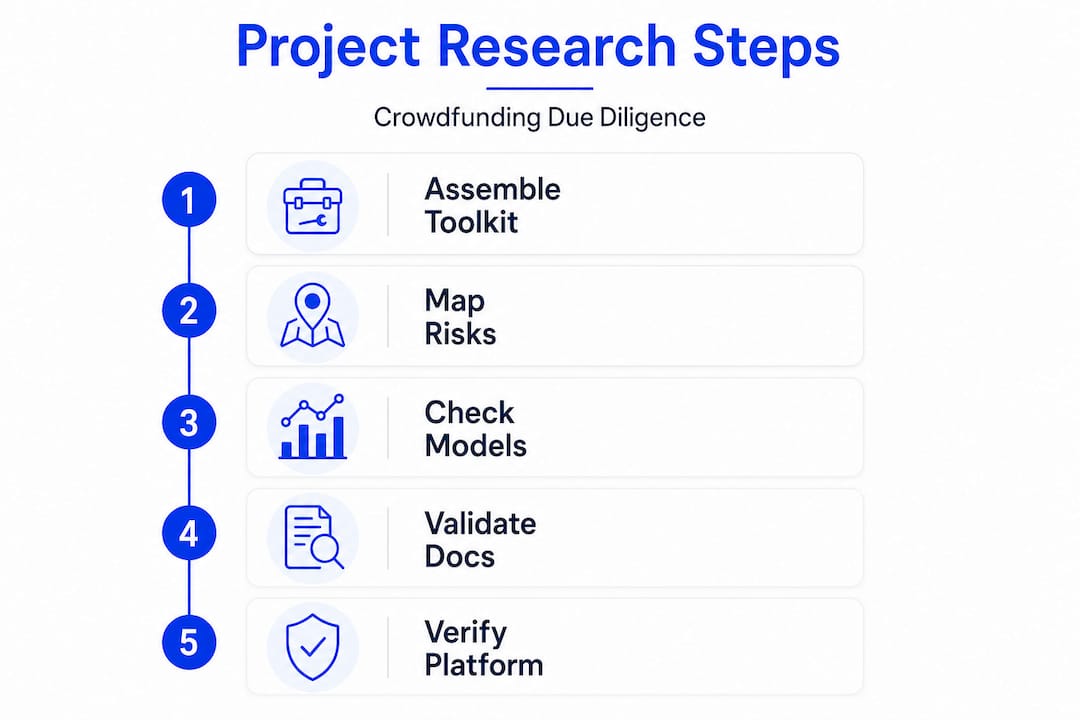
Before you open any project page, assemble the following:
-
KIIS document (request directly from the platform if not publicly visible)
-
Platform authorisation status (check the ESMA register or national competent authority list)
-
Basic financial model spreadsheet (even a simple DCF template lets you test assumptions independently)
-
Independent market data sources (IRENA, Ember, national grid operators for energy price benchmarks)
-
Document request checklist (covered in depth in Step 3 below)
Once you have these tools ready, cross-reference them with the renewable investment guide on Crowdinform to benchmark what strong project disclosures actually look like.
| What marketing materials show | What regulated disclosures require |
|---|---|
| Best-case return projections | Range of scenarios including downside |
| Simplified risk summaries | Full risk factor disclosures |
| Project highlights only | Use-of-funds breakdown |
| Platform-selected testimonials | Standardised investor classification |
| Estimated CO₂ savings | Auditable technical assumptions |
Pro Tip: Before reading a single number in a project pitch, confirm the platform holds a valid ECSPR licence and download the KIIS. If either is missing, treat the project as unregulated until proven otherwise.
Step 1: Build a 360° risk framework (not just the numbers)
With your toolkit assembled, the next step is to see why a multidimensional perspective beats a focus on returns alone.

Too many investors anchor exclusively on headline return metrics, typically the Internal Rate of Return (IRR) or a projected gross annual yield. These figures are seductive. A well-formatted pitch deck showing 8.5% IRR looks convincing, but IRR in isolation tells you nothing about how sensitive that figure is to construction delays, energy price volatility, or subsidy changes. For renewable project investing, an evaluation process that triangulates technical, legal, and financial risk rather than relying on a single return metric is significantly more reliable. 🔍
This approach is sometimes called techno-economic analysis (TEA). In practice, it means mapping risks across four core pillars before you build any financial opinion.
The four core risk pillars
| Risk pillar | Key questions to ask | Common red flags |
|---|---|---|
| Technical | Is the technology proven? Is the grid connection secured? | Unconfirmed connection dates, prototype technology |
| Legal | Are all permits issued? Is the PPA legally binding? | Conditional permits, verbal offtake agreements |
| Environmental | Is the site assessed? Is community acceptance confirmed? | Missing EIA, local opposition documented |
| Financial | Are cost assumptions realistic? Is revenue modelled conservatively? | Single-scenario projections, excluded incentives |
First-pass risk screening: four steps
-
Download and review the KIIS for all four pillar disclosures. Note any pillar where language is vague.
-
Check platform authorisation on the ESMA register before trusting any claim about regulatory standing.
-
Flag every gap. If the KIIS does not address a pillar, that absence is itself a data point.
-
Score preliminary risk on a simple 1 to 5 scale across the four pillars to prioritise which areas need deeper investigation.
Ignoring financial or legal variables at this stage has a material impact on outcome realism. Projects that omit legal contingency costs, for example, can present returns that are 2 to 3 percentage points higher than post-complication reality. That kind of gap frequently turns a competitive investment into a loss-making one.
Pro Tip: Use risk mapping before you do any numerical analysis. It prevents confirmation bias, the tendency to accept numbers that confirm a decision you’ve already emotionally made.
Pairing this risk framework with a thoughtful strategy for diversifying investments across project types and geographies further reduces concentration risk in your renewable portfolio.
Step 2: Examine financial models and test sensitivity
A robust risk overview sets the stage for zooming into the numbers. Here’s how to make sure models support reliable decisions.
Three metrics are central to any renewable energy financial model: IRR (Internal Rate of Return), LCOE (Levelised Cost of Energy), and DCF (Discounted Cash Flow). Each serves a distinct purpose.
The IRR measures the annualised return on your invested capital, accounting for the timing of cash flows. The LCOE expresses the average net cost of generating one megawatt-hour of electricity over a project’s lifetime, allowing you to compare whether the energy price in the offtake agreement is actually profitable. The DCF values all future cash flows in today’s money, making it the most rigorous tool for assessing whether the project price is fair.
Used together, these metrics are genuinely powerful. Used in isolation, each can mislead. For the mechanics of returns measurement, research should explicitly model LCOE, DCF, and IRR and then run sensitivity to the variables that most change cash flows.
Why government incentives matter enormously
One of the most overlooked elements in crowdfunding project models is the treatment of government incentives, feed-in tariffs, Contracts for Difference (CfD), or capacity market payments. Excluding or underrepresenting incentives can materially understate LCOE, making a project appear less profitable than it is, or conversely, assuming incentives that have not yet been awarded can overstate returns significantly.
Always confirm: Are the incentives already secured? Are they indexed to inflation? What happens to the model if they are delayed by 12 months?
“A 10% reduction in wholesale electricity price assumptions, combined with a 6-month construction delay, can reduce a project’s IRR by 1.5 to 2.5 percentage points. For an investment promising 8%, that shift moves the outcome from attractive to barely competitive.”
Three steps for effective return and risk testing
-
Extract model inputs. Ask the platform or project sponsor to share the key assumptions: energy production estimate (P90 vs P50), energy price used, discount rate, operating cost escalation.
-
Identify two or three critical variables. For most solar and wind projects, the biggest drivers are energy yield, electricity price, and operational costs. These are your sensitivity levers.
-
Check sensitivity results. Request or construct a simple table showing what happens to IRR if each variable moves 10 to 20% in the unfavourable direction. If the project sponsor cannot provide this, treat it as a serious gap.
Step 3: Validate documents and independent evidence
Once you’ve stress-tested the model, the time comes to dig into documents and seek authentic third-party validation.
Platforms often publish persuasive project summaries, but summaries are not substitutes for source documents. Direct document verification is the single most powerful habit you can build as a renewable energy investor. The most actionable approach is a data-room plus independent engineering model: validate permits, grid connection agreements, EPC and O&M contracts, insurance, and historical performance before committing. This approach, confirmed by technical due diligence standards for solar plant assessment, applies equally across wind, hydro, and biogas projects.
Must-have document checklist ✅
-
☐ Construction permits (fully issued, not conditional or under appeal)
-
☐ Grid connection agreement (confirmed capacity, connection date, cost)
-
☐ Power Purchase Agreement (PPA) (counterparty creditworthiness, term, price indexation)
-
☐ EPC contract (fixed-price or cost-plus, performance guarantees, liquidated damages)
-
☐ O&M contract (scope, provider track record, escalation clauses)
-
☐ Insurance policies (all-risks construction, operational, business interruption)
-
☐ Independent engineer report (energy yield assessment, technology review)
-
☐ Historical production data (for operational assets, compare actual vs. forecast)
Reading independent engineer reports
An independent engineer (IE) report is commissioned by a neutral technical expert to verify energy yield assumptions and technical feasibility. Look for:
-
Whether the P90 yield is used (conservative, 90% probability of being achieved) versus P50 (median estimate)
-
Explicit commentary on grid constraints or curtailment risk
-
Any qualifications or limitations flagged by the engineer
Red flags include reports that are more than 18 months old, vague about methodology, or produced by an entity with a commercial relationship to the project sponsor.
Pro Tip: If a platform or sponsor refuses to share original permits, grid agreements, or the IE report, escalate immediately. A refusal to produce source documents is one of the clearest warning signs in renewable crowdfunding due diligence.
Step 4: Cross-check platform, contracts, and regulatory standing
With technical and financial confidence growing, it’s critical to confirm the platform’s legal and regulatory basis and actual contract enforceability.
Not all crowdfunding platforms marketing themselves as “regulated” or “compliant” hold a valid ECSPR licence. Some operate under older national frameworks that offer materially weaker investor protections. Others market aggressively despite compliance gaps. As one detailed crowdfunding platform investigation highlights, there can be significant mismatches between what a platform communicates about investor protections and what the actual contract terms deliver.
Platform and contract verification checklist
-
☐ Licence status: Confirm ECSPR authorisation on the ESMA register (or applicable national register)
-
☐ Security package: Does the investor hold a real security interest (pledge, mortgage) or only an unsecured loan?
-
☐ Cash-flow waterfall: In what order are investors, platform fees, and sponsors paid?
-
☐ Investor classification: Are you classified as an experienced or inexperienced investor, and does this affect your access and protections?
-
☐ Dispute resolution: Is there a clear mechanism for investor complaints and escalation?
“Marketing brochures for crowdfunded renewable projects frequently describe ‘asset-backed’ investments. However, the actual legal documents may reveal that investor claims are subordinated, collateral is shared across multiple creditors, or security enforcement requires expensive legal action in a foreign jurisdiction.”
Pairing objective analysis with diverse review sources sharpens your list of demands considerably. Reading both positive and critical user reviews on aggregator platforms helps you identify which documents other investors struggled to obtain and which concerns recurred across multiple deals.
If you are new to the structure of investment contracts in this space, the crowdinvesting guide on Crowdinform provides a strong foundation for understanding how these arrangements work across European markets.
What most investors overlook about renewable project research
With the foundation covered, let’s address what actually separates effective due diligence from surface-level research.
Here is the uncomfortable truth: regulated status is not a proxy for safety. A platform holding a valid ECSPR licence has met minimum disclosure standards, but that licence does not validate the quality of individual projects it lists, the enforceability of security packages, or the accuracy of financial projections. Many investors implicitly assume that if the platform is authorised, the projects are vetted. They are not, at least not to the depth you need.
Equally, standardised KIIS documents, for all their regulatory value, can gloss over critical assumptions. A KIIS may note “subject to government incentives” without specifying whether those incentives are awarded, applied for, or merely anticipated. It may present a single IRR scenario without disclosing that the figure assumes a P50 energy yield and a 10-year fixed electricity price, two assumptions that can shift dramatically in practice.
The single most effective risk-reduction habit we’ve observed across hundreds of project evaluations is disciplined red-flag escalation. When something is vague, escalate with a specific written question. When a document is missing, request it in writing and note the response. When an answer contradicts earlier claims, push back formally. This creates a paper trail and often reveals how responsive, and how transparent, the project sponsor actually is.
The structured research approach covered in this guide, built around the comprehensive renewable investment guide, represents the methodology used by sophisticated impact investors who consistently separate promising projects from persuasive ones. The gap between those two categories is wider than most first-time investors expect. 🚀
Take the next step in renewable crowdfunding
You now have a clear, structured research process to apply to any renewable energy crowdfunding opportunity across Europe. The question is: where do you find projects worth analysing?
Crowdinform brings together data from over 500 European crowdfunding platforms, aggregating project listings and investor reviews in one place. Whether you’re screening solar projects in Spain 🇪🇸, wind farms in Poland 🇵🇱, or biogas installations in Germany 🇩🇪, the Crowdinform platform gives you access to project documentation, platform ratings, and AI-powered project review tools that accelerate every stage of the due diligence process described in this guide. Put your new research criteria to work on live, regulated investment opportunities today and invest in the energy transition with confidence. 🌱
Frequently asked questions
What is the ECSPR and how does it protect investors?
The ECSPR (European Crowdfunding Service Providers Regulation) regulates crowdfunding platforms across the EU, requiring them to publish standardised KIIS disclosures and implement investor classification safeguards that differentiate protections for experienced and inexperienced investors.
Which technical documents should I request when researching a renewable energy project?
Key documents include permits, grid connection contracts, PPA agreements, O&M contracts, insurance policies, and independent engineer reports, as outlined in the technical due diligence checklist for renewable plant assessment.
How can I tell if a crowdfunding platform is properly regulated?
Check for a valid ECSPR licence on the ESMA register, confirm that KIIS documents are published for each project, and review whether investor protections are detailed in official legal documentation rather than marketing materials, since some operators market aggressively despite compliance gaps.
Why is sensitivity analysis important when reviewing renewable investment models?
Sensitivity analysis reveals how changes in critical assumptions, such as electricity prices, energy yield, or construction timelines, affect actual returns, helping you avoid overoptimistic projections by showing the range of realistic outcomes across different scenarios.