
Sustainable crowdfunding has moved from niche curiosity to serious investment channel, and the numbers back it up. Research on Italian equity crowdfunding shows a 76% campaign success rate across hundreds of campaigns, shattering the old myth that environmental responsibility and strong financial returns are somehow in tension. For European investors who want their money to do meaningful work without sacrificing yield, sustainable crowdfunding offers a genuinely exciting entry point. This guide walks you through how it works, what the data actually says, and how to invest wisely.
Key Takeaways
| Point | Details |
|---|---|
| Sustainable crowdfunding defined | It is a way for investors to fund projects with an ESG focus using online platforms. |
| High success in Europe | Italian sustainable equity crowdfunding has a 76% campaign success rate and high overfunding. |
| Risks and mitigation | Greenwashing, behavioural bias, and information gaps exist; professional signals and platform due diligence can reduce risk. |
| Sector matters | Performance varies by project type and country, with solar and green real estate outperforming. |
| Next steps | Choosing the right platform and vetting projects is crucial for responsible and profitable investing. |
What is sustainable crowdfunding?
Sustainable crowdfunding sits at the crossroads of two fast-growing movements: democratised finance and responsible investing. At its core, sustainable crowdfunding is equity or debt crowdfunding specifically directed at projects with an ESG (Environmental, Social, and Governance) focus, spanning sectors like renewable energy, green real estate, and eco-focused startups.
It is worth clarifying what ESG actually means in practical terms:
-
Environmental: Projects that reduce carbon emissions, generate clean energy, or promote ecological preservation
-
Social: Ventures that create jobs, improve communities, or support fair labour practices
-
Governance: Businesses with transparent management, ethical leadership, and strong accountability structures
Most sustainable crowdfunding campaigns on European platforms lean heavily into the Environmental pillar, particularly renewable energy investment in solar, wind, and energy-efficiency retrofitting.
So how does sustainable crowdfunding differ from impact investing? Both pursue positive outcomes alongside financial returns, but impact investing typically involves institutional capital, rigorous third-party ESG measurement, and longer investment horizons. Sustainable crowdfunding is more accessible. You can invest as little as €50 or €100, the campaigns are public, and the platforms handle regulatory compliance. Think of it as impact investing with the barriers removed.
“Sustainable crowdfunding opens green finance to everyday investors, not just institutions. It validates demand for eco-projects and builds a community of stakeholders who are both financially and emotionally invested in outcomes.”
For a broader overview of the crowdinvesting landscape, the modern crowdinvesting guide is an excellent starting point before going deeper into sustainable-specific campaigns.
How sustainable crowdfunding works: mechanics and platforms
Once you understand the basics, it is crucial to grasp how the actual investment process unfolds and the key actors involved.
The mechanics are straightforward, but the nuances matter enormously. Online platforms connect retail investors to project creators seeking capital; retail investors contribute small amounts in exchange for equity shares, bonds (debt), or rewards in sustainable projects. Professional investors often back campaigns early, signalling quality and encouraging retail follow-on investment.
Here is a step-by-step breakdown of how a typical campaign unfolds:
-
Project listing: A solar farm developer, green property developer, or eco-startup creates a campaign on a regulated European crowdfunding platform, setting a funding target, a minimum investment amount, and a campaign deadline.
-
Due diligence phase: The platform vets the project for regulatory compliance and basic financial viability. Some platforms go further, applying ESG screening criteria before listing.
-
Professional lead-in: Institutional or professional investors often commit capital first. This early signal is powerful; retail investors observe it and interpret it as a quality indicator.
-
Retail funding window: The campaign opens to the public. Investors browse the project materials, financial projections, and ESG claims before pledging funds.
-
Funding threshold: If the campaign hits its minimum target before the deadline, the funds are released to the project. If not, investors are typically refunded.
-
Returns: Equity investors receive dividends or profit-share; debt investors receive fixed or variable interest over a defined period; reward investors might receive early access to a product or symbolic recognition.
The three main investment models each suit different risk appetites. Equity crowdfunding gives you ownership upside but carries more risk if the project underperforms. Debt crowdfunding (often called business loan crowdfunding) offers predictable yields with less exposure to business volatility. Reward-based models are less common in the sustainability sector but still exist for community energy projects and social enterprises.
Impact measurement platforms are increasingly integrated into the crowdfunding ecosystem, allowing investors to track the environmental outcomes of their portfolio, such as tonnes of CO₂ avoided or kilowatt-hours of clean energy generated.
Pro Tip: When you review a campaign, always check whether a professional or institutional investor has already committed. Their early presence is one of the strongest signals of project credibility and fundraising momentum.
Diversifying investments across multiple campaigns and sectors is also sensible. Spreading capital across solar, green real estate, and eco-startups reduces exposure to any single sector’s volatility.

Success rates, project benchmarks, and risks
Knowing how crowdfunding works, let’s evaluate its real-world success, risk factors, and the dangers to watch for as an investor. 🚀
The Italian equity crowdfunding market provides the richest empirical dataset available for European investors. The findings are striking:
| Metric | Value |
|---|---|
| Overall campaign success rate | 76% |
| Sustainability-oriented share of successful campaigns | 48.3% |
| Average overfunding ratio | 184.9% |
| Solar project maturity profile | Short to medium term |
| Solar project risk profile | Low |
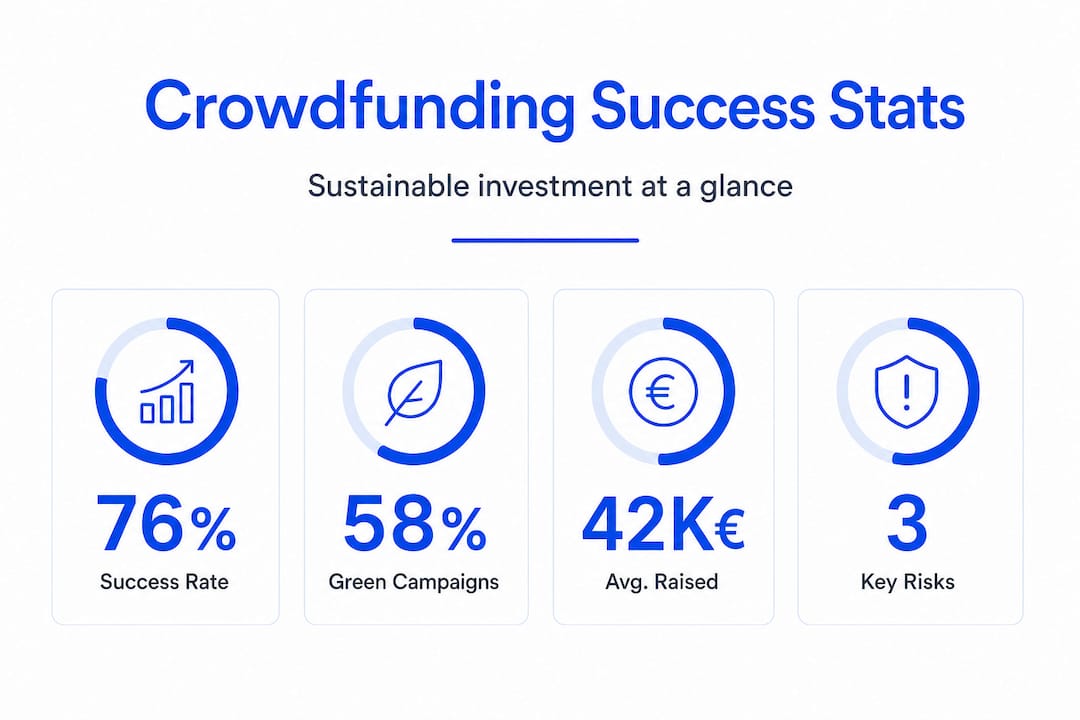
These figures, drawn from 771 Italian ECF campaigns, tell a powerful story. Nearly half of all successful campaigns were sustainability-oriented, and the average overfunding ratio of 184.9% means that successful campaigns raised almost twice their stated target. Solar projects in particular stood out for their combination of low risk, short maturity periods, and competitive gross annual yields.
What these numbers mean for you:
-
High success rates suggest that investors are genuinely willing to fund sustainable projects
-
Overfunding signals strong demand, which can also mean campaigns close quickly; you need to act fast
-
Solar energy projects offer a relatively accessible risk/return profile for newer impact investors
However, sustainable crowdfunding is not without significant risks. Research highlights three categories investors must understand:
-
🌱 Greenwashing: Projects may overstate their environmental credentials to attract investors. Without standardised ESG metrics, it is difficult to independently verify claims.
-
Information asymmetry: Project creators know far more about their ventures than investors do. Platforms reduce this gap, but they cannot eliminate it entirely.
-
Behavioural biases: Investors sometimes overweight emotional or values-driven narratives (a beautifully produced video about a solar village, for example) and underweight hard financial data.
Research confirms that sustainable crowdfunding democratises green investing and validates market demand for eco-startups, but these benefits come alongside genuine risks that require active management.
For sector-specific guidance, the real estate crowdfunding analysis guide walks you through how to assess green property campaigns in detail. If startup investing is your focus, the advantages of startup investing article provides useful context on risk calibration.
Fractional ownership models, increasingly common in green real estate crowdfunding, allow you to participate in large-scale projects with modest capital, further lowering the entry barrier.
Nuances, sector differences, and investor priorities
Having looked at broad metrics and risks, let’s dive deeper into the subtle differences that shape success or disappointment for European investors.
One of the most important things to understand is that sustainability does not function as a universal success lever. Research confirms that green campaign performance is contingent on sector, geography, and the institutional environment of the country in question. In markets with strong state support for renewable energy (think Germany or Denmark), green crowdfunding campaigns can actually underperform relative to markets where private capital fills the gap left by weaker public institutions.
| Factor | Positive impact on success | Negative impact on success |
|---|---|---|
| Early professional investment | ✅ Strong positive signal | — |
| Strong national ESG policy environment | Varies | Can reduce crowdfunding appeal |
| Standardised ESG measurement | Builds investor trust | Absence increases greenwashing risk |
| Home-country bias | Favours domestic campaigns | Reduces cross-border investment |
| Sector (solar vs general startup) | Solar performs strongly | General eco-startups more variable |
Home-country bias is a particularly interesting phenomenon in European crowdfunding. Investors consistently favour campaigns from their own country, even when cross-border projects offer superior risk-adjusted returns. This is partly cultural, partly practical (language barriers, unfamiliar legal frameworks), and partly psychological. As a European investor, being aware of this bias can open up genuinely attractive opportunities that others are overlooking.
Critically, sustainability boosts success but is not a standalone factor. Investors prioritise financial returns and low risk first; ESG credentials serve as a positive differentiator when the financial fundamentals are already sound. The data collected post-COVID also shows a measurable increase in interest in sustainability-focused campaigns, suggesting that market appetite is expanding and that this trend is likely to continue.
ESG measurement inconsistency remains one of the sector’s most pressing challenges. Unlike institutional impact investing, which can draw on frameworks like the Global Reporting Initiative or the UN’s Sustainable Development Goals, most crowdfunding campaigns self-report their environmental credentials. This makes independent verification difficult and underscores the importance of platform-level screening.
Pro Tip: Before committing capital, look for platforms that apply third-party ESG verification to listed projects. Platforms that publish specific metrics (kilowatts installed, carbon tonnes offset, community jobs created) are far more credible than those relying on vague “green” language.
For broader context on navigating European real estate as part of your sustainable portfolio, the real estate investment guide covers the fundamentals clearly and practically.
Our perspective: what most investors miss about sustainable crowdfunding
Most articles about sustainable crowdfunding focus on returns and sector trends. Those things matter. But in our experience reviewing hundreds of European platforms and thousands of campaigns, the biggest mistakes investors make are subtler and more behavioural than financial.
The first blind spot is trusting the platform’s ESG label without scrutiny. Not all platforms apply the same level of diligence. Some list any project that uses the word “green” in its pitch; others enforce rigorous screening with documented impact metrics. The platform you choose is arguably more important than the individual campaign you invest in. A weak platform with poor ESG standards will expose you to greenwashing regardless of how compelling a particular project sounds.
The second blind spot is ignoring professional investor signals. The research is clear: when institutional or professional investors commit early, retail campaigns perform significantly better. Yet many retail investors focus entirely on the campaign narrative and miss the funding composition data buried in the campaign details. Train yourself to look for this information first.
The third and perhaps most underestimated issue is behavioural bias. Sustainable crowdfunding campaigns are often emotionally compelling. A documentary-style video about a rural solar cooperative in southern Spain or a regenerative farming startup in the Netherlands can feel like more than an investment; it can feel like a cause. That emotional engagement is part of what makes the sector vibrant. But it can also cloud judgement. Investors who would never accept a 3% yield on a conventional bond sometimes accept it enthusiastically on a green project simply because of the narrative. Set your return expectations independently of the story.
Finally, geographic diversification is consistently underutilised. We see European investors repeatedly backing domestic campaigns when the renewable energy guide clearly shows exciting opportunities across multiple markets. Southern European solar projects, Eastern European energy-efficiency retrofits, and Nordic wind investments all carry different risk profiles. A genuinely well-constructed sustainable portfolio spans borders, not just sectors.
Sustainable crowdfunding is one of the most promising intersections of finance and positive environmental action available to retail investors today. But it rewards the careful and the curious, not simply the enthusiastic.
Discover sustainable crowdfunding opportunities with Crowdinform
You now have a clear framework for evaluating sustainable crowdfunding campaigns: understanding ESG fundamentals, reading professional signals, identifying greenwashing risks, and building a geographically diversified portfolio. The next step is putting those insights into action.
Crowdinform is Europe’s dedicated aggregator for crowdfunding platforms and investment projects, combining reviews of over 500 European platforms with an AI copilot that helps you assess individual projects, compare ESG credentials, and build a smarter investment strategy. Whether you are exploring green real estate, renewable energy campaigns, or eco-focused startups, Crowdinform gives you the data, the reviews, and the tools to invest with confidence. 🌱 Start exploring today and let the platform do the heavy lifting.
Frequently asked questions
How is sustainable crowdfunding different from impact investing?
Sustainable crowdfunding funds environmentally responsible ventures via accessible online platforms, while impact investing typically employs standardised ESG metrics and involves institutional capital with more rigorous verification processes.
What are the main risks in sustainable crowdfunding?
The key risks are information asymmetry, greenwashing, and behavioural biases, all of which can distort investment decisions and lead to disappointing outcomes if left unmanaged.
Are returns guaranteed for sustainability-focused campaigns?
Returns are never guaranteed; however, solar projects specifically have demonstrated a strong combination of low risk, short maturity, and high yields, making them among the more reliable sustainable investment options.
How important is professional investor participation?
Professional early backing is one of the strongest quality signals in sustainable crowdfunding, indicating credibility and attracting retail follow-on investment that drives campaigns past their funding targets.