
European startups are attracting serious attention from individual investors who want growth beyond traditional equity markets. The appeal is real. From fintech in Berlin to climate tech in Amsterdam, the continent is producing world-class companies at an accelerating pace. Yet knowing how to invest in European startups, safely and legally, is where most retail investors get stuck. Regulatory complexity, platform choices, and unfamiliar contract terms create genuine friction. This guide cuts through all of that. You will learn the main investment routes, the regulations that protect you, and the practical steps to get started with confidence.
Key takeaways
| Point | Details |
|---|---|
| ECSPR is your main access route | Regulated crowdfunding platforms under ECSPR let retail investors fund EU startups with cross-border access. |
| KIIS documents matter | Always read the Key Investment Information Sheet before committing to any crowdfunding investment offer. |
| Governance rights drive returns | Pro-rata follow-on rights and anti-dilution protections significantly affect your long-term upside. |
| The Scaleup Europe Fund opens in 2026 | A new €5bn growth fund managed by EQT offers indirect exposure to late-stage European scaleups. |
How to invest in European startups: the main routes
Individual investors have more options today than at any point in the past decade, but the routes are not all equal. Understanding the structure of each will save you from expensive mistakes.
Direct investment
Buying shares directly in a private European startup is technically possible, but the barriers are high. There is no secondary market for most private shares, brokerage access is limited, and bypassing regulated platforms means you must perform lawyer-level diligence on every deal yourself. Without standardised disclosures, pricing is opaque and exits are uncertain. This route suits sophisticated investors with legal support, not those just starting out.
ECSPR crowdfunding platforms
The European Crowdfunding Service Providers Regulation (ECSPR) is the most significant development for retail investors in the past five years. ECSPR harmonises rules for investment and lending crowdfunding platforms across all EU member states under a single licence. Practically, this means a platform authorised in the Netherlands can legally offer deals to investors in Poland, Spain, or Italy. Each project can raise up to €5 million, and the framework requires standardised disclosures at every step.
Here is a quick comparison of the main investment routes available to you:
| Route | Accessibility | Regulatory protection | Liquidity |
|---|---|---|---|
| ECSPR crowdfunding platforms | High (retail-friendly) | Strong (KIIS, suitability tests) | Low |
| Direct private investment | Low (complex) | Weak (self-managed diligence) | Very low |
| Venture capital funds | Medium (min. thresholds apply) | Moderate (fund prospectus) | Low to medium |
| Scaleup Europe Fund (EQT) | Indirect (institutional) | High (EU-backed) | Low |
Indirect exposure via funds
If you prefer not to pick individual startups, indirect routes exist. Venture capital funds accepting retail participation (often via feeder vehicles) give you diversified startup exposure managed by professionals. The risk profile changes accordingly, since the nature of investors backing funds influences the sector focus and risk appetite of the underlying portfolio. For higher-growth exposure, the Scaleup Europe Fund, a €5bn vehicle managed by EQT, is launching in autumn 2026 as part of the EU Startup and Scaleup Strategy. This fund targets late-stage European scaleups and is worth monitoring if you want growth-stage exposure without direct stock picking.

Getting started with crowdfunding platforms
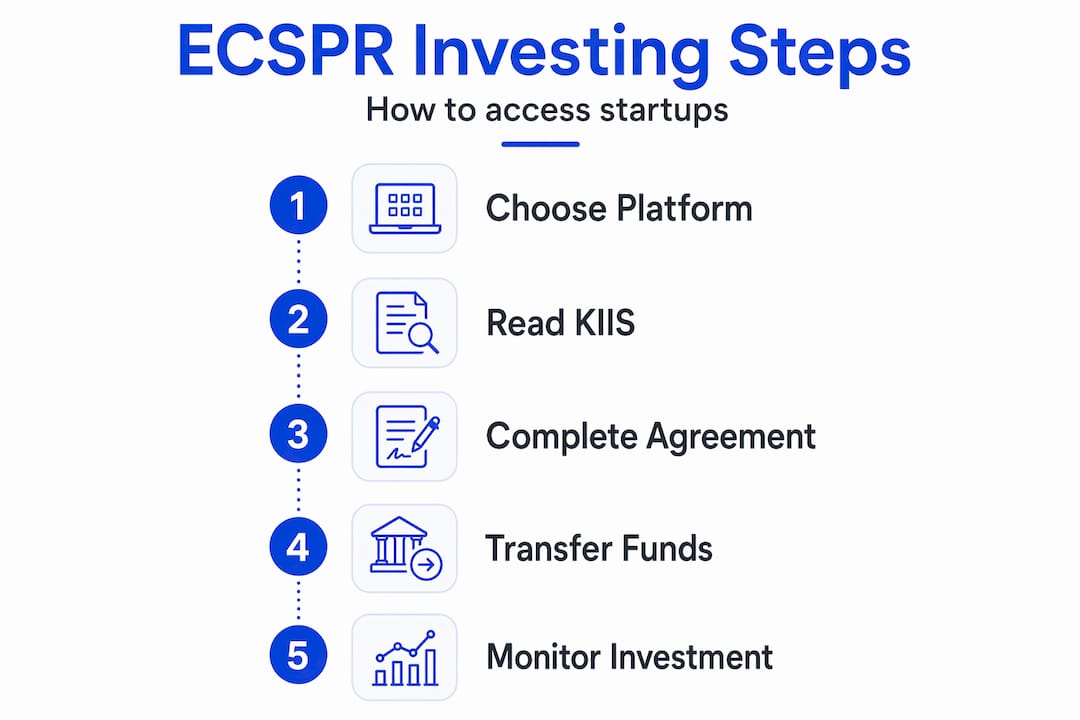
For most European individual investors, ECSPR crowdfunding platforms are the practical starting point. Here is a step-by-step process to get up and running.
-
Choose a licensed platform. Verify that the platform holds an ECSPR licence. You can check the ESMA register or the national competent authority in the platform’s home country. Licences are public and verifiable. Look for platforms with a track record, transparent fee structures, and a history of funded projects.
-
Complete your investor profile and knowledge test. Knowledge tests and loss-bearing simulations are required under ECSPR to gauge your understanding and financial capacity before allowing you to invest above certain thresholds. This is not a formality. The platform is legally required to adapt its suitability assessments to your profile, and you should treat it as a genuine self-check on your readiness.
-
Review the KIIS for every project. The Key Investment Information Sheet is mandatory reading before you invest. It covers the startup’s business model, financials, risk factors, and the specific terms of the offer. Critically, it confirms that your investment is not covered by deposit protection schemes. Marketing materials are secondary. The KIIS is the authoritative document.
-
Understand your investment limits. ECSPR imposes investment limits for non-sophisticated investors. These caps exist to protect you from overconcentration in a single illiquid position. Know what your limit is before you browse offers.
-
Register, fund your account, and invest. Once your profile is complete and you have reviewed the KIIS, the actual investment process is straightforward. You select the offer, confirm the amount, and execute. Most platforms handle settlement and documentation digitally.
Pro Tip: Before committing to any offer, read the full investment agreement, not just the headline terms. Look specifically for lock-up periods (how long your capital is tied up), equity dilution provisions (what happens if the startup raises more capital), and exit mechanics (how and when you might receive proceeds). These contractual terms, not the pitch deck, determine your actual return.
Indirect funds and co-investment opportunities
Beyond crowdfunding, there are broader ways to access the European startup ecosystem without selecting individual companies yourself.
The most talked-about development in 2026 is the Scaleup Europe Fund. Backed by EU policy to retain innovation capital within Europe, this €5bn growth fund targets late-stage companies that have already proven their model and are ready to scale internationally. The fund is managed by EQT, one of Europe’s most established private equity firms, which brings institutional discipline to deal selection and portfolio management.
For individual investors, the direct benefits of the Scaleup Europe Fund are indirect. You are unlikely to invest in it personally, but its existence shapes the broader ecosystem in ways that benefit you:
-
More late-stage capital means startups funded via crowdfunding platforms have a clearer path to follow-on funding, which reduces abandonment risk for your early-stage positions.
-
Institutional validation of European tech creates stronger exit opportunities (trade sales, IPOs) that eventually return capital to all stakeholders, including crowdfunding investors.
-
EU policy alignment signals regulatory stability, which supports the long-term viability of ECSPR platforms themselves.
Venture capital funds operating in Europe are also increasingly opening co-investment rights to limited partners. Co-investment and follow-on rights are becoming standard in European private deals, giving investors the chance to increase their stake in portfolio winners without paying full fund management fees on incremental capital.
Managing risk and doing proper due diligence
Startup investing has a genuinely asymmetric return profile. A small number of investments deliver outsized returns; the majority return little or nothing. Accepting this reality, rather than fighting it, is the foundation of a sensible approach. Understanding more about startup investment fundamentals before you commit capital is time well spent.
Start with a liquid foundation. Global equity ETFs tracking indices like FTSE All-World or MSCI ACWI provide exposure to roughly 90 to 95 per cent of investable global equity markets. Build this base first. Startup positions should represent a minority of your overall portfolio, proportional to your financial capacity to absorb losses.
The most common pitfalls for individual investors include:
-
Overconcentration. Putting a significant portion of your capital into a single startup or sector dramatically increases your downside risk. Spread positions across multiple companies, stages, and industries.
-
Ignoring governance rights. Rights attached to startup shares, including liquidation preferences, anti-dilution clauses, and pro-rata follow-on rights, critically determine long-term value. A cheap entry price means nothing if another investor class takes proceeds first in an exit.
-
Mistaking activity for strategy. Investing in ten mediocre deals is not diversification. Prioritise quality over volume, and use the KIIS to genuinely assess each opportunity.
-
Underestimating illiquidity. Most startup positions are locked up for three to seven years. Do not invest money you may need before then.
Pro Tip: When evaluating an investment offer, look for signs of quality beyond the pitch: independent audited accounts, a credible lead investor or institutional co-investor, clearly defined governance rights, and a realistic exit roadmap. These signals do not guarantee success, but their absence is a reliable warning sign.
For a deeper look at optimising returns through crowdfunding, the crowdfunding ROI guide on Crowdinform offers useful additional context on European market-specific dynamics.
My honest take on investing in European startups
I have watched the European startup investment space from the inside for a number of years, and my view has shifted meaningfully in that time. The arrival of ECSPR was genuinely transformative. Standardised disclosures, cross-border access, and mandatory suitability checks are not bureaucratic noise. They are the infrastructure that makes retail participation trustworthy rather than speculative. But, and this matters, reading the KIIS properly still requires effort. I have seen investors skim it and focus on the headline return figure. That is a mistake.
My honest assessment of the ecosystem right now is cautiously optimistic. The Scaleup Europe Fund signals that policy and institutional capital are finally aligned to keep great European companies in Europe rather than watching them get acquired by US or Asian buyers before reaching their potential. That structural shift matters for retail investors too, because it increases the probability that early-stage bets eventually find institutional buyers.
What I tell anyone starting out: build your ETF base first. Then allocate a defined, loss-tolerant proportion to startups via regulated platforms. Review the KIIS. Check governance rights. And commit to a multi-year horizon. Patience is the only edge available to individual investors in this asset class, and it is more valuable than any single deal you will ever find. The reasons to invest in startups via crowdfunding are compelling, but only if you approach them with discipline and realistic expectations.
— Jevgenijs
Explore European startups with Crowdinform
Ready to put this guide into practice? Crowdinform is Europe’s leading aggregator for crowdfunding platforms and investment projects, with reviews and data covering over 500 platforms across the continent. Whether you are comparing ECSPR-licensed platforms, researching top-rated startup offers, or using the built-in AI Copilot to analyse a specific project, Crowdinform gives you the tools to invest with confidence rather than guesswork.
The AI-powered project explorer lets you cut through marketing materials and surface the details that actually matter: governance terms, platform track record, sector exposure, and historical performance data. For individual investors navigating European startup funding options, this kind of independent, aggregated intelligence is the difference between informed decisions and costly ones. Start exploring the best crowdfunding platforms on Crowdinform today and find the startups in Europe worth investing in right now.
FAQ
What is the ECSPR and why does it matter for retail investors?
ECSPR regulates investment-based crowdfunding across the EU, allowing projects to raise up to €5 million with cross-border passporting. It standardises disclosures and investor protections, making startup investing accessible and safer for non-professional individuals.
How much money do I need to start investing in European startups?
Most ECSPR crowdfunding platforms allow entry from as little as €100 to €500 per project. However, investment limits for non-sophisticated investors apply, so the platform’s suitability process will confirm your specific thresholds.
What is a KIIS and do I have to read it?
The Key Investment Information Sheet is a mandatory document under ECSPR that every crowdfunding project must provide. It covers business risks, financial details, and investor protections. Reading it fully is not optional if you want to invest wisely.
Are European startup investments covered by deposit protection?
No. Unlike bank deposits, startup investments made via crowdfunding platforms are not covered by any deposit protection scheme. Your capital is at risk, and losses are possible.
How do I choose the best European startup to invest in?
Focus on platforms with a verified ECSPR licence, read each project’s KIIS, check for institutional co-investors, and review governance rights such as anti-dilution and follow-on provisions. Diversifying across multiple deals and sectors reduces single-project risk significantly.